
About Harry Weese
Lived 1915 – 1998 (aged 83). Harry Weese was an American architect.
Harry Mohr Weese (June 30, 1915 – October 29, 1998) was an American architect who had an important role in 20th-century modernism and historic preservation. His brother, Ben Weese, was also a renowned architect.
Early life and education
Weese was born on June 30, 1915, in Evanston, Illinois, the first son of Harry E. and Marjorie Weese. His father was an Episcopalian, and his mother was a Presbyterian. In 1919, the family moved to a house in Kenilworth, Illinois, where Harry was raised. Weese was enrolled in the progressive Joseph Sears School in 1919. By 1925, Weese decided that he wanted to be either an artist or an architect.
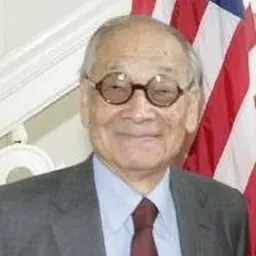
After graduating from New Trier High School, Weese enrolled at the Massachusetts Institute of Technology in 1933 to earn a Bachelor in Architecture degree. Weese also took architecture classes at Yale University starting in 1936. Weese studied under Alvar Aalto at MIT, and fraternized with classmates I.M. Pei and Eero Saarinen. As his schooling was at the height of the Great Depression, Weese avoided studying expensive historical revival styles in favor of more-affordable modern styles. In summer 1937, Weese toured northern Europe on a bicycle, fostering his appreciation for the Modernist movement. Weese also designed the First Baptist Church in Columbus, Indiana.
Weese was also known for his advocacy of historic preservation; he would be remembered as the architect who "shaped Chicago’s skyline and the way the city thought about everything from the lakefront to its treasure-trove of historical buildings". He led the restoration of Adler & Sullivan's Auditorium Building, and Daniel Burnham's Field Museum of Natural History and Orchestra Hall. In 1978, Harry Weese & Associates received the Architecture Firm Award from the American Institute of Architects (AIA). Weese also served as a judge for the Vietnam Veterans Memorial design competition, and defended fledgling architect Maya Lin's unconventional design.
From the mid-1980s, Weese drank heavily and his reputation faded; he died after years of going in and out of alcohol rehabilitation and a series of disabling strokes.
Personal life Weese's parents were Protestant Christians, but he himself was non-religious. While being interviewed by the building committee of the Seventeenth Church of Christ, Scientist in Chicago, when asked of his religious views, he said, "My father was Episcopalian, my mother Presbyterian, and I’m an architect".
Works
Weese is best known as the designer and architect of the first group of stations in the Washington Metro system. Other well known works include:
1952 - Davis Clinic, Marion, Indiana - a new model for delivering healthcare. 1954 - Robert and Suzanne Drucker House in Wilmette, Illinois 1956 - 227 East Walton Place Apartment Building in Chicago, now a Chicago Landmark building Alpha Sigma Phi, Alpha Xi chapter House at Illinois Institute of Technology in Chicago The United States Embassy Building, Accra, Ghana, closed in 1998 1960 - Arena Stage, Washington DC (remodeled in 2010 by Bing Thom Architects) 1960 - Pierce Tower, undergraduate residence hall at the University of Chicago (demolished 2013) 1963 - St Thomas' Episcopal Church, (Menasha, Wisconsin) Similar to the First Baptist Church, Columbus, Indiana, but with a more sweeping roof design and towering steeple. 1963 - Sterling Morton Library, The Morton Arboretum 1965 - Gray Campus Center at Reed College in Portland, OR 1965 - Aubrey R. Watzek Sports Center at Reed College. Renovated in 2016 after the roof collapsed during an unusually severe winter storm. 1965 - First Baptist Church, in Columbus, Indiana 1966 - Fewkes Tower at 55 W. Chestnut Street (formerly 838 N. Dearborn Street), Chicago 1968 - Seventeenth Church of Christ, Scientist, Chicago 1969 - Time-Life Building, Chicago 1969 - The Upper School (high school) building of The Latin School of Chicago, Chicago 1970 - Formica Building, Cincinnati 1972 - The Given Institute, Aspen Colorado (demolished 2011) 1973 - Westin Crown Center Hotel, Kansas City, Missouri 1975 - Mercantile Bank, Kansas City, Missouri 1975 - Oak Park Village Hall, Oak Park, Illinois 1975 - William J. Campbell United States Courthouse Annex in downtown Chicago (formerly known as the Metropolitan Correctional Center, Chicago.) Federal temporary holding prison which has no window bars, instead each cell is provided with a vertical 5" slot window. Weese was mandated to follow then new federal prison architectural guidelines, like cells having no bars and by original design each prisoner was housed separately. 1977 - O'Brian Hall at the State University of New York at Buffalo 1979 - Middletown City Building, Middletown, Ohio 1981 - Fulton House, 345 N. Canal Street, Chicago. Converted 19th century 16-story cold-storage warehouse building to condominium building. 1985 - 411 East Wisconsin Center, Milwaukee
Chazen Museum of Art at the University of Wisconsin–Madison, formerly known as the Elvehjem Museum of Art River Cottages at 357-365 N. Canal Street, Chicago. Sloped, structurally expressive facade responds to the angle and cross bracing of the railroad bridge directly across the river. The Healey Library, University of Massachusetts Boston Swissôtel, Chicago. The cross-section is an equilateral triangle, so that two-thirds of the rooms have a view of the main stem of the Chicago River.
Weese also led numerous restoration projects including: 1967 - Louis Sullivan's Auditorium Building in Chicago (1967) Wayne, Illinois
Don’t just read it —
keep it.
Full-length biographies made to live with: read them, listen on the way to work, watch them tonight.
- E-book
- Audio
- Video
Instant download · yours to keep · every purchase keeps this site free
Important facts
People in Harry Weese's life
Named in this biography and alive at the same time





Related people
Same field, nearest in time

Contemporaries
People whose lives overlapped Harry Weese's



Frequently asked questions
Who was Harry Weese?
American architect (1915–1998)
When was Harry Weese born?
Harry Weese was born on 30 June 1915 in Evanston.
When did Harry Weese die?
Harry Weese died on 29 October 1998 in Manteno.
What was Harry Weese's occupation?
Harry Weese was an architect.
What nationality was Harry Weese?
Harry Weese was American.
Sources & further reading
Cite this page
APA: Biography.guide. (2026). Harry Weese. https://biography.guide/harry-weese/
MLA: "Harry Weese." Biography.guide, https://biography.guide/harry-weese/.
Chicago: "Harry Weese." Biography.guide. https://biography.guide/harry-weese/.
Data last updated: 2026-09-20 · Spot an error? Report a correction.
Page generated 2026-09-27 05:09 UTC