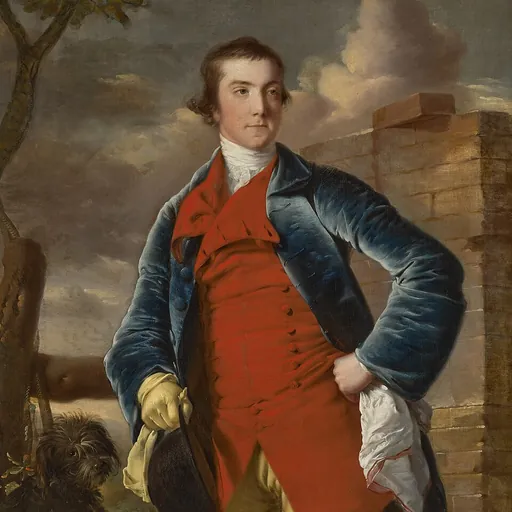
About Harry Peckham
Lived 1740 – 1787 (aged 46–47). Harry Peckham was a British cricketer, barrister, traveler and jurist.
Harry Peckham (1740 – 10 January 1787) was a King's Counsel, judge and sportsman who toured Europe and wrote a series of letters which are still being published over 200 years later. Peckham was a member of the committee that drew up early laws of cricket He was christened in his mother's church of the Holy Trinity, Hurstpierpoint, on 7 August 1740. Sir Thomas Peckham was his first cousin once removed and Henry Peckham (MP for Chichester) a first cousin three times removed.
He was a contemporary of diarist James Woodforde at school ( Winchester College) and at New College, Oxford, where he was also a friend of Francis Noel Clarke Mundy. Woodforde makes reference to Peckham playing cricket at Oxford in 1760 and 1761.
Peckham was a member of the private Markeaton Hunt. In 1762–63, his friend Mundy commissioned a set of six portraits. Each of the subjects was in the distinctive dress of the Markeaton Hunt, consisting of a blue coat over a scarlet waistcoat and yellow breeches. Peckham sat for one of these paintings. The paintings hung at Mundy's ancestral home, Markeaton Hall. As well as the Wright portrait, Peckham sat for Romney and one canvas in the possession of Chichester City Council which hangs in the Chichester Council House. Another canvas, now classed as « after Romney », is in the Royal Collection.
Peckham entered Middle Temple in 1764 and was called on 29 January 1768. among a number of travel books Kearsley published in London. Peckham's writings were and are still considered witty and interesting.
The first edition of his book in 1772 was anonymous and only the fourth posthumous edition of 1788 was attributed to Peckham.
Peckham continued to play cricket as it seems likely that he was the "Mr Peckam [sic], jun" who played for the Gentlemen of Sussex against the Gentlemen of Hampshire at Broadhalfpenny Down on 20 August 1771.
In 1774, Peckham sat on the committee that formulated some early laws of cricket. They were settled and revised at the Star and Garter in Pall Mall on Friday 25 February 1774. The meeting was chaired by Sir William Draper and the committee included the Duke of Dorset, the Earl of Tankerville and other "Noblemen and Gentlemen of Kent, Hampshire, Surrey, Sussex, Middlesex, and London". This meeting agreed one of the earlier sets of cricket rules and is acknowledged as being the first where the leg before wicket rule was introduced.
In 1781, Peckham was junior counsel to the former attorney-general John Dunning in the unsuccessful defence of François Henri de la Motte accused of supplying naval secrets to the French.
Dunning was taken ill during the trial and Peckham found himself having to conduct the defence in a case that is said to have been the inspiration for the trial of Charles Darnay in the Charles Dickens novel A Tale of Two Cities.
On 22 May 1783, Peckham wrote to the prime minister 3rd Duke of Portland from the Inner Temple thanking him for his 'Interposition in my favour'. He was called to the bench on 20 June 1783. His burial at the Temple Church was on 19 January 1787.
He was survived by his father, who was his executor, by his sister and by his illegitimate daughter, Sarah, born 3 May 1771. His will dated 29 September 1784 was proved on 12 April 1787.
In it, he appointed three guardians for his daughter, one being his sister Sarah. The young woman objected to being under the tutelage of her aunt and in the Chancery case of Peckham v Peckham [2 Cox, 46] the Lord Chancellor agreed. Her subsequent career is so far unknown.
His name was added to a white marble monument erected on the north wall of Chichester Cathedral, noting that he was Recorder of Chichester. This monument had been created for Peckham's parents by his sister, Sarah Farhill. Mrs Farhill was anxious to keep the name of Peckham alive and made her second cousin once removed, Charles Peckham Smith (1801-1873), her legatee if he would assume the name and arms of Peckham. This he did in 1820, becoming Charles Peckham Peckham.
Major works Harry Peckham's Tour, Harry Peckham & Martin Brayne (editor), The History Press,
Don’t just read it —
keep it.
Full-length biographies made to live with: read them, listen on the way to work, watch them tonight.
- E-book
- Audio
- Video
Instant download · yours to keep · every purchase keeps this site free
Important facts
People in Harry Peckham's life
Named in this biography and alive at the same time

Related people
Same field, nearest in time


Contemporaries
People whose lives overlapped Harry Peckham's





Frequently asked questions
Who was Harry Peckham?
English cricketer (1740–1787)
When was Harry Peckham born?
Harry Peckham was born in 1740.
When did Harry Peckham die?
Harry Peckham died on 10 January 1787.
What was Harry Peckham's occupation?
Harry Peckham was a cricketer, barrister, traveler and jurist.
What nationality was Harry Peckham?
Harry Peckham was British.
Sources & further reading
Cite this page
APA: Biography.guide. (2026). Harry Peckham. https://biography.guide/harry-peckham/
MLA: "Harry Peckham." Biography.guide, https://biography.guide/harry-peckham/.
Chicago: "Harry Peckham." Biography.guide. https://biography.guide/harry-peckham/.
Data last updated: 2026-09-24 · Spot an error? Report a correction.
Portrait: Wikimedia Commons · author & licence
Page generated 2026-09-27 05:09 UTC