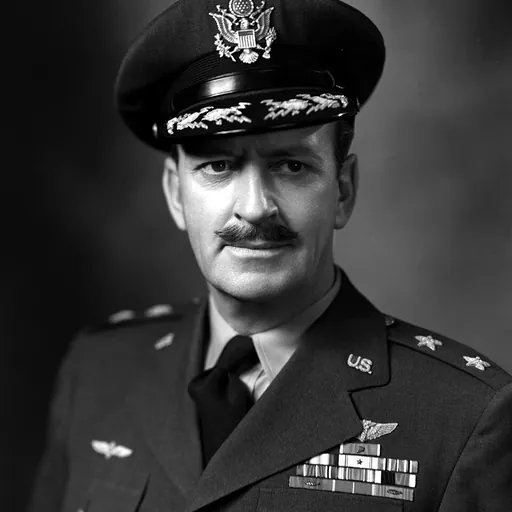
Harry George Armstrong
United States Marine and aviation expert
About Harry George Armstrong
Lived 1899 – 1983 (aged 83). Harry George Armstrong was an American military officer, physician and aircraft pilot.
Harry George Armstrong (February 17, 1899 – February 5, 1983) was a major general in the United States Air Force, a physician, and an airman. He is widely recognized as a pioneer in the field of aviation medicine. The Armstrong limit, the altitude above which water boils at the temperature of the human body, is named after him.
Armstrong served in the Marines during World War I and the Army and Air Force from 1930 to 1957. As director of the United States Aeromedical Research Laboratory, he applied his medical and aviation knowledge to the improvement of aircrew protection from temperature extremes and the lack of oxygen at high altitude.
Early life, education, and military career Armstrong was born in De Smet, South Dakota, in 1899. He attended the University of Minnesota, but left after one year to enlist in the US Marine Corps, serving with them as a private from October 1918 to March 1919. He then entered the University of South Dakota, graduating in 1921. In 1925 he received his Doctor of Medicine Degree from the University of Louisville. He entered the Medical Corps Reserve in April 1925. Armstrong entered the School of Aviation Medicine at Brooks Field, Texas, that September. Upon graduation in 1930, he was commissioned a first lieutenant in the Regular Army Medical Corps.
Military career In 1931, he was attached to the Air Corps and assigned as assistant surgeon. He was promoted to captain in 1932, to major in 1938, lieutenant colonel (temporary) in February 1942, and to colonel (temporary) in August 1942. Serving alternately in England and the United States, in 1945 he became surgeon for the Air Division in the office of Military Government for Germany (U.S.), with headquarters in Berlin. In 1946, he was promoted to lieutenant colonel (permanent), returned to the School of Aviation Medicine at Randolph Field upon appointment as assistant commandant, and that July was named commandant. In 1948, he was promoted brigadier general (temporary), then to major general (temporary).
Surgeon General of the Air Force In June 1949, he was assigned to air force headquarters at Washington, D.C., as Deputy Surgeon General of the U.S. Air Force, promoted to colonel (permanent) in October, and the following December was designated surgeon general. Armstrong was promoted to brigadier general (permanent) October 9, 1951. In 1954, General Armstrong went to Wiesbaden, Germany, as Surgeon of the United States Air Forces in Europe.
Later life Armstrong retired from the air force in 1957. He died in 1983 from heart disease.
In 1977, the Air Force Aerospace Medical Research Laboratory created the Harry G. Armstrong Award for Scientific Excellence.
Awards and decorations
Ribbon bar
Other awards Wellcome Award (1937) Collier Award (1939) John Jeffries Award (1941) Honorary Fellow of American College of Healthcare Executives (HFACHE) (1953) Edward Warner Award (1981) National Aviation Hall of Fame (1998)
Effective dates of promotion Source:
Published works Armstrong published 105 scientific papers in the field of aviation medicine and aerospace medicine. Principles and Practice of Aviation Medicine, Williams & Wilkins (1939) Aerospace medicine, Williams & Wilkins Co (1961)
Don’t just read it —
keep it.
Full-length biographies made to live with: read them, listen on the way to work, watch them tonight.
- E-book
- Audio
- Video
Instant download · yours to keep · every purchase keeps this site free
Important facts
People in Harry George Armstrong's life
Named in this biography and alive at the same time



Related people
Same field, nearest in time



Contemporaries
People whose lives overlapped Harry George Armstrong's

Frequently asked questions
Who was Harry George Armstrong?
United States Marine and aviation expert (1899-1983)
When was Harry George Armstrong born?
Harry George Armstrong was born on 17 February 1899 in De Smet Township.
When did Harry George Armstrong die?
Harry George Armstrong died on 5 February 1983.
What was Harry George Armstrong's occupation?
Harry George Armstrong was a military officer, physician and aircraft pilot.
What nationality was Harry George Armstrong?
Harry George Armstrong was American.
Sources & further reading
· Wikipedia: Harry George Armstrong
· DBpedia: Harry George Armstrong
Cite this page
APA: Biography.guide. (2026). Harry George Armstrong. https://biography.guide/harry-george-armstrong/
MLA: "Harry George Armstrong." Biography.guide, https://biography.guide/harry-george-armstrong/.
Chicago: "Harry George Armstrong." Biography.guide. https://biography.guide/harry-george-armstrong/.
Data last updated: 2026-09-22 · Spot an error? Report a correction.
Portrait: Wikimedia Commons · author & licence
Page generated 2026-09-27 05:04 UTC