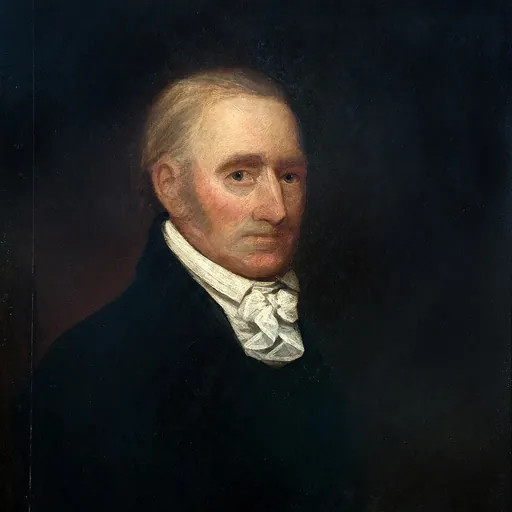
Harry Dorsey Gough
Early American merchant, planter, preacher, Methodist patron
About Harry Dorsey Gough
Lived 1745 – 1808 (aged 63). Harry Dorsey Gough was a plantations in the American South.
Harry Dorsey Gough (28 January 1745 – 8 May 1808) was a prominent 18th-century merchant, planter, and patron of the fledgling Methodist Church in Baltimore, Maryland, in the early United States.
Family and estate
Harry's father was the English merchant Thomas Gough, who emigrated to the United States prior to the outbreak of its Revolution against Britain. As his new home was near Patapsco Ferry and his new wife had extensive holdings in the colonies, Thomas would later side with the revolutionaries against the Crown. Thomas had already married the American Sophia Dorsey, who bore him Harry on January 28, 1745, in Annapolis. The money came from his English half-brother John William Gough (1729–1767), by Thomas Gough's first wife Ann Brooksby. John's year-old son was subsequently brought to America and raised in Maryland. Confusingly, this nephew was also named Harry Dorsey Gough (1766–1807) and his son (1793–1867) would later also bear the same name.
The eldest Harry Dorsey Gough's estate eventually comprised along the Great Gunpowder River northeast of Baltimore. Much of this was Corbin Lee's plantation The Adventure, which Gough purchased for £5,000 in 1774 after Corbin's death in 1773. (The deed was finalized on January 16, 1775.) Many years later, modern Baltimore's Bel Air Road (U.S. Route 1) was known as "Gough's Road" or "Perry Hall Road". in befriending Bishop Francis Asbury, the "Father of American Methodism". In 1775, Gough attended a Methodist camp meeting in Baltimore with his friends for the purpose of mocking the attendees; instead, he found himself moved and contemplating the meaning of his life and even suicide. He subsequently joined his wife in supporting them, off Perry Hall's eastern wing.
During the American Revolution, Gough was a Nonjuror who declined to swear the oath of allegiance to the rebel government. As such, he was excluded from political office and even indicted in October 1778 for illegal preaching at his house chapel. (Many of the early Methodist exhorters returned to England during the Revolution and those who didn't, such as Asbury, were often suspected of Loyalist sympathies. Swearing the oath of allegiance was a necessary condition of leading a lawful religious assembly.)
Postwar After the Revolution, Gough swore the oath of allegiance and again became active in politics, philanthropy, and experimental farming. He was a member of the Federalist Party in the fledgling United States. He had already helped with Maryland's first Alms House in 1773; and he may have been the first to import shorthorn bulls to America.
Slave holdings In this early period, Gough was one of the largest owners of slaves in Maryland, with around 70. Gough credited his own conversion to the touching sermon of thanksgiving he found being preached to his slaves by an African Methodist from a neighboring plantation. to make an example of him before his other term laborers. By 1804, Gough and other planters had passed legislation allowing them to increase the terms of their indentured servants' contracts in the event of runaways.
Death Gough's funeral was attended by over 2,000 mourners and presided over by Bishop Asbury. His estate was estimated to be worth $300,000 (~$ in )
Legacy The Belair Road bridge over the Great Gunpowder River was named in his honor in 2004. In 2013, Gough Park opened in Perry Hall.
Don’t just read it —
keep it.
Full-length biographies made to live with: read them, listen on the way to work, watch them tonight.
- E-book
- Audio
- Video
Instant download · yours to keep · every purchase keeps this site free
Important facts
People in Harry Dorsey Gough's life
Named in this biography and alive at the same time
Contemporaries
People whose lives overlapped Harry Dorsey Gough's






Frequently asked questions
Who was Harry Dorsey Gough?
early American merchant, planter, preacher, Methodist patron
When was Harry Dorsey Gough born?
Harry Dorsey Gough was born on 28 January 1745 in Annapolis.
When did Harry Dorsey Gough die?
Harry Dorsey Gough died on 8 May 1808.
What was Harry Dorsey Gough's occupation?
Harry Dorsey Gough was a plantations in the American South.
What nationality was Harry Dorsey Gough?
Harry Dorsey Gough's recorded nationality: Thirteen Colonies.
Sources & further reading
· Wikipedia: Harry Dorsey Gough
Cite this page
APA: Biography.guide. (2026). Harry Dorsey Gough. https://biography.guide/harry-dorsey-gough/
MLA: "Harry Dorsey Gough." Biography.guide, https://biography.guide/harry-dorsey-gough/.
Chicago: "Harry Dorsey Gough." Biography.guide. https://biography.guide/harry-dorsey-gough/.
Data last updated: 2026-09-22 · Spot an error? Report a correction.
Portrait: Wikimedia Commons · author & licence
Page generated 2026-09-27 05:04 UTC