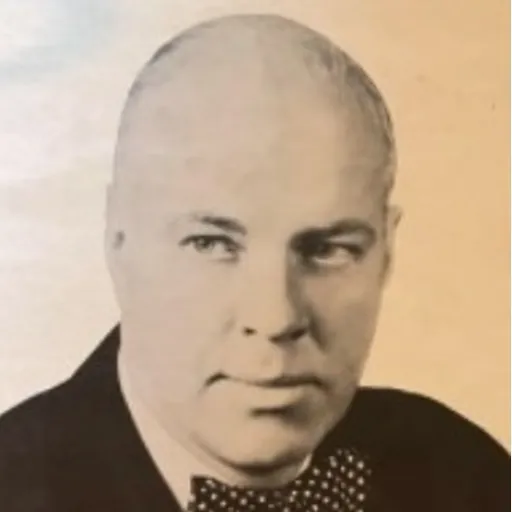
About Harold W. Handley
Lived 1909 – 1972 (aged 62). Harold W. Handley was an American politician and governor.
Harold Willis Handley (November 27, 1909 – August 30, 1972) was the 40th governor of Indiana from 1957 to 1961. A veteran of World War II, and furniture salesman by trade, Handley began his political career as a state senator. Thanks to his longtime friendship with state party leader and United States Senator William E. Jenner, he was able to secure the nomination to run for lieutenant governor in 1952, during which time he opposed many of the actions of Governor George N. Craig. His popularity rose among the conservative leadership of the Indiana Republican Party and aided him in winning the nomination and subsequent election as governor in 1956.
He was elected during a period of conservative domination of the state government. He successfully implemented major parts of his party's agenda that affected the state for decades. After raising the gasoline tax 50% to balance the state budget, his opponents branded him "High Tax Harold", ignoring the fact that he also eliminated state property taxes. He launched an unprecedented mid-term campaign for a United States Senate seat but ended in defeat and he finished his term as governor. He personally advocated mental health reform in Indiana and after leaving office he remained active in several charities that helped the mentally disabled, winning a Drummer Boy Award in 1970. He operated a successful public relations business in Indianapolis for several years and in 1969 served on the Constitutional Revision Committee that authored a set of major amendments to the state constitution.
Early life Background and education Harold Handley was born November 27, 1909, in LaPorte, Indiana, one of the three sons of Harold Lowell and Lottie Margaret Brackbill Handley. His father was a merchant who sold furniture. He attended local public schools before enrolling in Indiana University Bloomington. His classmates included William E. Jenner and George N. Craig. Handley became good friends with Jenner; the two later became important political allies. Craig however, would become Handley's major opponent within his own party. He studied at the school for four years and graduated in 1932 with a bachelor's degree in economics.
After school Handley returned home where he joined his father's sales department. Although Handley was an able salesman, his company was one of many that folded during the mid-1930s because of the continuing Great Depression.
World War II After the United States entered World War II in 1941, Handley resigned from the senate and enlisted in the army as a lieutenant, but eventually rose to the rank of lieutenant colonel. He was assigned to the Eighty-eighth Infantry Division headquartered in Mojave Desert. Despite making multiple requests to be sent overseas, the army kept him in the United States for the duration of the war to serve as a trainer for new recruits. As fresh soldiers arrived in the camp he was responsible for overseeing the drill sergeants and ensuring they were properly trained before they were dispatched to serve as reinforcements to the main body of the division.
In his role as President of the Senate, Handley became an early opponent of Governor Craig. Craig submitted a plan to reorganize the state's 141 agencies into eleven departments centralized under his leadership, a reversal of the reorganization Handley supported during his first term as a senator. Handley was able to kill all debate on the bill in the Senate and prevent it from passing. The short legislative sessions allowed Handley to focus most of his attention on his statutory offices, serving as the Commissioner of Agriculture and Commissioner of Commerce. He successfully attracted a number of companies to expand and move operations to Indiana, providing thousands of new jobs. He also used his position to build a considerable political base of support.
The most controversial position Harold took was advocating a 50% increase in the state gasoline tax. The bonuses paid to soldiers, and the state's school consolidation plan had used up the budget surplus in 1956. A deficit was predicted for 1957 and 1958, but the state was not permitted to take on debt by the constitution. Members of his party recommended using some of the state's reserve fund to handle the deficit, but ultimately the tax increase was approved, earning him the nickname "High Tax Harold." Handley also successfully advocated the passage of a withholding law that allowed employers to withhold state income taxes from their employee's pay. This led to the discovery of thousands of tax cheats that produced an unexpected windfall for the state government. Hoping to use the situation to restore some confidence in his conservativeness, Handley proposed that most of the state property taxes be repealed. The General Assembly readily agreed and state-level property taxes completely repealed, leaving only some local property taxes in place.
Chain O'Lakes State Park in Noble County was established in 1960, during Handley's term. Handley spoke at the park's opening ceremony.
1958 Senate campaign Senator William Jenner resigned shortly before the mid-term elections in 1958 and urged Handley to seek his seat. A plan was created where Handley would resign the governorship, his lieutenant would appoint him senator, and he could finish the term. When the plan was revealed to the party leadership, they strongly advised him to not implement it because they feared it would hurt the party and be perceived as a scandal. Handley then decided to have the Secretary of State order an election for the office in November, and Handley himself ran for the position.
Handley started a public relations and advertising firm based in Indianapolis that became very successful. In 1969, a major revision of the state constitution was finally authorized. He and fellow former Governor Matthew E. Welsh were appointed to the Constitutional Revision Commission. Among the important influences he had on the revision was allowing governors to serve consecutive terms again. The state courts were also reorganized, and a level of appointment power was also returned to the governor. In total seven amendments he helped author were drafted and passed into law.
Don’t just read it —
keep it.
Full-length biographies made to live with: read them, listen on the way to work, watch them tonight.
- E-book
- Audio
- Video
Instant download · yours to keep · every purchase keeps this site free
Important facts
Related people
Same field, nearest in time






Contemporaries
People whose lives overlapped Harold W. Handley's


Frequently asked questions
Who was Harold W. Handley?
American politician (1909–1972)
When was Harold W. Handley born?
Harold W. Handley was born on 27 November 1909 in La Porte.
When did Harold W. Handley die?
Harold W. Handley died on 30 August 1972 in Rawlins.
What was Harold W. Handley's occupation?
Harold W. Handley was a politician and governor.
What nationality was Harold W. Handley?
Harold W. Handley was American.
Sources & further reading
· Wikipedia: Harold W. Handley
Cite this page
APA: Biography.guide. (2026). Harold W. Handley. https://biography.guide/harold-w-handley/
MLA: "Harold W. Handley." Biography.guide, https://biography.guide/harold-w-handley/.
Chicago: "Harold W. Handley." Biography.guide. https://biography.guide/harold-w-handley/.
Data last updated: 2026-09-21 · Spot an error? Report a correction.
Portrait: Wikimedia Commons · author & licence
Page generated 2026-09-27 05:00 UTC