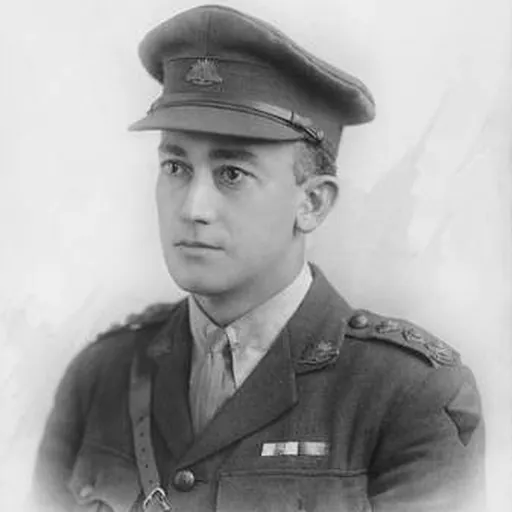
About Harold Burfield Taylor
Lived 1890 – 1966 (aged 75). Harold Burfield Taylor was an Australian chemist.
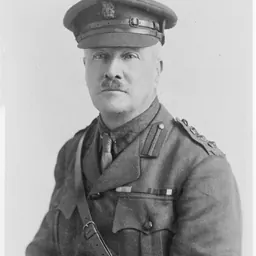
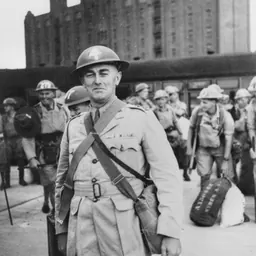
Brigadier Harold Burfield Taylor, (10 August 1890 – 15 March 1966) was an analytical chemist and an Australian Army officer who served in the First and the Second World Wars. A junior officer in the First World War, during the Second World War he was commander of the 22nd Infantry Brigade during the Japanese invasion of Malaya. Captured along with many of his fellow soldiers following the fall of Singapore, he spent the remainder of the war as a prisoner of war. In civilian life, he was an analyst for the government and an expert in poisons, often called upon to give evidence in criminal trials involving poisoning.
Early life and scientific career
Taylor was born on 10 August 1890 in Enfield, Sydney to Ernest Taylor, a civil servant originally from England, and his Australian wife, Louisa Chowne. He was educated at Sydney Boys' High School and the University of Sydney, where he graduated Bachelor of Science in 1912. Interested in chemistry and military science, he served with the Sydney University Scouts (a Militia unit), and was commissioned in 1913.
Taylor commenced his analytic career as assistant government analyst in the New South Wales Department of Public Health in 1915. While his work involved analysis of a wide range of products, he became well known for giving evidence in criminal trials involving poisons.
The battalion engaged in the trench warfare that was typical of the front, and took part in the Battle of Pozières. and he was rewarded with a Military Cross (MC).
Taylor was recommended for a Bar to his MC on 9 October 1917. This was for his actions during the Battle of Poelcappelle which was part of the Battle of Passchendaele, when he led a small force of two companies to capture German positions in Daisy Wood, near Ypres. The citation for the Bar, appearing in The London Gazette in April 1918, read:
He continued to serve with the battalion until the end of the war, brought about by the armistice with Germany on 11 November 1918, and, upon his return to Australia, was discharged from the AIF the following year.
Taylor also continued to be involved with the militia, having resumed his militia career in 1920. A battalion commander by 1926, he was promoted to lieutenant colonel in July 1927 and continued to be appointed to command various militia battalions, including the 18th and 56th battalions. this was initially commanded by Vernon Sturdee but he would shortly be made Army chief of staff, with Major General Gordon Bennett taking over command of the division in his stead. The brigade was originally destined for the Middle East but the Australian government offered to send it to Singapore to shore up Britain's defences, an offer gratefully accepted by the British prime minister, Winston Churchill.
Malaya and Singapore After a period of training in New South Wales, the brigade embarked for Malaya on 2 February 1941 with Taylor travelling in advance of the main body by flying boat. He spent time gauging the current training methods in use amongst the British and Indian units already stationed in Malaya. Observing the terrain in which his soldiers may have to fight, he implemented acclimatisation and jungle warfare training for his brigade.
The brigade was based at Mersing, and spent time constructing defences and laying minefields. It also underwent brigade level training exercises and it was during one of these exercises that Taylor clashed with Bennett, his new commanding officer. Taylor's relationship with Bennett was difficult. Bennett's command in Malaya at the time consisted solely of Taylor's brigade, with other elements of the 8th Division to follow. This meant that Bennett's oversight was more overbearing than would normally be the case and this resulted in disputes over the use and distribution of his brigade. Following the invasion of Malaya by the Japanese Empire, the brigade was forced into fighting rear guard actions against the advancing Japanese. This led to more clashes with Bennett, who felt that Taylor, by requesting to establish fallback positions, was too pessimistic in his defence arrangements.
The brigade later withdrew to Singapore Island, its three battalions taking up positions across an eight-mile front on the north western coast of the island. On the night of 8 February, the Japanese launched landings on Taylor's sector, forcing his brigade into a fighting withdrawal. The Japanese advance may have been assisted by Taylor's directions to his platoon and company commanders to withdraw back to their headquarters position if they felt in danger of being overrun.
By 12 February, the Japanese were well established on Singapore Island and advancing on all fronts. That day Taylor, extremely fatigued, asked Lieutenant Colonel Arthur Varley, commander of 2/18th Battalion, to take over temporary command of the brigade. The following day, Bennett promoted Varley to brigadier and made him the permanent commander of the brigade, a command which would last only a few more days before the surrender of Singapore on 15 February.
Taylor spent the remainder of the war as a prisoner of war of the Japanese. While imprisoned at Changi, he set up and ran an educational program dubbed the Changi University for his fellow prisoners which was significantly diminished as men were transferred to other camps. Sent to prisoner camps in Taiwan and then Manchuria,
Later life Returning to his scientific career upon his return to Australia after the Second World War, Taylor became the government analyst in March 1946. He continued to be called upon to advise in criminal cases involving poisons, including those by the multiple murderer Caroline Grills. He retired from public service in 1954 although worked as a consultant for several more years. At the time of his retirement he was working on setting standards for the amount of fruit in juices and jams.
Taylor died while under hospital care at Concord on 15 March 1966. He was survived by his wife, Nellie Birkenhead Starling, whom he married in 1940. The couple had no children.
Publications
Don’t just read it —
keep it.
Full-length biographies made to live with: read them, listen on the way to work, watch them tonight.
- E-book
- Audio
- Video
Instant download · yours to keep · every purchase keeps this site free
Important facts
People in Harold Burfield Taylor's life
Named in this biography and alive at the same time

Related people
Same field, nearest in time

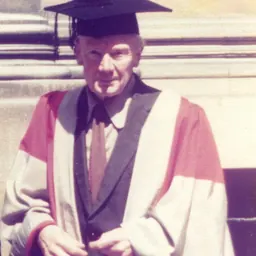


Contemporaries
People whose lives overlapped Harold Burfield Taylor's



Frequently asked questions
Who was Harold Burfield Taylor?
Analytical Chemist; Australian Army officer (1890–1966)
When was Harold Burfield Taylor born?
Harold Burfield Taylor was born on 10 August 1890 in Enfield.
When did Harold Burfield Taylor die?
Harold Burfield Taylor died on 15 March 1966 in Concord.
What was Harold Burfield Taylor's occupation?
Harold Burfield Taylor was a chemist.
What nationality was Harold Burfield Taylor?
Harold Burfield Taylor was Australian.
Sources & further reading
· Wikipedia: Harold Burfield Taylor
· DBpedia: Harold Burfield Taylor
Cite this page
APA: Biography.guide. (2026). Harold Burfield Taylor. https://biography.guide/harold-burfield-taylor/
MLA: "Harold Burfield Taylor." Biography.guide, https://biography.guide/harold-burfield-taylor/.
Chicago: "Harold Burfield Taylor." Biography.guide. https://biography.guide/harold-burfield-taylor/.
Data last updated: 2026-09-20 · Spot an error? Report a correction.
Page generated 2026-09-27 05:09 UTC