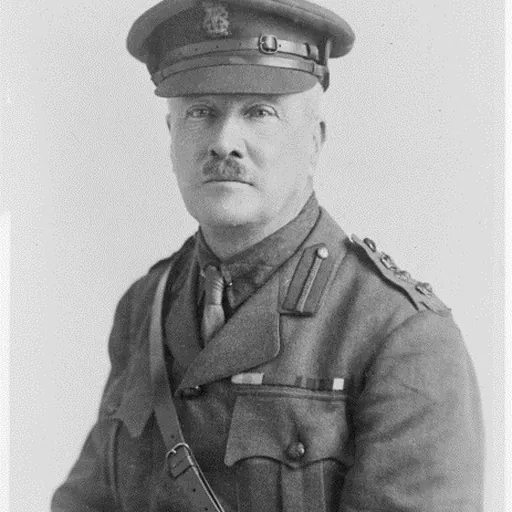
About Vernon Sturdee
Lived 1890 – 1966 (aged 76). Vernon Sturdee was an Australian engineer and military personnel.
Lieutenant General Sir Vernon Ashton Hobart Sturdee, (16 April 1890 – 25 May 1966) was an Australian Army commander who served two terms as Chief of the General Staff. A regular officer of the Royal Australian Engineers who joined the Militia in 1908, he was one of the original Anzacs during the First World War, participating in the landing at Gallipoli on 25 April 1915. In the campaign that followed, he commanded the 5th Field Company, before going on to lead the 8th Field Company and the 4th Pioneer Battalion on the Western Front. In 1918 he was seconded to General Headquarters (GHQ) British Expeditionary Force as a staff officer.
Promotion was stagnant between the wars, and Sturdee remained at his wartime rank of lieutenant colonel until 1935. He served in a series of staff posts, and attended the Staff College at Quetta in British India and the Imperial Defence College in Britain. Like other regular officers, he had little faith in the government's "Singapore strategy", and warned that the Army would have to face an effective and well-equipped Japanese opponent.
Ranked colonel at the outbreak of the Second World War in 1939, Sturdee was raised to lieutenant general in 1940 and became Chief of the General Staff. He proceeded to conduct a doomed defence of the islands to the north of Australia against the advancing Japanese forces. In 1942, he successfully advised the government to divert the Second Australian Imperial Force troops returning from the Middle East to Australia. He then became head of the Australian Military Mission to Washington, D.C., where he represented Australia before the Combined Chiefs of Staff. As commander of the First Army in New Guinea in 1944–45, Sturdee directed the fighting at Aitape, and on New Britain and Bougainville. He was charged with destroying the enemy when opportunity presented itself, but had to do so with limited resources, and without committing his troops to battles that were beyond their strength.
When the war ended, Sturdee took the surrender of Japanese forces in the Rabaul area. As one of the Army's most senior officers, he succeeded General Sir Thomas Blamey as Commander in Chief of the Australian Military Forces in December 1945. He became the Chief of the General Staff a second time in 1946, serving in the post until his retirement in 1950. During this term, he had to demobilise the wartime Army while fielding and supporting the Australian contingent of the British Commonwealth Occupation Force in Japan. He developed a structure for the post-war Army that included regular combat formations. As a result, the Australian Regular Army was formed, laying the foundations for the service as it exists today.
Education and early life Vernon Ashton Hobart Sturdee was born in Frankston, Victoria, on 16 April 1890, the son of Alfred Hobart Sturdee and his wife Laura Isabell, née Merrett. Alfred Sturdee, a medical practitioner from England, came from a prominent naval family and was the brother of Doveton Sturdee, who later became an admiral of the fleet. Alfred emigrated to Australia in the 1880s, travelling as a ship's doctor. He served in the Boer War, where he was mentioned in despatches after he rode under fire to a donga near the enemy's position to aid wounded men. Re-enlisting in the Australian Army Medical Corps as a captain in January 1905, he was promoted to major in August 1908 and lieutenant colonel in December 1912. He received three more mentions in despatches and was appointed a Companion of the Order of St Michael and St George. His Australian-born wife Laura, known as Lil, was the sister of Charles Merrett, a prominent businessman and Militia officer. Her half-brother, Colonel Harry Perrin, was another Militia officer. He married Edith Georgina Robins on 4 February 1913 at St Luke's Church of England, Fitzroy North, Melbourne. He embarked from Melbourne for Egypt on the former P&O ocean liner Orvieto on 21 October 1914. He participated in the landing at Anzac Cove on 25 April 1915, disembarking from the transport before 9:00. His duties included supervising the engineer stores park on the beach at Anzac Cove, In July, Sturdee contracted influenza and was evacuated from Anzac Cove. From then until the end of the campaign, he was responsible for all engineering and mining work at Steele's, Quinn's and Courtney's Posts, He departed Anzac Cove for the last time on 17 December 1915, two days before the final evacuation.
Western Front On returning to Egypt after the evacuation of Anzac, Sturdee assumed responsibility for the provision of hutting at the AIF reinforcement camp at Tel el Kebir.
B Company, 4th Pioneer Battalion shifts camp from the Butte de Warlencourt to Fremicourt by light railway. The 5th Division moved to France in June 1916, where it participated in the disastrous Battle of Fromelles in July. During the action, Sturdee's 8th Field Company supported the 8th Infantry Brigade. A trench dug by the former facilitated the latter's withdrawal across no man's land. and awarded the Distinguished Service Order. Heavy losses in the fighting at Fromelles prevented the 5th Division from participating in the Battle of the Somme. To free up another division to participate, II ANZAC Corps organised "Franks Force" to take over a divisional frontage in the Houplines sector, and Sturdee became its Commander Royal Engineers (CRE). When the 5th Division finally moved to the Somme sector in November, he became CRE in charge of the road from Albert to Montauban.
On 13 February 1917, Sturdee was appointed to command the 4th Pioneer Battalion, with the rank of lieutenant colonel. On 27 March 1918, Sturdee was seconded to General Headquarters (GHQ) British Expeditionary Force as a staff officer, remaining there until 22 October 1918. and appointed an Officer of the Order of the British Empire for his work at GHQ.
Between the wars Sturdee embarked for Australia on 16 November 1918, and his AIF appointment was terminated on 14 March 1919. and then served as Director of Staff Duties until 12 October 1938. He was given the brevet rank of colonel on 1 July 1935; this became temporary on 1 July 1936 and finally substantive on 1 July 1937, over twenty years after he had become a lieutenant colonel in the AIF.
Like his predecessor as Director of Military Operations and Intelligence, Colonel John Lavarack, and many other officers, Sturdee had little faith in the government's "Singapore strategy", which aimed to deter Japanese aggression through the presence of a powerful British fleet based at Singapore. In 1933, Sturdee told senior officers that the Japanese
Second World War Defence of Australia In 1939, the Chief of the General Staff, Lieutenant General Ernest Squires, implemented a reorganisation of the Army in which the old military districts were replaced by larger commands led by lieutenant generals. On 13 October 1939, Sturdee was promoted from colonel to lieutenant general and assumed control of the new Eastern Command. He had to supervise the raising, training and equipping of the new Second Australian Imperial Force units being formed in New South Wales, as well as the now-conscript Militia. His period in this command was brief. On 13 August 1940, the Chief of the General Staff, General Sir Brudenell White, was killed in the Canberra air disaster. Sturdee was restored to his rank of lieutenant general and appointed Chief of the General Staff. As such, he was responsible for the training and maintenance of the AIF in the Middle East and the Far East—although not their operational control—and for the administration and training of the Militia.
As the prospect of war with Japan became more likely, so also did the need to make appropriate arrangements for leading the defence of Australia. In 1935, Lavarack had recommended that in the event of war, the Military Board be abolished and its powers vested in a Commander-in-chief. In April 1941, the Minister for the Army, Percy Spender, recommended that this now be done and Sturdee become Commander in Chief of the Australian Military Forces. Instead, the government elected to adopt the British system, in which the Military Board (or Army Council as it was called there) continued to operate, with a separate GOC Home Forces. On 5 August 1941, Major General Sir Iven Mackay was appointed to this newly created post. The idea of a Commander in Chief did not go away and editorials in the Sunday Telegraph and Sydney Morning Herald advocated the appointment.
East Indies campaign Sturdee attempted to defend the islands to the north of Australia to satisfy an allied agreement made during the second Four-Power Staff Conference at Singapore on 22 February 1941. With only one AIF infantry brigade available, the 23rd, he could only afford to protect the islands most strategically important to the defence of Australia. He sent Gull Force centred on the 2/21st Infantry Battalion to Ambon, Lark Force centred on the 2/22nd to Rabaul, and Sparrow Force centred on the 2/40th Infantry Battalion with 2/2nd Independent Company to Timor.
Sturdee knew that their prospects were slim at best but he was required to secure Dutch support for the defence of the region. He expected them "to put up the best possible defence" with what resources they had, and hopefully slow the Japanese advance to allow time for reinforcements to arrive. When there were doubts about the morale of one commander, Sturdee replaced him with a staff officer from Army Headquarters who volunteered for the position despite being well aware of the odds. All the garrisons were overrun after a spirited defence, except for the 2/2nd Independent Company, which managed to hold on in East Timor. After the war Sturdee described the situation thus:
Commenting on Sturdee's forward defence strategy after the war, Colonel Eustace Graham Keogh wrote:
In a 2010 PhD thesis on Ambon, David Evans attacked Sturdee as incompetent. A more balanced appraisal was written by Michael Evans in 2000:
In February 1942, on advice from Lavarack that the Dutch East Indies would soon fall, Sturdee urged the Australian government that the 17,800 troops returning from the Middle East, originally bound for Java, be diverted to Australia. Sturdee contended that Java could not be held, and that Allied resources should instead be concentrated in an area from which an offensive could be launched. The best place for this, he argued, was Australia. When Prime Minister John Curtin backed his Chief of the General Staff, it brought him into conflict with British Prime Minister Winston Churchill and United States President Franklin D. Roosevelt, who suggested that the AIF be diverted to Burma. In the end, Curtin won his point, and subsequent events vindicated Sturdee's appreciation of the situation. Official historian Lionel Wigmore concluded:
Island campaigns alt=Five soldiers in peaked caps and shirtsleeves study a map on an improvised table in the bush. In March 1942, the Military Board was abolished and General Sir Thomas Blamey was appointed Commander in Chief. Blamey decided that after the hectic events of the previous months, Sturdee needed a rest and appointed him as Head of the Australian Military Mission to Washington, D.C., where the war's strategy was now being decided. Sturdee accepted on condition that after a year's duty in Washington he would be appointed to an important command. In Washington, Sturdee represented Australia before the Combined Chiefs of Staff and managed to obtain the right of direct access to the Chief of Staff of the United States Army, General George Marshall.
Sturdee returned to Australia and assumed command of the First Army on 1 March 1944.
Sturdee was concerned by this order's ambiguity and sought clarification from Blamey. The Commander in Chief responded by stating that "my conception is that action must be of a gradual nature" involving the use of patrols to determine Japanese strengths and positions before large offensives were undertaken. The situation on New Britain was straightforward enough; the enemy was known to be stronger than the Australian forces there—although it was not realised just how much stronger—and so the best that could be done was to eliminate small numbers of Japanese troops by aggressive patrolling. At Aitape, Stevens was tasked on the one hand with pushing the Japanese back far enough to protect the airfields; but on the other, with not allowing the 6th Division to become heavily engaged since it might be required for use elsewhere. On Bougainville, Savige had the strength and ability to conduct a major campaign, but Blamey counselled caution. On 18 July 1945, Sturdee wrote to Savige:
Sturdee's operations were effective. On Bougainville, at a cost of 516 Australian dead and 1,572 wounded, Savige's troops had occupied much of the island and killed 8,500 Japanese; another 9,800 died from malnutrition and disease. On New Britain, where 74 Australians died and 140 were wounded, the heavily outnumbered 5th Division had overrun central New Britain. Meanwhile, the 6th Division at Aitape and Wewak had lost 442 dead and 1,141 wounded while clearing the Japanese from the coast and driving them into the mountains, killing 9,000 and taking 269 prisoners.
On 6 September 1945, Sturdee received the surrender of Japanese forces in the First Army area from General Hitoshi Imamura, the commander of the Japanese Eighth Area Army, and Admiral Jinichi Kusaka, the commander of the South East Area Fleet, in a ceremony held on the deck of the British aircraft carrier at Rabaul. The two Japanese swords handed over in the surrender ceremony, together with the sword worn by Sturdee, which was his father's, were presented to the Australian War Memorial by Lady Sturdee in 1982. For his service in the final campaigns, Blamey recommended Sturdee for a knighthood, but this was reduced to a third mention in despatches.
Later life In November 1945, the Minister for the Army, Frank Forde, informed Blamey that the government had decided to re-establish the Military Board and he should therefore vacate his office. Sturdee became acting Commander in Chief on 1 December 1945. On 1 March 1946, the post of Commander in Chief was abolished and Sturdee became Chief of the General Staff again. There was much work to be done; the wartime Army had a strength of 383,000 in August 1945, of whom 177,000 were serving outside Australia.
alt=Formal portrait of a group of nine men. Four are sitting at the front and five are standing at the back. Six are wearing uniforms without headgear, while the other three are wearing civilian suits. Field Marshal Bernard Montgomery, Chief of the Imperial General Staff, meets with Sturdee and the other members of the Military Board. These troops had to be demobilised, but what should replace the wartime Army had not yet been determined. Sturdee and his Vice Chief of the General Staff, Lieutenant General Sydney Rowell, had to develop an appropriate structure. The proposal submitted to Cabinet called for national service, a regular army of 33,000 and reserves of 42,000, but the government baulked at the £20m per annum price tag. A smaller force of 19,000 regulars and 50,000 reservists at a cost of £12.5m per annum was finally approved in 1947. Conditions of service were also overhauled.
At the same time, the Army had to handle huge stockpiles of equipment, stores and supplies. Some were far in excess of the Army's needs and had to be disposed of. Hospitals still had to be run, although some were transferred to the Department of Repatriation. The Army had to maintain its schools and training establishments. Moreover, the Army had to field and maintain part of the British Commonwealth Occupation Force in Japan. Over next fifty years, operations would be conducted by the new Australian Regular Army that Sturdee created, rather than the Militia or specially enlisted expeditionary forces.
Sturdee retired on 17 April 1950. In recognition of his services, he was created a Knight Commander of the Order of the British Empire on 1 January 1951. In retirement, he continued to live in Kooyong, Melbourne. He became a director of the Australian arm of Standard Telephones and Cables and was honorary colonel of the Royal Australian Electrical and Mechanical Engineers from 1951 to 1956. The Army named the Landing Ship Medium Vernon Sturdee after him. He died on 25 May 1966 at the Repatriation General Hospital, Heidelberg. He was accorded a funeral with full military honours, and cremated. Sturdee was survived by his wife, their daughter and one of their two sons. Before he died, he burned all his private papers. "I have done the job," he said. "It is over."
Don’t just read it —
keep it.
Full-length biographies made to live with: read them, listen on the way to work, watch them tonight.
- E-book
- Audio
- Video
Instant download · yours to keep · every purchase keeps this site free
Important facts
People in Vernon Sturdee's life
Named in this biography and alive at the same time




Related people
Same field, nearest in time


Contemporaries
People whose lives overlapped Vernon Sturdee's




Frequently asked questions
Who was Vernon Sturdee?
former Australian Chief of the General Staff
When was Vernon Sturdee born?
Vernon Sturdee was born on 16 April 1890 in Frankston.
When did Vernon Sturdee die?
Vernon Sturdee died on 25 May 1966 in Heidelberg.
What was Vernon Sturdee's occupation?
Vernon Sturdee was an engineer and military personnel.
What nationality was Vernon Sturdee?
Vernon Sturdee was Australian.
Sources & further reading
Cite this page
APA: Biography.guide. (2026). Vernon Sturdee. https://biography.guide/vernon-sturdee/
MLA: "Vernon Sturdee." Biography.guide, https://biography.guide/vernon-sturdee/.
Chicago: "Vernon Sturdee." Biography.guide. https://biography.guide/vernon-sturdee/.
Data last updated: 2026-09-23 · Spot an error? Report a correction.
Portrait: Wikimedia Commons · author & licence
Page generated 2026-09-27 05:07 UTC