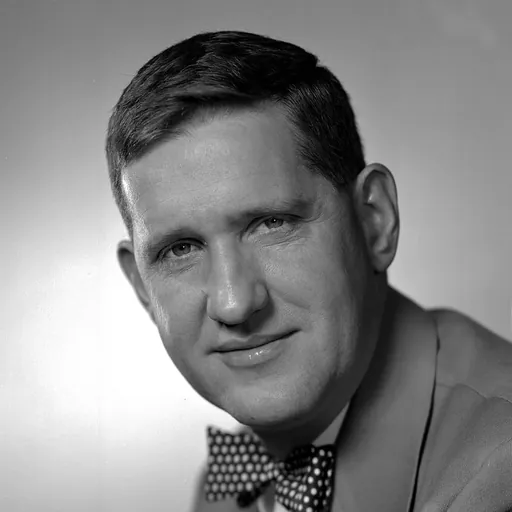
About Harold Agnew
Lived 1921 – 2013 (aged 92). Harold Agnew was an American physicist, known for Norris Bradbury.
Harold Melvin Agnew (March 28, 1921 – September 29, 2013) was an American physicist, best known for having flown as a scientific observer on the Hiroshima bombing mission and, later, as the third director of the Los Alamos National Laboratory.
Agnew joined the Metallurgical Laboratory at the University of Chicago in 1942, and helped build Chicago Pile-1, the world's first nuclear reactor. In 1943, he joined the Los Alamos Laboratory, where he worked with the Cockcroft–Walton generator. After the war ended, he returned to the University of Chicago, where he completed his graduate work under Enrico Fermi.
Agnew returned to Los Alamos in 1949, and worked on the Castle Bravo nuclear test at Bikini Atoll in 1954. He became head of the Weapon Nuclear Engineering Division in 1964. He also served as a Democratic New Mexico State Senator from 1955 to 1961, and was the Scientific Adviser to the NATO Supreme Allied Commander Europe (SACEUR) from 1961 to 1964. He was director of the Los Alamos National Laboratory from 1970 to 1979, when he resigned to become President and Chief Executive Officer of General Atomics. He died at his home in Solana Beach, California, on September 29, 2013.
Early life and education Harold Melvin Agnew was born in Denver, Colorado on March 28, 1921, the only child of a pair of stonecutters. He attended South Denver High School and entered the University of Denver, where he majored in chemistry. He was a strong athlete who pitched for the university softball team that won a championship. He left the University of Denver in January 1942, but had enough credits to graduate Phi Beta Kappa with his Bachelor of Arts degree in June, and he received a scholarship to Yale University.
After the Japanese bombing of Pearl Harbor brought the United States into the Pacific War, Agnew and his girlfriend Beverly, a fellow graduate of South Denver High School and the University of Denver, attempted to join the United States Army Air Corps together. They were persuaded not to sign the enlistment papers. Instead, Joyce C. Stearns, the head of the physics department at the University of Denver, persuaded Agnew to come with him to the University of Chicago, where Stearns became the deputy head of the Metallurgical Laboratory. Although Agnew had enough credits to graduate, Beverly did not and had to remain behind. They were married in Denver on May 2, 1942. They then went to Chicago, where Beverly became a secretary to Richard L. Doan, then head of the Metallurgical Laboratory. Agnew and Beverly had two children, a daughter Nancy, and a son, John.
At the Metallurgical Laboratory, Agnew worked with Enrico Fermi, Walter Zinn and Herbert L. Anderson. There, he was involved in the construction of Chicago Pile-1. Initially, Agnew worked with the instrumentation. The Geiger counters were calibrated using a radon-beryllium source, and Agnew received too high a dose of radiation. He was then put to work stacking the graphite bricks that were the reactor's neutron moderator. He witnessed the first controlled nuclear chain reaction when the reactor went critical on December 2, 1942.
Agnew and Beverly moved to the Los Alamos Laboratory in March 1943.
When experimental work wound down, Agnew was transferred to Project Alberta, working as part of Luis W. Alvarez's group, whose role was to monitor the yield of nuclear explosions. With Alvarez and Lawrence H. Johnston, Agnew had devised a method for measuring the yield of the nuclear blast by dropping pressure gauges on parachutes and telemetering the readings back to the plane.
After the war ended, Agnew entered the University of Chicago, where he completed his graduate work under Fermi. Agnew and Beverly stayed with Fermi and his family, due to the post-war housing shortage. Fellow postgraduate students at Chicago at the time included Tsung-Dao Lee, Chen Ning Yang, Owen Chamberlain and Jack Steinberger.
Los Alamos years
With his doctorate in hand, Agnew returned to Los Alamos as a National Research Foundation Fellow, and worked on weapons development in the Physics Division. He became head of the Weapon Nuclear Engineering Division in 1964. He was the first state senator to be elected from Los Alamos County. Senators served unpaid, receiving only a per diem allowance of five dollars. Since the New Mexico legislature convened for only 30 days in even numbered years and 60 days in odd numbered years, he was able to continue working at Los Alamos, taking leave without pay to attend. Agnew managed to get the Los Alamos Laboratory responsibility for the development of the W76, used by the Trident I and Trident II Submarine Launched Ballistic Missiles, and the W78 used by the Minuteman III intercontinental ballistic missiles. He was proud of the work with insensitive high explosive that made nuclear weapons safer to handle. Support from the Atomic Energy Commission for reactor development dried up, but during the 1970s energy crisis, the laboratory explored other types of alternative fuels.
Later life In 1979, Agnew resigned from Los Alamos and became President and Chief Executive Officer of General Atomics, a position he held until 1985.
Agnew chaired the General Advisory Committee of the Arms Control and Disarmament Agency from 1974 to 1978, and served as a White House science councillor from 1982 to 1989. He was a member of NASA's Aerospace Safety Advisory Panel from 1968 to 1974, and from 1978 to 1987. He became an adjunct professor at the University of California, San Diego in 1988. He was the recipient of the E.O. Lawrence Award in 1966, and of the Department of Energy's Enrico Fermi Award in 1978. Along with Hans Bethe, Agnew was the first to receive the Los Alamos National Laboratory Medal. He was a member of the National Academy of Sciences and the National Academy of Engineering.
A proponent of tactical nuclear weapons, Agnew pointed out in 1970 that the Thanh Hoa Bridge in Vietnam required hundreds of sorties to destroy with conventional weapons when a nuclear weapon could have done the job with just one. In a 1977 article for the Bulletin of the Atomic Scientists, Agnew argued that the fusion reactions of neutron bombs could provide "tactical" advantages over conventional fission weapons, especially in countering the "massive armor component possessed by the Eastern bloc." Citing conclusions reached by the Rand Corporation, Agnew argued that without affecting the armor of a tank, the neutrons produced by a fusion blast would penetrate the vehicle and "in a matter of a few tens of minutes to hours kill or make the crew completely ineffective." Because the neutron bomb reduced collateral damage, it could be used in a much more selective fashion than a fission weapon, thereby providing a clear "advantage for the military defender as well as for the nearby non-combatant."
Agnew maintained that no new U.S. nuclear weapon design could be certified without nuclear testing, and that stockpile reliability stewardship without such testing may be problematic. In a 1999 letter to the Wall Street Journal, he commented on the significance of allegations of Chinese nuclear espionage. "As long as any nation has a demonstrated nuclear capability and a means of delivering its bombs and warheads, it doesn't really matter whether the warheads are a little smaller or painted a color other than red, white, and blue," he wrote. "I suspect information published in the open by the National [sic.] Resources Defense Council has been as useful to other nations as any computer codes they may have received by illegal means."
In a 2005 BBC interview, Agnew stated, "About three-quarters of the U.S. nuclear arsenal was designed under my tutelage at Los Alamos. That is my legacy."
In another interview, he was asked how he felt about the dropping of atomic bombs on Hiroshima and Nagasaki. Agnew replied, "Oh, yeah, there is no difference to me. It’s not a copout, but we say that by ending the war so quickly, and it’s certainly true, we saved a lot of lives. Saved a lot of our lives, and then of course we need to be saying saved a lot of Japanese lives. Saved a lot of Chinese lives too. They were losing about 30,000 a week. The Japanese were just butchering them starting in Nanking in 1937. But really, I wasn’t interested. My objective was not saving lives, although that was clearly a prime factor as far as President Truman was concerned. But it was just to beat those bastards—that’s all."
Beverly died on October 11, 2011. He was survived by his daughter Nancy and son John.
Don’t just read it —
keep it.
Full-length biographies made to live with: read them, listen on the way to work, watch them tonight.
- E-book
- Audio
- Video
Instant download · yours to keep · every purchase keeps this site free
Important facts
People in Harold Agnew's life
Named in this biography and alive at the same time


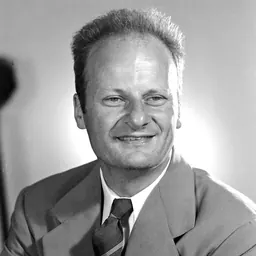




Related people
Same field, nearest in time



Contemporaries
People whose lives overlapped Harold Agnew's




Frequently asked questions
Who was Harold Agnew?
American physicist (1921–2013)
When was Harold Agnew born?
Harold Agnew was born on 28 March 1921 in Denver.
When did Harold Agnew die?
Harold Agnew died on 29 September 2013 in Solana Beach.
What was Harold Agnew's occupation?
Harold Agnew was a physicist.
What was Harold Agnew known for?
Harold Agnew was known for Norris Bradbury.
What nationality was Harold Agnew?
Harold Agnew was American.
Sources & further reading
Cite this page
APA: Biography.guide. (2026). Harold Agnew. https://biography.guide/harold-agnew/
MLA: "Harold Agnew." Biography.guide, https://biography.guide/harold-agnew/.
Chicago: "Harold Agnew." Biography.guide. https://biography.guide/harold-agnew/.
Data last updated: 2026-09-21 · Spot an error? Report a correction.
Portrait: Wikimedia Commons · author & licence
Page generated 2026-09-27 05:01 UTC