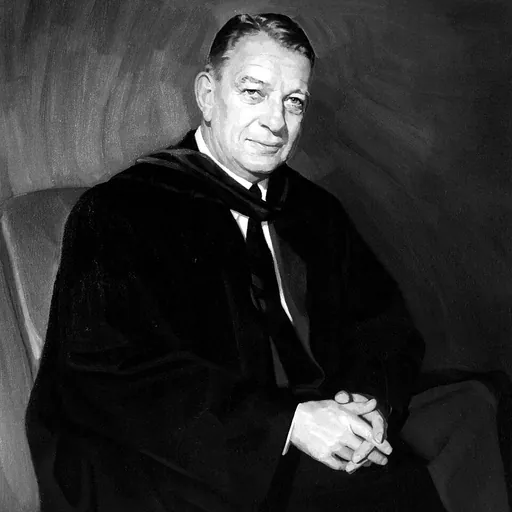
About Hardy Cross Dillard
Lived 1902 – 1982 (aged 79). Hardy Cross Dillard was an American judge and university teacher.
Hardy Cross Dillard (23 October 1902 – 12 May 1982) was an American jurist who served as a judge on the International Court of Justice from 1970 to 1979, as a judge appointed by Queen Elizabeth II to a court of arbitration concerning the Beagle Channel islands dispute, Dean of the University of Virginia School of Law (1963–1968), legal adviser to the High Commissioner for Germany, first director of the National War College (1946), and as a colonel in the U.S. Army during World War II (1941–1946). During World War II, Dillard served as deputy chief of staff for civil affairs (G5) in the China Command, Commander of the Civil Affairs Staging Area at the Presidio of Monterey where he oversaw preparation and planning for the Occupation of Japan and as commander of the European Civil Affairs Training Division of SHAEF in preparation for Operation Overlord. Previously, he initiated and served as director of the School of Military Government.
Early life and academic career Hardy Cross Dillard was the son of Avarene Lippincot Budd and James Hardy Dillard, an educator who devoted his life to the education of African Americans and former Dean of Tulane University. Hardy Cross Dillard was also cousin of civil engineer Hardy Cross – originator of the Hardy Cross method.
Dillard attended the Virginia Episcopal School and later the U.S. Military Academy where he graduated in 1924. Upon graduation, Dillard was commissioned a second lieutenant in the Infantry. However, with the First World War fading in to the background, fresh West Point graduates were encouraged to leave the service. Thus, like many of his classmates, Dillard resigned his commission two months after graduation. He subsequently entered the University of Virginia Law School and served on the editorial board of the Virginia Law Review and was also president of the law school student body. Due to his legal ability, the law faculty took the unusual step of asking him to stay after graduation to serve as an instructor. He taught primarily international law for two years before leaving to become an associate in the New York City law firm of Gregg & Church. After only a year with the law firm, he was awarded a fellowship by the Carnegie Endowment for International Peace to study international law at the University of Paris.
Upon completion of the program, Dillard accepted an appointment as assistant professor of law at the University of Virginia. He returned to New York City in the summers of 1932 and 1933 and worked as an associate at Davis, Polk, Wardwell, Gardiner and Reed. In 1934 he became the university's director of Institute of Public Affairs – an assignment in addition to his law duties. The institute brought prominent speakers to the university from government, business and academia to discuss topics of national and international interest. As the director, Dillard became acquainted with some of the leading figures of the day such as Senator Robert A. Taft, Supreme Court Justice Robert Jackson, Ambassador Paul V McNutt, Owen Lattimore, Thurman Arnold, Max Lerner, David Sarnoff, Rexford Guy Tugwell, Major George Fielding Eliot, Max Eastman, Quincy Howe, and William L. Shirer. Dillard, however, drew controversy by inviting communists such as Earl Browder to speak. A former president of the university's Alumni Association protested in a letter to the Alumni News that Dillard went "beyond freedom of speech" when he offered a rostrum from which the general secretary of the American Communist Party and the Soviet Ambassador could, "spread subversive doctrines." Dillard responded that where controversial topics are selected, "both sides should be fairly heard." A spokesman for Germany was also invited to speak.
Jurisprudence On 27 October 1970, The U.N. General Assembly and U.N. Security Council elected Dillard to a nine-year term on The International Court of Justice. During his tenure on the Court, Dillard adjudicated seven contentious and three advisory cases. According to his peers, Judge Dillard's ICJ decision's were resolute and consistent with jurisprudence depicted in writings during his years as a legal scholar. Dillard's international jurisprudence espoused an interlocking of law and diplomacy whereby law serves as an "ordering device" which helps in dispute settlement and at the same time leaves room for the parties to play a major role in the final determination. and also serve as an indicator of emerging norms. Judge Dillard also stressed that the leaders of national governments – described by him as the "wielders of power" – must understand that effective international law is,"essential to the long range national interests of all the components of the international community." Judge Dillard's multi method jurisprudence is reflected in an adage he often used and first noticed on a sign outside of a Unitarian Church in London during the Second World War – between dogmatism on one hand and skepticism on the other, there is a middle way, which is our way - open minded certainty.
International Court of Justice rulings Case Application date ICJ category Parties Challenger Defendant Outcome favored OpinionDispositionAppendment Nuclear Tests 9 May 1973 Contentious vs. Dissenting App. nullified by Court Dissenting opinion (joint) Declaration (joint) Nuclear Tests 20 December 1974 Contentious vs. Dissenting App. nullified by Court Dissenting opinion (joint) Declaration (joint) Declaration (joint) Fisheries Jurisdiction 14 April 1972 Contentious vs. Majority Judgment on merits Separate opinion Fisheries Jurisdiction 22 November 1971 Contentious vs. Majority Judgment on merits Declaration Aegean Sea Continental Shelf 10 August 1976 Contentious vs. Majority Judgment on jurisdiction None ICAO Jurisdiction (appeal) 3 August 1971 Contentious vs. Majority Judgment on jurisdiction Separate opinion Western Sahara 3 January 1975 Advisory Saharan nomadic tribes N/A N/A Saharan nomadic tribes (self determination) Majority Opinion on merits Separate opinion South Africa in Namibia (South West Africa) 5 August 1970 Advisory South Africa N/A N/A Majority Opinion on merits Separate opinion U.N. Administrative Tribunal (appeal of judgment no. 158) 28 June 1972 Advisory , Mohamed Fasla N/A N/A Mohamed Fasla Majority Opinion on merits Separate opinion
Beagle Channel Islands dispute Dillard was appointed by Queen Elizabeth II along with four other ICJ judges to a court of arbitration separate from the ICJ in order to mediate the long running territorial dispute between Chile and Argentina. The dispute involved the three tiny and resource rich islands of Lennox, Nueva & Picton. The arbitrators lived in Geneva for six months holding hearings and studying voluminous documents. A unanimous judgment was handed over to Queen Elizabeth II on 2 May 1977 awarding the three channel islands to Chile. The Argentine government, however, repudiated the court's verdict and the two countries moved to the brink of war.
Legal Adviser to High Commissioner for Germany
In April 1950 Dillard, under the auspices of the state department, was placed on active duty in the international section of the Pentagon as Legal Adviser to the High Commissioner for Occupied Germany. In this role, Dillard educated the German Judiciary throughout the American zone on the constitutional framework of U.S. foreign policy. Specifically, his talks analyzed constitutional issues involved in the NATO, Yalta & Potsdam Agreements. He also addressed the issue of public opinion in shaping (U.S.) policy.
Don’t just read it —
keep it.
Full-length biographies made to live with: read them, listen on the way to work, watch them tonight.
- E-book
- Audio
- Video
Instant download · yours to keep · every purchase keeps this site free
Important facts
People in Hardy Cross Dillard's life
Named in this biography and alive at the same time





Related people
Same field, nearest in time



Contemporaries
People whose lives overlapped Hardy Cross Dillard's



Frequently asked questions
Who was Hardy Cross Dillard?
judge on the World Court 1970–1979 (1902–1982)
When was Hardy Cross Dillard born?
Hardy Cross Dillard was born on 23 October 1902 in New Orleans.
When did Hardy Cross Dillard die?
Hardy Cross Dillard died on 12 May 1982 in Charlottesville.
What was Hardy Cross Dillard's occupation?
Hardy Cross Dillard was a judge and university teacher.
What nationality was Hardy Cross Dillard?
Hardy Cross Dillard was American.
Sources & further reading
· Wikipedia: Hardy Cross Dillard
· DBpedia: Hardy Cross Dillard
Cite this page
APA: Biography.guide. (2026). Hardy Cross Dillard. https://biography.guide/hardy-cross-dillard/
MLA: "Hardy Cross Dillard." Biography.guide, https://biography.guide/hardy-cross-dillard/.
Chicago: "Hardy Cross Dillard." Biography.guide. https://biography.guide/hardy-cross-dillard/.
Data last updated: 2026-09-22 · Spot an error? Report a correction.
Portrait: Wikimedia Commons · author & licence
Page generated 2026-09-27 05:03 UTC