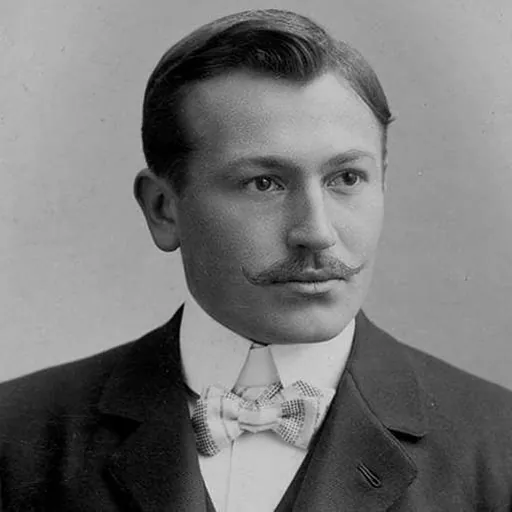
About Hans Wilsdorf
Lived 1881 – 1960 (aged 79). Hans Wilsdorf was a British and German watchmaker and entrepreneur, known for Montres Tudor SA and Rolex.
Hans Wilsdorf (22 March 1881 – 6 July 1960) was a German watchmaker, best known as the founder of Rolex and Tudor. Wilsdorf's philosophy for the companies was "only great marketing is needed to make a company successful".
Early life Hans Wilsdorf was born in Kulmbach, Bavaria, to Protestant parents, Anna and Johan Daniel Ferdinand Wilsdorf and was the second son of a family of three children.
The photo above shows Hans Wilsdorf (front row right) standing in front of his father, with his mother sitting down between his sister and brother.
His mother died when he was a boy and he became an orphan when his father died soon after when Hans was twelve years old.
Wilsdorf's fate was placed in the hands of his uncles who sold the prosperous family iron tools business which had belonged to his grandfather, and later to his father. Hans and his brother and sister, for education, were sent to boarding schools.
Wilsdorf published his autobiography in 1946 as part of a four-volume set of books named Rolex Jubilee Vade Mecum. In his autobiography Hans said "Our uncles were not indifferent to our fate; nevertheless, the way in which they made me become self-reliant very early in life made me acquire the habit of looking after my possessions and, looking back, I believe that it is to this that much of my success is due."
Wilsdorf had an interest in mathematics and languages, which inspired him to travel and work in foreign countries. Hans began his career as an apprentice with an international pearl-exporting company. The experience Hans gained during this apprenticeship was applied to his future dealings.
In 1900 Wilsdorf began his career in Swiss watchmaking when he moved to La Chaux-de-Fonds to work as an English correspondent and clerk with the watch firm of Messrs. Cuno Korten, at 49, rue Leopold Robert, where he was paid a salary of 80 Swiss Francs. Cuno Korten worked with all grades of watches, and manufactured a small number of watches from the ground up.
In 1914, Wilsdorf wrote: "My personal opinion ... is that pocket watches will almost completely disappear and that wrist watches will replace them definitively! I am not mistaken in this opinion and you will see that I am right".
In 1915 the British government implemented a 33% customs duty that prompted Rolex to move its international headquarters from London to Bienne, Switzerland. In 1919 Rolex moved its headquarters to Geneva, Switzerland, where it remains to this day.
World War II In mid 1941, the British authorities investigated Hans Wilsdorf, a British citizen but of German origin, whose brother was allegedly active in the German Ministry of Propaganda. They contacted the Swiss authorities (AF, E2001E#196878#9624, confidential letter to the Federal Public Prosecutor's Office, 25 June 1941). An investigation by the security police of the canton of Geneva, carried out at the request of Werner Balsiger, head of the police department of the Federal Public Prosecutor's Office, concluded:
The information gathered shows that Wilsdorf is a fervent admirer of the Hitler regime. He does not hide his satisfaction when events favourable to Germany occur. However, we have not seen or heard of any pro-Hitler propaganda or suspicious activity on his part. The above-mentioned person is not unfavourably known to our judicial services and has not been convicted in our town. From a political point of view, Wilsdorf is known to our services as a 'Nazi'. A check of his correspondence was carried out in 1940, but nothing suspicious was found at the time.
By the start of World War II, Royal Air Force pilots were buying Rolex watches to replace their inferior standard-issue watches. When captured and sent to POW camps, their watches were confiscated. When Wilsdorf heard of this, he offered to replace all watches that had been confiscated and not require payment until the end of the war, if the officers would write to Rolex and explain the circumstances of their loss and where they were being held. Wilsdorf personally oversaw this effort.
In 2022, Christie's sold a Rolex Oyster Chronograph that had belonged to Gerald Imeson for $189,000. He had been a POW in Stalag Luft III and had taken Rolex up on the offer to order a replacement for the watch confiscated by the Germans. Christie's stated it believed Imeson used the watch during the 24 March 1944 escape that inspired the movie The Great Escape.
1960: Death and legacy
Wilsdorf died in Geneva, Switzerland, on July 6, 1960. He was buried in Kings Cemetery in Geneva beside his first and second wives. The Hans Wilsdorf Foundation, established in 1945, still owns and controls Rolex.
Don’t just read it —
keep it.
Full-length biographies made to live with: read them, listen on the way to work, watch them tonight.
- E-book
- Audio
- Video
Instant download · yours to keep · every purchase keeps this site free
Important facts
Related people
Same field, nearest in time




Contemporaries
People whose lives overlapped Hans Wilsdorf's





Frequently asked questions
Who was Hans Wilsdorf?
German watchmaker (1881-1960)
When was Hans Wilsdorf born?
Hans Wilsdorf was born on 20 January 1881 in Kulmbach.
When did Hans Wilsdorf die?
Hans Wilsdorf died on 6 July 1960 in Geneva.
What was Hans Wilsdorf's occupation?
Hans Wilsdorf was a watchmaker and entrepreneur.
What was Hans Wilsdorf known for?
Hans Wilsdorf was known for Montres Tudor SA and Rolex.
What nationality was Hans Wilsdorf?
Hans Wilsdorf was British and German.
Sources & further reading
Cite this page
APA: Biography.guide. (2026). Hans Wilsdorf. https://biography.guide/hans-wilsdorf/
MLA: "Hans Wilsdorf." Biography.guide, https://biography.guide/hans-wilsdorf/.
Chicago: "Hans Wilsdorf." Biography.guide. https://biography.guide/hans-wilsdorf/.
Data last updated: 2026-09-22 · Spot an error? Report a correction.
Portrait: Wikimedia Commons · author & licence
Page generated 2026-09-27 05:03 UTC