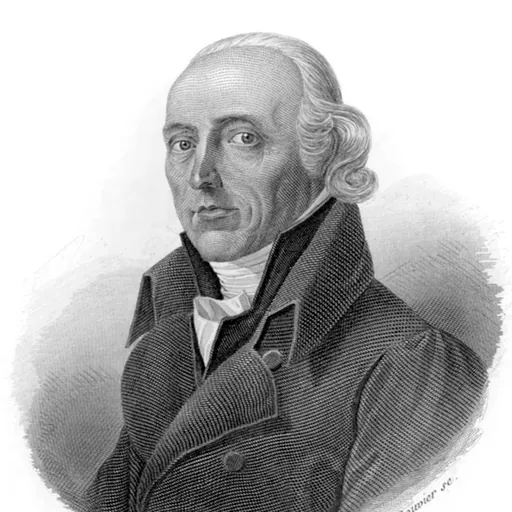
Hans Conrad Escher von der Linth
Swiss artist, scientist and politician
About Hans Conrad Escher von der Linth
Lived 1767 – 1823 (aged 55). Hans Conrad Escher von der Linth was a Swiss politician, scientist, engineer, polymath, civil engineer and entrepreneur.
Hans Conrad Escher von der Linth (24 August 1767 – 9 March 1823) was a Swiss politician, engineer, geologist and artist. He held senior political office during the Helvetic Republic and later directed the correction of the Linth River, the first public undertaking on a nationwide scale in Switzerland. The project reduced repeated flooding in the Linth plain and restored waterlogged land to productive use. Alongside his political and engineering work, Escher conducted extensive geological research in the Swiss Alps and produced more than 1,000 drawings and watercolours. He is considered a pioneer of Alpine panorama art.
Biography Hans Conrad Escher von der Linth was born on 24 August 1767 in Zurich. His parents were Hans Kaspar Escher, a textile manufacturer and member of the Zurich government, and Anna Dorothea Landolt. While in Geneva, Escher developed a strong interest in the Alps, influenced in particular by the writings of Horace-Bénédict de Saussure. In 1785, he made his first Alpine excursion with his tutor, the biologist Jean-Pierre-Étienne Vaucher. There, he studied natural sciences, with Georg Christoph Lichtenberg among his teachers. After completing his travels and education, he worked in his father’s business while continuing to develop his interests in science, geology and philosophy.
In Zurich, Escher gave public lectures on politics and economics and later served on the cantonal education council. and later lectured there on statistics and economics.
Escher's travel writings, collected as Fragmente über die Naturgeschichte Helvetiens, grew to more than 1,500 pages.
Linth project From 1807 to 1822, Escher chaired the Linth Commission and oversaw the project to regulate the Linth River. The river’s unstable course hindered shipping to Zurich and disrupted trade across the Alpine passes. Extensive deforestation in the surrounding mountains increased runoff and sediment accumulation, which impeded the river’s flow and contributed to repeated flooding of the Linth plain.
Escher first saw the Linth region in 1786 while travelling as a cartographer and draughtsman. In 1804, he submitted a proposal for the project, known as Sumpfpack, to the Federal Diet.
Johann Gottfried Tulla, an engineer from Baden, was brought in to develop the technical plans,
Escher was involved in the project’s financial planning from 1803 and later directed its administration and implementation. To finance the project, he sold shares tied to the future sale of reclaimed land. Construction was divided into 30-metre sections that were auctioned to subcontractors, and Escher sometimes advanced his own money when wages were delayed. The Linth correction later served as a model for other hydraulic-engineering projects in Switzerland. was inaugurated in 1811, Among his works were 118 panorama drawings, including eleven that formed complete 360-degree views. The works combined close scientific observation with a distinctive artistic approach.
Escher produced hand-drawn maps, 58 of which are held by the Zentralbibliothek Zurich.
Legacy
Shortly after Escher’s death, the federal Diet decided that he should be publicly commemorated. After several proposals for a monument were considered, a memorial plaque was approved near Ziegelbrücke in 1832, and the Mollis Canal was officially renamed the Escher Canal.
Escher’s drawings are held by ETH Zurich and the Zentralbibliothek Zurich. He left his geognostic drawings and terrain studies to his son Arnold, who later gave the collection to ETH Zurich. Around 700 of these works are now held by the Graphische Sammlung ETH Zurich. They were rediscovered there by art historian Gustav Solar in 1971. ETH Library has made books from Escher’s private library available through a dedicated collection on the e-rara platform.
Gallery
Don’t just read it —
keep it.
Full-length biographies made to live with: read them, listen on the way to work, watch them tonight.
- E-book
- Audio
- Video
Instant download · yours to keep · every purchase keeps this site free
Important facts
People in Hans Conrad Escher von der Linth's life
Named in this biography and alive at the same time

Related people
Same field, nearest in time



Contemporaries
People whose lives overlapped Hans Conrad Escher von der Linth's





Frequently asked questions
Who was Hans Conrad Escher von der Linth?
Swiss artist, scientist and politician (1767-1823)
When was Hans Conrad Escher von der Linth born?
Hans Conrad Escher von der Linth was born on 24 August 1767 in Zurich.
When did Hans Conrad Escher von der Linth die?
Hans Conrad Escher von der Linth died on 9 March 1823 in Zurich.
What was Hans Conrad Escher von der Linth's occupation?
Hans Conrad Escher von der Linth was a politician, scientist, engineer, polymath, civil engineer and entrepreneur.
What nationality was Hans Conrad Escher von der Linth?
Hans Conrad Escher von der Linth was Swiss.
Sources & further reading
· Wikipedia: Hans Conrad Escher von der Linth
· DBpedia: Hans Conrad Escher von der Linth
Cite this page
APA: Biography.guide. (2026). Hans Conrad Escher von der Linth. https://biography.guide/hans-conrad-escher-von-der-linth/
MLA: "Hans Conrad Escher von der Linth." Biography.guide, https://biography.guide/hans-conrad-escher-von-der-linth/.
Chicago: "Hans Conrad Escher von der Linth." Biography.guide. https://biography.guide/hans-conrad-escher-von-der-linth/.
Data last updated: 2026-09-21 · Spot an error? Report a correction.
Portrait: Wikimedia Commons · author & licence
Page generated 2026-09-27 05:00 UTC