About Hannah Duston
Lived 1657 – 1736 (aged 78). Hannah Duston was a writer.
Hannah Duston (also spelled Dustin, Dustan, Durstan, Dustun, Dunstun, or Durstun) (born Hannah Emerson, December 23, 1657 – March 6, 1736, 1737 or 1738 ) was a colonial Massachusetts Puritan woman who was taken captive by Abenaki people from Quebec during King William's War, with her first newborn daughter, during the 1697 raid on Haverhill, in which 27 colonists, 15 of them children, were killed. In her account given to Cotton Mather, it is stated that the Abenakis killed her newborn baby and several other captives soon after the raid. While detained on an island in the Merrimack River in present-day Boscawen, New Hampshire, she killed and scalped ten of the Abenaki family members holding them hostage, with the assistance of two other captives.
Duston's captivity narrative became famous more than 100 years after she died. During the 19th century, she was referred to as an American folk hero and the "mother of the American tradition of scalp-hunting." Some scholars assert Duston's story became a legend in the 19th century only because her story was used to justify white American violence against Native Americans as innocent, defensive, and virtuous. Duston is believed to be the first American woman honored with a statue.
Biography
Early life Hannah Emerson was born December 23, 1657, in Haverhill, Massachusetts, to Michael Emerson and Hannah Webster Emerson; she was the oldest of 15 children. At age 20, she married Thomas Duston Jr., a farmer and brick-maker. The Emerson family would later become the subject of attention when Elizabeth Emerson, Hannah's younger sister, was hanged for infanticide on June 8, 1693. One of Hannah's cousins, Martha Toothaker Emerson, and her father, Roger Toothaker, were accused of practicing witchcraft and tried at the Salem witch trials (1692–93). the town was raided by a group of about 30 Abenaki from Quebec. In the attack, 27 colonists were killed (half of them children), and 13 were taken captive, to be either adopted or held as hostages for the French. Hannah's husband Thomas, who was building a new brick home about half a mile away, fled with eight of their nine children.
"About 19 or 20 Indians now led these away, with about half a score of other English captives, but ere they had gone many steps, they dash'd out the brains of the infant against a tree, and several of the other captives, as they began to tire in the sad journey, were soon sent unto their long home."
Rebellion and escape The captives were taken north to an island in the Merrimack River at the mouth of the Contoocook River, where, during the night of April 29 or 30, while the Indians were sleeping, Hannah led Mary and Samuel in a revolt:
"...furnishing themselves with hatchets for the purpose, they struck home such blows upon the heads of their sleeping oppressors, that ere they could any of them struggle...they fell down dead." #tag:ref|In 1739, Hannah's neighbor Hannah Heath Bradley, who was also captured by the Indians during the March 15th raid, but who was taken to another Abenaki village, testified that "the next night...there came to us one squaw who said that Hannah Dustan and the aforesaid Mary Neff assisted in killing the Indians of her wigwam, except herself and a boy, herself escaping very narrowly. Shewing to myself and others seven wounds as she said with a hatchet on her head which wounds were given her when the rest were killed." They went downriver, traveling only during the night, and after several days reached Haverhill.
Reward A few days later, Thomas Duston brought Hannah, Samuel and Mary to Boston, along with the scalps, the hatchet and a flintlock musket they had taken from the Indians. so her husband petitioned the Legislature on behalf of Hannah Duston, requesting that the bounties for the scalps be paid, even though the law providing for them had been repealed:
"The Humble Petition of Thomas Durstan of Haverhill Sheweth That the wife of ye petitioner (with one Mary Neff) hath in her Late captivity among the Barbarous Indians, been disposed & assisted by heaven to do an extraordinary action, in the just slaughter of so many of the Barbarians, as would by the law of the Province which [only] a few months ago, have entitled the actors unto considerable recompense from the Publick. That tho the [want] of that good Law [warrants] no claims to any such consideration from the publick, yet your petitioner humbly [asserts] that the merit of the action still remains the same; & it seems a matter of universal desire thro the whole Province that it should not pass unrecompensed... Your Petitioner, Thomas Durstun"
On June 16, 1697, the Massachusetts General Court voted to give them a reward for killing their captors; Hannah Duston received 25 pounds, and Neff and Lennardson
Later life Following her return, Hannah gave birth to a second daughter, Lydia, on October 4, 1698. Her neighbor Hannah Heath Bradley, who had also been abducted in the 1697 raid (and two of her children killed), was held for nearly two years before she was ransomed, returning to Haverhill in 1699. During Queen Anne's War Indians raided Haverhill again in 1704 and 1707. In yet another raid on Haverhill (1708), Algonquin and Abenaki Indians led by the French officer Jean-Baptiste Hertel de Rouville killed sixteen, including the town's minister. She probably died between 1736 and 1738, Mary Neff died in Haverhill on October 17, 1722. In 1739 Mary Neff's son Joseph was granted two hundred acres of land at Penacook by the General Court of New Hampshire "in consideration of his mother's services in assisting Hannah Duston in killing divers Indians."
Written accounts
Contemporary accounts Title page of Cotton Mather's Magnalia Christi Americana (1702) in which he published Hannah Duston's narrative.The event became well known, due in part to Cotton Mather's account in Magnalia Christi Americana: The Ecclesiastical History of New England (1702). Mather interviewed Hannah after her return to Haverhill, and on May 6, 1697, he preached a sermon celebrating her return from captivity, with Hannah herself in the audience. Decennium Luctuosum (1699), and in Magnalia Christi Americana (1702). Mather titled the story "A Notable Exploit: Dux Faemina Facti," (Latin: "The leader of this deed/exploit was a woman") and compared Hannah Duston's story to the murder of Sisera by Jael in the Old Testament, and to the captivity narratives of Hannah Swarton (captured in 1690) and Mary Rowlandson (captured in 1675). Captivity narratives featuring women were often used as metaphors for the identity struggle evolving in New England at that time, wherein submissive, humble and obedient Puritan women fought to regain their freedom from the oppression of their Indian captors, in the same way that during the American revolution, the long-suffering colonists resisted the oppressive governance by the British crown.
Hannah's story also appears in the diary of Samuel Sewall, who had heard the story directly from her on May 12, 1697, less than two weeks after her escape. Sewall's account adds the detail that the night before their escape, one of their male captors showed Samuel Lennardson how to take a scalp:
"April 29...is signalized by the achievement of Hannah Dustun, Mary Neff, and Samuel Lennerson, who killed two men, their masters, and two women and six others, and have brought in ten scalps...May 12:...Hannah Dustan came to see us. . . She said her master, whom she kill'd did formerly live with Mr. Roulandson at Lancaster...The single man shewed the night before, to Saml Lenarson, how he used to knock Englishmen on the head and take off their Scalps; little thinking that the Captives would make some of their first experiment upon himself. Sam. Lenarson kill'd him."
Hannah's story is recorded in the diary of John Marshall (1634–1732), a bricklayer in Quincy, Massachusetts, who wrote the following entry for April 29, 1697: "At the latter end of this month two women and a young lad that had been taken captive from Haverhill in March before, watching their opportunity when the Indians were asleep, killed ten of them, scalped them all and came home to Boston. [They] brought a gun
Another reference to Hannah Duston is found in the journal of John Pike (1634–1714, son of New Jersey judge John Pike), in the following entry:
"March 15: The Indians fell upon some part of Haverhill, about 7 in the morning, killed and carried away 39 or 40 persons -- two of these Captive women, viz. Dunstan & Neff (with another young man), slew ten of the Indians & returned home wth ye scalps."
Although Hannah herself never provided a written account of her captivity and escape (there is no evidence that she was literate), the Haverhill Historical Society possesses a letter dated May 17, 1724, addressed to the elders of the church, declaring her desire to be admitted as a full member of the church so that she might take communion with the other congregants, and offering a confession.#tag:ref|H. D. Kilgore says the letter was found "behind an old gallery pew" in the Center Congregational Church of Haverhill in March of 1929; and others state that it was given to the Haverhill Historical Society in 1909.
Later renditions After Cotton Mather's death, Hannah Duston's story was largely forgotten until it was included in “Travels in New England and New York” by historian Timothy Dwight IV, published in 1821. After this, Duston became more famous in the 19th century as her story was retold by authors like Nathaniel Hawthorne, John Greenleaf Whittier, Thoreau's version adheres to information provided in primary sources, whereas Whittier describes her "thirst of revenge...an insatiate longing for blood. An instantaneous change had been wrought in her very nature; the angel had become a demon, —and she followed her captors, with a stern determination to embrace the earliest opportunity for a bloody retribution." in which Stearns, for reasons that remain unclear, depicted Samuel Lennardson as a woman. The Indian children Duston killed are omitted. A second painting, showing Hannah's husband fleeing with her children, is now lost. Violent revenge against American Indians was another popular subject of literature and theater, as in Robert Montgomery Bird's 1837 novel Nick of the Woods.
From the 1820s until the 1870s, Duston's story was included in nearly all books about US history, as well as many biographies, and magazine articles.
Memorials There are eight memorials that were or are dedicated to Hannah Duston and the other captives that were with her.
Aborted first memorial (erected 1861–1865) The original monument to Hannah Duston, which was later removed and converted into a monument dedicated to the Civil War soldiers of Barre, Massachusetts.The campaign to build the first monument in Haverhill, Massachusetts, began in 1852, at a time when building public monuments was still a somewhat rare occurrence. The monument chosen was a simple marble column that would cost about $1,350, and by 1861 the necessary funds had been raised. On its base was a shield, surrounded by a musket, bow, arrows, tomahawk, and scalping knife. Engravings on its sides told the story of the "barbarous" murder of Duston's baby and her "remarkable exploit;" the column was topped by an eagle.
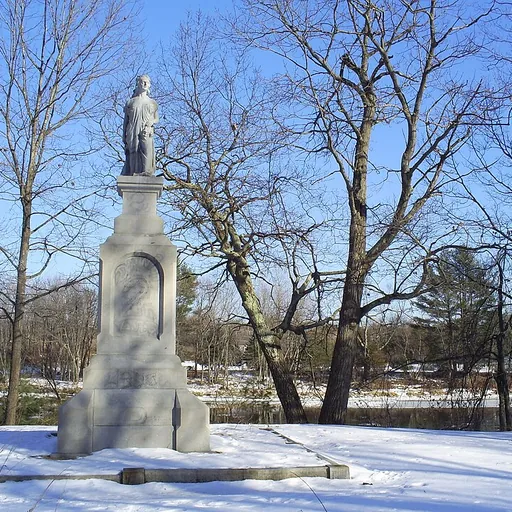
First successful memorial (erected 1874) Statue on the island in Boscawen, New Hampshire, where Hannah killed her captors and escaped down the river.Now known as the Hannah Duston Memorial State Historic Site, the first Duston memorial actually executed was sculpted by William Andrews (1836–1927), a marble worker from Lowell, Massachusetts. An attorney named Robert Boody Caverly, author of The Heroism of Hannah Duston, Together with the Indian Wars of New England (1875),
A crowd of almost five thousand people overwhelmed the island on the day of its dedication, with speeches presented all day long, culminating with a dedication by New Hampshire Governor James A. Weston.
Local members of the Cowasuck Band of the Pennacook Abenaki People have proposed adding another statue to the island park to honor fallen Abenaki, in order to "tell a more complete story about New England's indigenous peoples." They also want to erect plaques with historical information on the Merrimack and Contoocook rivers and the old railroad track that runs across to the island.
Second memorial (erected 1879)
In 1879, a bronze statue of Hannah Duston grasping a hatchet was created by Calvin H. Weeks (1834–1907) in Haverhill town square (now Grand Army Park), where it still stands on the site of the Haverhill Center Congregational Church, of which Hannah Duston became a member in 1724. It depicts Hannah wearing only one shoe, per Haverhill tradition. On October 31, 1934, the statue's hatchet was stolen, but it was later recovered and welded back into place. On July 10, 2020, the words "Haverhill's own monument to genocide" were found written on the statue's base in pink chalk. The statue was vandalized again on August 28, 2020, with splashes of red paint. On Thanksgiving Day, 2021, the statue was again vandalized with either red spray-paint or with splashes of red paint. To prevent further vandalism, city workers draped the statue in a blue plastic tarp, pending cleaning by the highway department.
Some local residents have proposed that the statue should be removed because it promotes harmful stereotypes of warlike Indians. A city council subcommittee was assigned to consider the possibility of moving the statue to another location after a period of public discussion. and to provide space for a memorial honoring Indigenous peoples. Haverhill mayor James Fiorentini subsequently established the Native American Commemorative Task Force to examine the history and culture of the Native peoples of the Haverhill region, and to recommend ways in which the community might honor them. One proposal calls for renaming the New Hampshire site "Unity Park N'dakinna," which means "our land" in Abenaki.
Third memorial (1902) In 1902 a third memorial was placed by the Daughters of the American Revolution on a small plot of land at Allds and Fifield streets in Nashua, New Hampshire, at the site of John Lovewell's home (part of Dunstable, New Hampshire, in Lovewell's time), where Hannah, Mary, and Samuel spent the night on their way home from captivity. The stone marker's inscription reads: "On this point of land dwelt John Lovewell, one of the earliest settlers of Dunstable at whose house Hannah Duston spent the night after her escape from the Indians at Penacook Island March 30, 1697. Erected by Matthew Thornton Chapter, DAR 1902"
Fourth memorial (1902) In December 1902 a millstone was placed on the shores of the Merrimack River where Hannah, Mary, and Samuel beached their canoe upon their return to Haverhill.
Fifth memorial (inscribed in 1908) The fifth memorial was created in 1908, when an inscription was placed on a boulder in memorial to both Hannah and Martha. The 30-ton glacial erratic rock was pulled out of Bradley Brook where it emptied into the Merrimack, near where Hannah landed her canoe after her escape, and placed on the site of Hannah's son Jonathan's home in Haverhill, It was reported stolen in 1969, just before the tower was demolished, and has not been recovered. using an alternate spelling of her last name. It is on display with the knife she allegedly used to scalp her captors, along with her letter of confession petitioning to join the Center Congregational Church of Haverhill. The Dustin House or Dustin Garrison House, built about in 1700, is a historic First Period house at 665 Hilldale Avenue in Haverhill, Massachusetts.
Commemorative structures Other commemorations, all in the city of Haverhill, include: Dustin House, which Hannah's husband Thomas Duston was building at the time of the 1697 raid, was completed in the 1700 and is listed on the U.S. National Register of Historic Places. The Hannah Duston Healthcare Center is located on Monument Street in Haverhill.
Don’t just read it —
keep it.
Full-length biographies made to live with: read them, listen on the way to work, watch them tonight.
- E-book
- Audio
- Video
Instant download · yours to keep · every purchase keeps this site free
Important facts
People in Hannah Duston's life
Named in this biography and alive at the same time



Related people
Same field, nearest in time



Contemporaries
People whose lives overlapped Hannah Duston's



Frequently asked questions
Who was Hannah Duston?
colonial Massachusetts Puritan
When was Hannah Duston born?
Hannah Duston was born on 23 December 1657 in Haverhill.
When did Hannah Duston die?
Hannah Duston died on 6 March 1736 in Haverhill, Massachusetts.
What was Hannah Duston's occupation?
Hannah Duston was a writer.
What nationality was Hannah Duston?
Hannah Duston's recorded nationality: Province of Massachusetts Bay.
Sources & further reading
Cite this page
APA: Biography.guide. (2026). Hannah Duston. https://biography.guide/hannah-duston/
MLA: "Hannah Duston." Biography.guide, https://biography.guide/hannah-duston/.
Chicago: "Hannah Duston." Biography.guide. https://biography.guide/hannah-duston/.
Data last updated: 2026-09-22 · Spot an error? Report a correction.
Portrait: Wikimedia Commons · author & licence
Page generated 2026-09-27 05:03 UTC