
Hanjirō Asanuma
Father of Japanese politician Inejirō Asanuma
About Hanjirō Asanuma
Lived 1861 – 1951 (aged 89–90).
Hanjirō Asanuma (, Asanuma Hanjirō; 1861 – January 1951) was a Japanese local official and farmer. He served as the village headman (sonchō or namushi) of Kamitsuki on Miyake Island (now part of Miyake, Tokyo), and later operated a dairy farm in Sunamachi (now part of Kōtō, Tokyo). He is known primarily as the father of Inejirō Asanuma, the prominent Japan Socialist Party politician assassinated in 1960.
Life Hanjirō served as village headman of Kamitsuki on Miyake Island and was responsible for conducting military conscription examinations.
According to his son Inejirō's memoir, when Inejirō announced his intention to attend Waseda University and become a politician after graduating from Tokyo Prefectural Third Middle School in 1916, Hanjirō severely reprimanded him:In Taishō 5 , after graduating from Prefectural Third Middle School, I told my father, 'I want to enter Waseda University and become a politician.' He scolded me severely. My father said, 'Politicians are the type who squander the family fortune and end up ruining the household—become a businessman, or go to Keio's medical school and become a doctor.' Later, when Inejirō's leftist activities led to surveillance by military police (including one tailing him from Tokyo during a conscription examination), Hanjirō became so distressed that he considered resigning as village headman, but Inejirō persuaded him not to:The following year, during the conscription examination, I returned to Miyake Island again, but this time a military policeman had deliberately come all the way from Tokyo to tail me. Ironically, it was my father, who was serving as village headman, who was in charge of executing the conscription examination. What with the previous exile to the island and now this surveillance, my father must have been quite troubled. He even talked about resigning as village headman, but I told him there was no need for parents to bear responsibility for their child's ideas, and I persuaded him to stay.
In January 1951, Hanjirō's death was announced to his son during a Japan Socialist Party congress at Waseda University Lecture Hall, while Inejirō was serving as secretary-general. Inejirō initially withheld public announcement of the news to avoid bad omens for the party. The following day he chaired the party funeral of fellow socialist Minekubo Manryō before traveling to Miyake Island:In January of the 25th year [Shōwa 25 = 1950], at the party congress in Waseda University Lecture Hall, my father's death was announced to me. This was the congress where I was re-appointed as secretary-general, and announcing my father's death at that congress—while I don't necessarily believe in omens—seemed bad for the party, so I kept it secret. The next day there was the party funeral of the late Minekubo Manryō, and since I was serving as funeral committee chairman, I finished the funeral and only then headed to Miyake Island. There was no regular ferry service at the time, so I returned to Miyake Island on a small boat of about 100 tons, but in my haste I left my morning coat behind in a taxi along the way. Was this divine punishment for defying my father to become a politician, or for failing even to be at his deathbed? Such failures happened too.
Family
Legal wife: Hisa Inoue (from Tokyo; sister of Okio Inoue according to some records) Eldest daughter: Toshi Asanuma (married to Masahiko Nami of Fukuoka) Concubine: Yoshi Asaoka Illegitimate son: Inejirō Asanuma (member of the House of Representatives, Japan Socialist Party leader) Illegitimate daughter: Harue Asanuma (married to Gentarō Fukuda of Tochigi; eldest son of Fukuda Genhichi)
(Source: Asanuma family genealogy based on Jinji Kōshinroku and related biographical dictionaries. One biographical summary states that Hanjirō and his legal wife had no children at the time of Inejirō's birth and recognition (implying no legitimate heirs existed prior to acknowledging the illegitimate son), while the more detailed genealogy confirms at least one daughter from the marriage afterward. Birth years for Toshi and Harue are not recorded in available sources.)
Don’t just read it —
keep it.
Full-length biographies made to live with: read them, listen on the way to work, watch them tonight.
- E-book
- Audio
- Video
Instant download · yours to keep · every purchase keeps this site free
Important facts
People in Hanjirō Asanuma's life
Named in this biography and alive at the same time
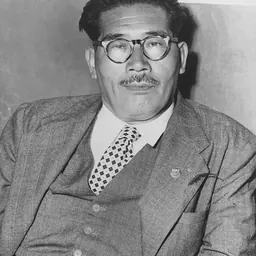
Contemporaries
People whose lives overlapped Hanjirō Asanuma's



Frequently asked questions
Who was Hanjirō Asanuma?
father of Japanese politician Inejirō Asanuma
When was Hanjirō Asanuma born?
Hanjirō Asanuma was born in 1861.
When did Hanjirō Asanuma die?
Hanjirō Asanuma died in 1951.
Sources & further reading
Cite this page
APA: Biography.guide. (2026). Hanjirō Asanuma. https://biography.guide/hanjiro-asanuma/
MLA: "Hanjirō Asanuma." Biography.guide, https://biography.guide/hanjiro-asanuma/.
Chicago: "Hanjirō Asanuma." Biography.guide. https://biography.guide/hanjiro-asanuma/.
Data last updated: 2026-09-20 · Spot an error? Report a correction.
Page generated 2026-09-27 05:12 UTC