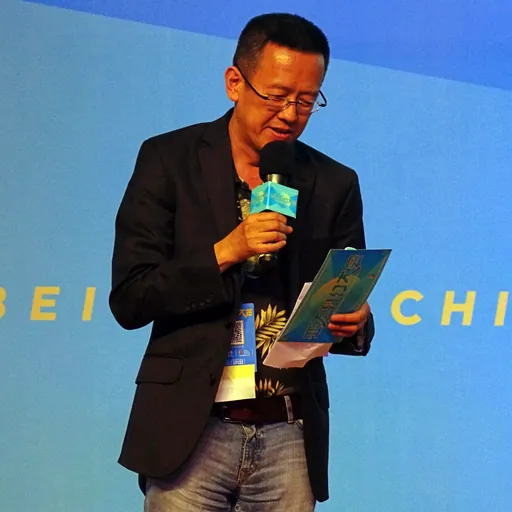
Han Song
Chinese science fiction writer and journalist
About Han Song
Born 1965. Han Song is a Chinese science fiction writer, reporter, journalist, writer, editing staff and opinion journalist.
Han Song (; born 1965) is a Chinese science fiction writer and a journalist at the Xinhua News Agency.
Life Han was born in 1965 in Chongqing, a year before the Cultural Revolution was launched. During this period, Mao Zedong aimed to "purge" anti-revolutionary elements from Chinese society, including intellectuals and scientists. Nevertheless, Han's father, a journalist, brought home science magazines and books that fascinated his young son.
Han went on to study English and journalism at university. His first novel, Cosmic Tombstones (宇宙墓碑) was published in 1981 in the Taiwanese magazine Huanxiang. It waited ten years for publication in the People's Republic of China because publishers found its tone too dark. It was finally published in 1991, the year Han began working for state news agency Xinhua.
Han has received the Chinese Galaxy Award for fiction six times. The LA Times described him as China's premier science fiction writer. Following a diagnosis of dementia, Han began using Chinese AI chatbot DeepSeek to help him write stories. He told The New York Times in 2025 that he was initially dispirited that the bot sometimes produced better stories than him, but now views it merely as a tool. According to the China Daily, Han describes himself as a "staunch nationalist at heart", and his work is critical of China's desire to Westernize as fast as possible. He believes that "fast-track development does not agree with core Asian values", and that adoption of the "alien entities" of science, technology and modernization by the Chinese will turn them into monsters.
An overview of his work in Los Angeles Times notes that Han's "prolific body of work deals largely with the clash between the U.S. and the Middle Kingdom," and that "if the author is critical of a cocky America, he is also unafraid to ruthlessly satirize an overreaching China." The New York Times describes Han's work as often "bleak, graphic, and grotesque," citing his use of "ordinary settings, like subway trains, as backdrops for wild scenes of cannibalism or orgies."
A significant amount of Han's work is banned in his home country. In 2012, it was reported that most of his works are banned in mainland China. Subway (2010), a novel of Chinese spacefarers returning to a post-apocalyptic Beijing subway. first published in Chinese on November 17, 2014 in Southern People Weekly, first published in English in the anthology Broken Stars. "Salinger and the Koreans" (塞林格与朝鲜人), first published in Chinese and English in 2016 in Tales of Our Time (故事新编), later published in the anthology Broken Stars. "Reunion", published in the anthology The Book of Beijing.
Don’t just read it —
keep it.
Full-length biographies made to live with: read them, listen on the way to work, watch them tonight.
- E-book
- Audio
- Video
Instant download · yours to keep · every purchase keeps this site free
Important facts
People in Han Song's life
Named in this biography and alive at the same time
Related people
Same field, nearest in time






Contemporaries
People whose lives overlapped Han Song's



Frequently asked questions
Who is Han Song?
Chinese science fiction writer and journalist
When was Han Song born?
Han Song was born in 1965 in Chongqing.
What is Han Song's occupation?
Han Song is a science fiction writer, reporter, journalist, writer, editing staff and opinion journalist.
What nationality is Han Song?
Han Song is Chinese.
Sources & further reading
Cite this page
APA: Biography.guide. (2026). Han Song. https://biography.guide/han-song-science-fiction-writer/
MLA: "Han Song." Biography.guide, https://biography.guide/han-song-science-fiction-writer/.
Chicago: "Han Song." Biography.guide. https://biography.guide/han-song-science-fiction-writer/.
Data last updated: 2026-09-23 · Spot an error? Report a correction.
Portrait: Wikimedia Commons · author & licence
Page generated 2026-09-27 05:08 UTC