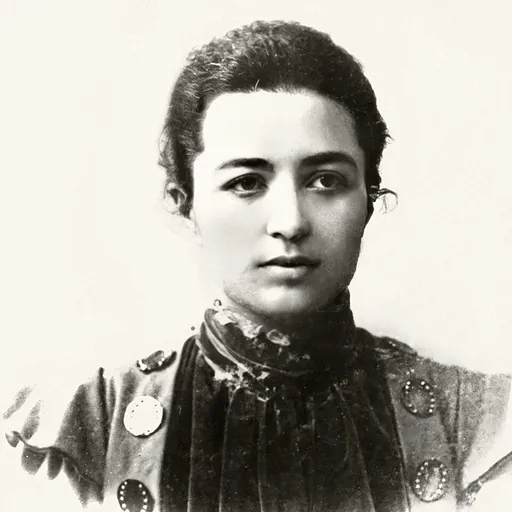
Hamida Javanshir
Azerbaijani philanthropist and women's rights activist
About Hamida Javanshir
Lived 1873 – 1955 (aged 82). Hamida Javanshir was a Russian benefactor, philanthropist, opinion journalist, memoirist, women's rights activist and writer.
Hamida Ahmad bey qizi Javanshir (; 19 January 1873 – 6 February 1955) was an Azerbaijani activist and one of the first enlightened women of Azerbaijan, wife of Jalil Mammadguluzadeh, daughter of historian Ahmad Bey Javanshir, philanthropist, translator, and member of Azerbaijan Writers' Union.
Early life
Born on her family's ancestral estate in the village of Kahrizli, Hamida Javanshir was the eldest child of Ahmad bey Javanshir (1828–1903), an Azeri historian, translator and officer of the Russian Imperial army, and his wife Mulkijahan. She was the great-great-grandniece of Ibrahim Khalil Khan, the last ruling khan of the Karabakh Khanate. Hamida and her younger brother were educated at home; when she was nine, a family of Russian tutors came to live with them to guide their education. By age 14, she was familiar with European and Islamic literature, and spoke Russian and French fluently.
In 1889, Hamida Javanshir married a Barda-native, Lieutenant Colonel Ibrahim bey Davatdarov. They settled in Brest-Litovsk (present-day Brest, Belarus). Soon their two children, Mina and Muzaffar, were born. Javanshir took ballroom dance lessons and studied German and Polish. In 1900, the family moved to Kars, where Davatdarov was appointed commander of a military fortress. A year later, he died and Hamida's aims to study medicine in Moscow seemed unrealizable. and lived in Tiflis until 1920. They had two sons – Midhat, born in 1908, and Anvar, born in 1911. She worked with Mammadguluzadeh to publish Molla Nasraddin, a satirical magazine.
During the Karabakh famine of 1907, Javanshir distributed flour and millet to starving villagers and also acted as a mediator between local Armenians and Azeris after two years of reciprocal massacres.
In 1921, after having lived in Tabriz for a year, the family moved to Baku, where she wrote memoirs and translated her husband's works. She published a memoir in the 1930s, Awake: A Moslem Woman’s Rare Memoir of Her Life and Partnership with the Editor of Molla Nasreddin, the Most Influential Satirical Journal of the Caucasus and Iran, 1907–1931, published posthumously in 1967, and translated into English by Hasan Javadi and Willem Floor. She also translated Russian poetry. She outlived two of her children: Mina (died 1923) and Midhat (died 1932). She died in Baku in 1955. There is a museum of her life and works in Kahrizli.
Don’t just read it —
keep it.
Full-length biographies made to live with: read them, listen on the way to work, watch them tonight.
- E-book
- Audio
- Video
Instant download · yours to keep · every purchase keeps this site free
Important facts
Family & relationships
People in Hamida Javanshir's life
Named in this biography and alive at the same time


Related people
Same field, nearest in time





Contemporaries
People whose lives overlapped Hamida Javanshir's

Frequently asked questions
Who was Hamida Javanshir?
Azerbaijani philanthropist and women's rights activist (1873-1955)
When was Hamida Javanshir born?
Hamida Javanshir was born on 19 January 1873 in Böyük Kəhrizli.
When did Hamida Javanshir die?
Hamida Javanshir died on 6 February 1955 in Baku.
What was Hamida Javanshir's occupation?
Hamida Javanshir was a benefactor, philanthropist, opinion journalist, memoirist, women's rights activist and writer.
What nationality was Hamida Javanshir?
Hamida Javanshir was Russian.
Sources & further reading
Cite this page
APA: Biography.guide. (2026). Hamida Javanshir. https://biography.guide/hamida-javanshir/
MLA: "Hamida Javanshir." Biography.guide, https://biography.guide/hamida-javanshir/.
Chicago: "Hamida Javanshir." Biography.guide. https://biography.guide/hamida-javanshir/.
Data last updated: 2026-09-22 · Spot an error? Report a correction.
Portrait: Wikimedia Commons · author & licence
Page generated 2026-09-27 05:02 UTC