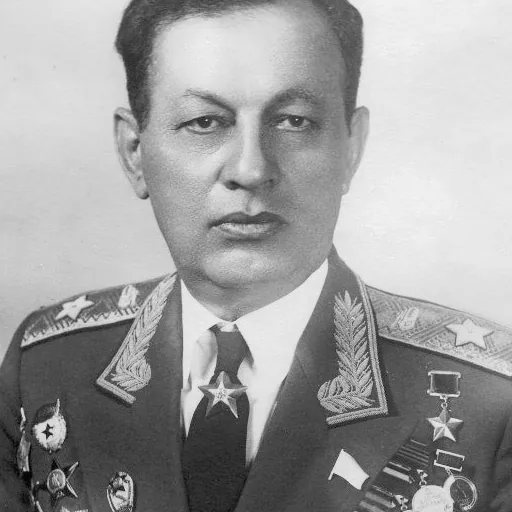
Hamazasp Babadzhanian
Soviet Chief marshal of armored forces
About Hamazasp Babadzhanian
Lived 1906 – 1977 (aged 71). Hamazasp Babadzhanian was a Russian military personnel, military officer, military commander, marshal and soldier.
Hamazasp Khachaturi Babadzhanian or Babajanian (; ; 18 February 1906 – 1 November 1977) was a Soviet military officer of Armenian origin who held the rank of Chief Marshal of the Armoured Troops. He was a recipient of the Hero of the Soviet Union.
Biography Early life Babadzhanian was born into an Armenian family in the village of Chardakhlu (Khachisar) near Yelizavetpol (later Kirovabad, now Ganja, Azerbaijan), then part of the Russian Empire. Ivan Bagramyan, a fellow Armenian who would also go on to become a Marshal of the Soviet Union, was born in the same village. Babadzhanian attended the local, four-year primary school in Çardaqlı before moving to Tiflis (Tbilisi) in 1915 to continue his education at an Armenian secondary school there. His family, however, was unable to support him financially for long and he was forced to return to home, where he went to work in the fields.
In 1925, Babadzhanian applied to the Red Army's Aleksandr Myasnikian Combined Military School in Yerevan, Armenia. The school was later relocated to Tbilisi and renamed the Transcaucasus Combined Infantry School, and he graduated from there as an officer in 1929. He served with distinction in the fighting and was later given command of the 751st Rifle Regiment, based in the North Caucasus Military District. His unit was involved in a rearguard action during a temporary Soviet retreat, putting up stiff resistance against Axis forces before turning once again to the offensive. His unit was the first to re-enter the city of Yelnya on 8 September 1941, an achievement that earned it a period of respite from the fighting. After a short rest and refit in Kursk, fighting soon enveloped that part of RSFSR and Babadzhanian's regiment engaged Axis forces in Fatezh and assisted in the evacuation of Kursk. In January, he was ordered to attack and capture German positions in the village of Sokolia Plota. Reconnaissance revealed that the Germans had concentrated there a force six times larger than his, a fact that forced him to launch an attack that would strike it on the flanks. His maneuver was successful in driving a wedge between the defending forces, which suffered heavy casualties and withdrew from their positions. His regiment went on to capture the village of Vipolzovo and Shumakovo Station, the beginning terminus to the Kursk-Belgorod railway line, and drove deep into the region of Sedvenskiyi, south-east of Kursk. In September 1942, he was made commander the 3rd Mechanized Brigade, part of the Third Mechanized Corps. His unit was incorporated into the 1st Ukrainian Front and sent once more to take part in the struggle to evict the Axis out of Ukraine. Over the course of the winter of 1943-44 Babadzhanian's brigade participated in the liberation of the towns and villages of Vinnytsia, Zhmerynka, and Ternopil. The tanks under Babadzhanian's command distinguished themselves in particular in the battle of Koziatyn, which resulted in the annihilation of the German 70th Motorized Rifle Division.
In March 1944, Babadzhanian led his brigade across the Dniester in a drive to retake the town of Stanislav. After even days of heavy fighting his forces took and occupied the right bank of the river. For its efforts, the commanders of the 8th Mechanized Corps on 2 April conferred upon Babadzhanian the title of Hero of the Soviet Union.
In January 1945, as part of the Vistula–Oder offensive, his armor provided heavy fire support for the units advancing into Poland, where they reduced the fortresses guarding the inner approaches into the country, and helped them in the capture of the cities of Łódź, Kutno, and Poznań. By the end of the month, Babadzhanian's corps had reached the borders of Germany and begun military operations to take Landsberg, Tczew, Wejherowo, and a host of other towns in Pomerania. As part of the 1st Belorussian Front, on 2 February the 11th Tank Corps crossed the Oder and, with artillery and air support, and took part in the capture of Frankfurt an der Oder. His forces arrived in time to take part in the battle for Berlin, fighting in heavy street battles, alongside units of the 1st Ukrainian Front, and participating in the seizure of the Reichstag.
Later career On 11 July 1945 Babadzhanian was promoted to major general in the Soviet tank forces. He graduated from the Military Academy of the General Staff in 1948, and was appointed to responsible command positions. Babadzhanian served as the 1st Deputy Commander of the Carpathian Military District from 1950 to 1951. and held the position until his death.
Memory
In 1978, an area in the North-Western Administrative District of Moscow was named after Babadzhanian. One of the streets in Yerevan is named after Babadzhanian. A street in Odessa was renamed the Marshal Babadzhanian Street on 22 December 2012.
On 23 May 2016, a monumental statue of Marshal Hamazasp Babadzhanian was erected in the Armenian capital Yerevan on a street bearing his name.
Published works Дороги Победы [The Road to Victory]. Moscow: Molodaia Gvardiia, 1972. Tанки и Tанковые Войска [Tanks and Tank Forces]. Moscow: Voenizdat, 1970.
Awards and honors Certificate of Honor from the Presidium of the Supreme Soviet of the USSR dedicated to the title Chief marshal of the Armored Troops to Babadzhanian. Military-historical museum of the Ministry of Defense of Armenia “Mother Armenia”
USSR
Wound stripe
Foreign
Honorary Citizen Yelnya, Russia (1970) Zalishchyky, Ukraine Gdynia, Poland (1972-2004).
Don’t just read it —
keep it.
Full-length biographies made to live with: read them, listen on the way to work, watch them tonight.
- E-book
- Audio
- Video
Instant download · yours to keep · every purchase keeps this site free
Important facts
People in Hamazasp Babadzhanian's life
Named in this biography and alive at the same time

Related people
Same field, nearest in time




Contemporaries
People whose lives overlapped Hamazasp Babadzhanian's


Frequently asked questions
Who was Hamazasp Babadzhanian?
Soviet Chief marshal of armored forces (1906–1977)
When was Hamazasp Babadzhanian born?
Hamazasp Babadzhanian was born on 18 February 1906 in Çardaqlı.
When did Hamazasp Babadzhanian die?
Hamazasp Babadzhanian died on 1 November 1977 in Moscow.
What was Hamazasp Babadzhanian's occupation?
Hamazasp Babadzhanian was a military personnel, military officer, military commander, marshal and soldier.
What nationality was Hamazasp Babadzhanian?
Hamazasp Babadzhanian was Russian.
Sources & further reading
· Wikipedia: Hamazasp Babadzhanian
· DBpedia: Hamazasp Babadzhanian
Cite this page
APA: Biography.guide. (2026). Hamazasp Babadzhanian. https://biography.guide/hamazasp-babadzhanian/
MLA: "Hamazasp Babadzhanian." Biography.guide, https://biography.guide/hamazasp-babadzhanian/.
Chicago: "Hamazasp Babadzhanian." Biography.guide. https://biography.guide/hamazasp-babadzhanian/.
Data last updated: 2026-09-20 · Spot an error? Report a correction.
Portrait: Wikimedia Commons · author & licence
Page generated 2026-09-27 04:58 UTC