
About Guy de Rougemont
Lived 1935 – 2021 (aged 86). Guy de Rougemont was a French painter and sculptor.
Guy du Temple de Rougemont, known as Guy de Rougemont, born 23 April 1935 in Paris and died 19 August 2021 in Montpellier, was a French painter, watercolourist, draughtsman and sculptor who spent much of his life between Paris and Marsillargues, in the south of France.
A multi-disciplinary artist, he sought to remove the boundaries between the arts, particularly between sculpture and painting, and worked in everyday places, squares and streets, as well as creating objects and furniture. His famous works include his Cloud table (1970), designed for the interior designer Henri Samuel, his Mise en couleurs d'un musée (1974), a temporary artistic intervention during which he covered the columns of the Musée d'art Moderne de la Ville de Paris with strips of coloured PVC, and his Environnement pour une autoroute, in which he installed urban sculptures over 30 km along the La Veuve-Sainte Ménéhould section of the A4 motorway, France (1977).
A member of the Académie des Beaux-Arts, he was the son of General Jean-Louis du Temple de Rougemont.
Childhood and family Guy du Temple de Rougemont was born on 23 April 1935 in Paris. His father, Jean-Louis du Temple de Rougemont, was a Cavalry Officer. His mother, Louise Marie Cécile Lejeune, was descended on her father's side from General Baron Lejeune, a battle painter. Guy de Rougemont was the eldest of five children. His brother, François de Rougemont, is a civil engineer and a graduate of Harvard Business School. His sister, Cécile Marie Edith du Temple de Rougemont, Duchess of Lorges, was a pupil of André Chastel at the Institut d'Histoire de l'Art and helped him discover Florence, guided by the illustrious art historian himself. His second sister, Laure, Princesse de Beauvau Craon, was President of Sotheby's in France. Lastly, her younger sister, Anne de Rougemont, was Aimé Maeght's assistant, then attached to the I.C.O.M,
Early life Guy de Rougemont was exposed to art from an early age, as his paternal American grandmother introduced him to watercolours in his childhood. that adorned the pavement of the Bellechasse forecourt, in front of the Musée d'Orsay. Finally, from the 2000s until the end of his life, the artist deployed the serpentine line, marking a return to the use of curved forms.
Urban sculptures and installations His many projects include the Saint-Louis hospital, the Marne-la-Vallée RER station, the Musée d'Orsay forecourt, the Hakone Open Air Museum in Japan, the Place Albert-Thomas in Villeurbanne, the Hofgarten in Bonn, the Quito metropolitan park in Ecuador, the Nanterre Hospital, where he created a 300-metre-long mural, the sculptures on the A4 motorway between Châlon-en-Champagne and Sainte-Ménéhould, and the 140-metre-long carpet-paving comprising 28 types of coloured marble, known as "le grand ruban " in the Pierre Beregovoy hall of the Colbert building at the French Ministry of Finance in the Bercy district (Paris 12e). Numerous monumental sculptures were also commissioned for private collections in Dubai, Marrakech and Majorca, in New York, the painter Marisol. On his return to France, Guy de Rougemont produced a number of silkscreen prints. At the time of the events of May 1968, he was one of the figures who introduced the practice of screen printing to France, at the Atelier populaire des beaux-arts. In 1988, he told Laurent Gervereau how this happened: "On 14 May, it must have been half past nine, ten o'clock in the evening. I came home and there was a general meeting. At this general meeting, I recognised a number of my painter friends who spotted me and waved to me. The Beaux-Arts lithography workshop is printing a poster [...] I speak up and say that I know a quick, easy, inexpensive way of doing it... And my comrades, my friends, make me take responsibility. They say to me: "That's great, now that you know that, tomorrow morning you can bring us the equipment and we can start a silk-screen printing workshop... ". This is how he became the technician at the Atelier Populaire des beaux-arts, but he always maintained that he had not designed any posters himself. For several years, he shared his studio in the Marais, rue des Quatre Fils, in Paris, with his friend Éric Seydoux, with whom he produced silkscreens for other artists and for various social events.
Objects and furniture Guy de Rougemont was also a furniture designer. In 1969, for his exhibition at the Suzy Langlois gallery in Paris, he presented his first cardboard "Volumes" and created his first carpet, known as the Tapis de forme libre, he lived mainly in Marsillargues during his final years. He continued to collaborate with the Diane de Polignac where he exhibited for the last time in 2017.
Recognition and posterity A member of the Institut of France, he was elected to the Académie des Beaux-Arts, painting section, on the 17th of December, 1997 at the Centre Bouvet-Ladubay in Saumur (Loire Valley), organised with the participation of the Diane de Polignac gallery. His works can also be found in major collections, including the Musée d'Art Moderne in Paris, the Musée des Arts Décoratifs, the Musée Internationale de la Résistance Salvador Allende (Santiago, Chile), the Centre National des Arts Plastiques and the Musée d'Art Moderne et Contemporain in Saint-Étienne.
In the summer of 2024, the artist will once again be honoured with a solo exhibition entitled ‘Incursion dans l'atelier de Rougemont ’ at the Pavillon de la Comtesse de Caen in Paris, an exhibition space supervised by the Académie des Beaux-Arts and belonging to the Institut de France. Simultaneously with the exhibition, Norma published the first major monograph devoted to Guy de Rougemont, written by Gay Gassmann, with contributions from Julio Le Parc, Adrien Goetz, Pierre Passebon, Jacques Grange, Diane de Polignac, Hervé Lemoine and Julie Goy. From April to August 2025, the Polaris Art Centre in Istres will showcase Guy de Rougemont's work at the heart of the Magnificence Rougemont exhibition, alongside works by Vincent Bioulès, Claude Viallat, Lucio Fanti and Pierre Bendine Boucar.
Guy de Rougemont had no children. The joint estate formed by his heirs - his brother, his sister Anne and his nephews - is managed by his nephew Laurent de Rougemont and his wife Sophie de Rougemont. in Paris, which showed his work in a first solo exhibition entitled ‘Guy de Rougemont, peintre avant tout ’ (Guy de Rougemont, painter above all) in October 2024, then at international art and design fairs (TEFAF Maastricht, Maze Design Basel ).
Exhibitions
Solo and group exhibitions (selection)
Solo exhibition, Galerie Suzy Langlois, Paris, 1969. Group exhibitions, Galerie Karl Flinker, Paris, 1965, 1980. Solo exhibitions, Galerie Cupillard, Grenoble, 1974, 1983. Solo exhibitions, Galerie Pascal Gabert, Paris, 1987, 1992, 2005, 2007. Solo exhibition, Galerie Gamarra y Garrigues, Madrid, 1988, 1989 (FIAC), 1990 (ARCO collective). Solo and group exhibition, Galerie Maeght, Paris and Barcelona, 1998, 1999. Retrospective Rougemont at the Musée d'Art Moderne de la Ville de Paris, Paris, 1974. Retrospective, Rougemont, Espaces publics et Arts décoratifs 1965-1990, at the Musée des Arts décoratifs, Paris, from 22 May to 19 August 1990. On this occasion, texts by Yvonne Brunehammer, Daniel Marchesseau, Bernard Chapuis and Bernard Minoret were published in the exhibition catalogue. Solo exhibitions, Galerie du Passage, Paris, 2003, 2010, 2017. Solo exhibition, Tribute to Guy de Rougemont, Centre Bouvet-Ladubay, Saumur, 2022. Solo exhibition, Incursion into Rougemont's studio, Pavillon de la Comtesse de Caen, Paris, 2024. Solo exhibition, Guy de Rougemont, Painter Above All Else, Galerie Ketabi-Bourdet, Paris, 2024. Group exhibition, Magnificence Rougemont, Centre d'art Polaris, Istres, 2025.
Participation in fairs and exhibitions
Salon de Mai, Paris, 1966 Salon de Mai, Havana, 1967 Salon de la Jeune Peinture, Paris, 1968, 1969, 1970, 1971 Biennale Internationale de l'Estampe, Paris, 1968 Tokyo Print Biennial, 1969 Salon des Réalités Nouvelles, Paris, 1970 Salon Grands et Jeunes d'Aujourd'hui, Paris, 1975, 1976, 1977 Lausanne Tapestry Biennial, 1977, 1979 Salon de Montrouge, 1980, 1981, 1982, 1983, 1987 Salon des Artistes Décorateurs, 1985 Retrospective, Pavillon des Arts et du Design (PAD) Tuileries, Paris, Galerie Diane de Polignac, 2013
Don’t just read it —
keep it.
Full-length biographies made to live with: read them, listen on the way to work, watch them tonight.
- E-book
- Audio
- Video
Instant download · yours to keep · every purchase keeps this site free
Important facts
People in Guy de Rougemont's life
Named in this biography and alive at the same time




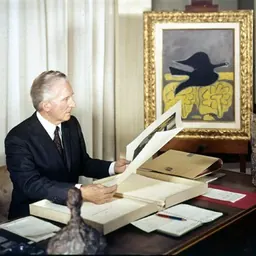

Related people
Same field, nearest in time


Contemporaries
People whose lives overlapped Guy de Rougemont's



Frequently asked questions
Who was Guy de Rougemont?
French painter and sculptor (1935–2021)
When was Guy de Rougemont born?
Guy de Rougemont was born on 23 April 1935 in 7th arrondissement of Paris.
When did Guy de Rougemont die?
Guy de Rougemont died on 18 August 2021 in Montpellier.
What was Guy de Rougemont's occupation?
Guy de Rougemont was a painter and sculptor.
What nationality was Guy de Rougemont?
Guy de Rougemont was French.
Sources & further reading
Cite this page
APA: Biography.guide. (2026). Guy de Rougemont. https://biography.guide/guy-de-rougemont/
MLA: "Guy de Rougemont." Biography.guide, https://biography.guide/guy-de-rougemont/.
Chicago: "Guy de Rougemont." Biography.guide. https://biography.guide/guy-de-rougemont/.
Data last updated: 2026-09-22 · Spot an error? Report a correction.
Page generated 2026-09-27 05:20 UTC