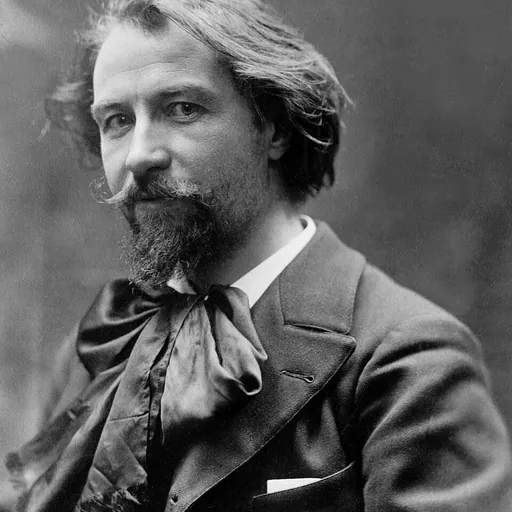
About Gustave Charpentier
Lived 1860 – 1956 (aged 95). Gustave Charpentier was a French composer, conductor and writer.
Gustave Charpentier (; 25 June 1860 – 18 February 1956) was a French composer, best known for his opera Louise.
Life and career Charpentier was born in Dieuze, Moselle, the son of a baker, and with the assistance of a rich benefactor he studied violin at the conservatoire in Lille before entering the Paris Conservatoire in 1881. There he took lessons in composition under Jules Massenet (from 1885) and had a reputation of wanting to shock his professors. In 1887 he won the Prix de Rome for his cantata Didon. A film adaptation of the work followed in 1939 with Grace Moore in the title role. At the revival of Louise at the Opéra-Comique on 28 February 1950, celebrating the 50th anniversary of its creation and the 90th birthday of its composer, it was hoped that Charpentier himself might conduct the performance, but André Cluytens did so, with the composer conducting the "Chant de l'apothéose" after the third act.
Louise is still occasionally performed today, with the soprano aria "Depuis le jour" a popular recital piece.
In 1902, Charpentier founded the Conservatoire Populaire Mimi Pinson, intended to provide a free artistic education to Paris's working girls. However, he became unproductive as a composer. He worked on a sequel to Louise, Julien, ou la vie du poète, but it was quickly forgotten after its tepidly received 1913 premiere. Thereafter, Charpentier wrote very little.
He was, nevertheless, no recluse. During World War I, he started the Œuvre de Mimi Pinson and Cocarde de Mimi Pinson to aid wounded soldiers. He was awarded the Légion d'honneur in 1900, became a Commandeur in 1930, and a Grand Officier in 1950. In 1934, he conducted a recording of his Impressions d'Italie with a Paris symphony orchestra. He died, aged 95, in Paris.
Charpentier's brother Victor (also born in Dieuze, on 23 July 1867) was a cellist in the orchestra of the Paris Opera and later a conductor of popular symphony concerts in Paris. In 1931 Marc Delmas published a biography of Charpentier entitled Gustave Charpentier et le Lyrisme Francais.
Compositions
Didon, Scène dramatique – 1887 Impressions d'Italie – 1892 La vie du poète – symphonie-drame – 1892 Sérénade à Watteau (words by Verlaine) – 1896 La couronnement de la muse – spectacle – 1897 Louise – 1900 Munich – symphonic poem – 1911 Julien, ou La vie du poète – 1913 L'amour au faubourg – 1913 (unperformed) Orphée – 1931 (unfinished) Songs
Don’t just read it —
keep it.
Full-length biographies made to live with: read them, listen on the way to work, watch them tonight.
- E-book
- Audio
- Video
Instant download · yours to keep · every purchase keeps this site free
Important facts
People in Gustave Charpentier's life
Named in this biography and alive at the same time
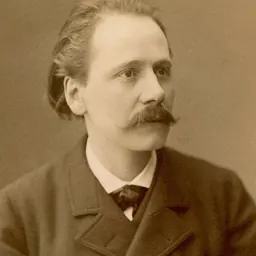



Related people
Same field, nearest in time
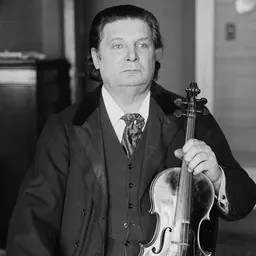

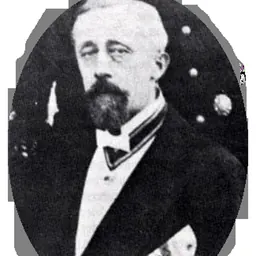



Contemporaries
People whose lives overlapped Gustave Charpentier's


Frequently asked questions
Who was Gustave Charpentier?
French composer (1860-1956)
When was Gustave Charpentier born?
Gustave Charpentier was born on 25 June 1860 in Dieuze.
When did Gustave Charpentier die?
Gustave Charpentier died on 18 February 1956 in Paris.
What was Gustave Charpentier's occupation?
Gustave Charpentier was a composer, conductor and writer.
What nationality was Gustave Charpentier?
Gustave Charpentier was French.
Sources & further reading
· Wikipedia: Gustave Charpentier
· DBpedia: Gustave Charpentier
Cite this page
APA: Biography.guide. (2026). Gustave Charpentier. https://biography.guide/gustave-charpentier/
MLA: "Gustave Charpentier." Biography.guide, https://biography.guide/gustave-charpentier/.
Chicago: "Gustave Charpentier." Biography.guide. https://biography.guide/gustave-charpentier/.
Data last updated: 2026-09-23 · Spot an error? Report a correction.
Portrait: Wikimedia Commons · author & licence
Page generated 2026-09-27 05:04 UTC