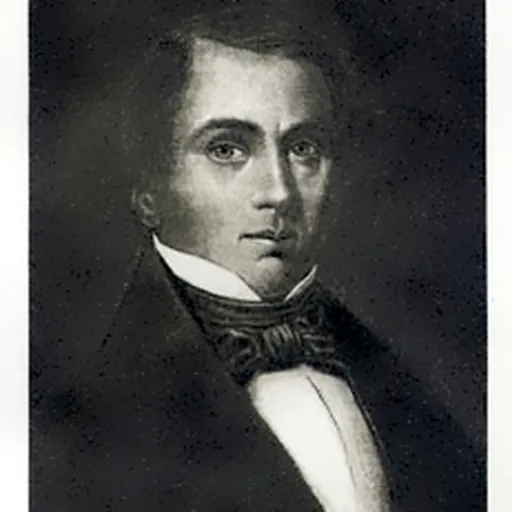
Gustav Koerner
German American politician, lawyer, judge, and diplomat
About Gustav Koerner
Lived 1809 – 1896 (aged 86). Gustav Koerner was an American politician, journalist, lawyer, judge, revolutionary and diplomat.
Life
Early life and education Gustav was the son of the Frankfurt publisher, bookseller and art dealer Bernhard Körner (1776–1829) and his wife Maria Magdalena Kämpfe (1776–1847), daughter of another Frankfurt bookseller. He graduated with Abitur from the Gymnasium Francofurtanum. Then he studied law at the University of Jena, the Ludwig-Maximilians-Universität München, and Heidelberg University, and graduated 1832 from Heidelberg University as Dr. iuris utriusque, doctor as well as German and Roman law.
Escape from Persecution in Germany On Christmas Eve 1830 in Munich, Koerner was involved in a somewhat drunken snowball fight that led to a confrontation with the Gendarmerie of that city in royal Bavaria where an officer was knocked down and wounded. Because of his participation in these so-called "Christmas riots," he was taken into custody for four months, later recalling that during the time of his captivity he learned more about the law than during the whole of his two-years of study at the University of Jena. Owing to this event, the Ludwig-Maximilians-Universität München was temporarily closed and after his custody, Koerner changed to the university in Heidelberg. A warrant was out for him. He is counted as one of the Dreissiger.
The Central Federal Bureau for Investigations in Frankfurt was set up after the revolt against the reign of the President of the German Confederation, Francis I, Emperor of Austria, his chancellor Prince Metternich and his other vassals including King Frederick William III of Prussia. These authorities assigned him number 908 with the name Gustav Peter Philipp Koerner in their infamous "black book" of revolutionary suspects. The Free City of Frankfurt was occupied by federal troops from Austria and Prussia which meant a de facto total loss of its independence.
Rescued by "Angels"
Sophie Koerner, née Engelmann (1815–1888), spouse of Gustav KoernerOn 1 May 1833, Koerner boarded a ship in Le Havre sailing to North America with a group of emigrants headed by the patriarch of the Engelmann family, whose son Theodor was an old friend of his from college. On the passage he became engaged to his future wife Sophie, a daughter of Engelmann's who was born in Imsbach in the Palatinate , a historic region of Germany. In 1838 he received American citizenship.
Elected Koerner was elected to the Illinois House of Representatives in 1842, served on the Illinois Supreme Court from 1845 to 1848, and as the 12th Lieutenant Governor of Illinois from 1853 to 1857. Originally a Democrat, he became a member of the Republican Party after its formation, and helped develop its anti-slavery platform. As a friend, he took over some of Abraham Lincoln's cases when Lincoln was elected president.
Koerner was the first citizen of German extraction ever elected to the Illinois or Missouri legislatures. In 1851, in a clash with the editor of Anzeiger des Westens Henry Boernstein, he called the Forty-Eighters Greens in his Belleviller Zeitung newspaper and Boernstein, in a published reply, insultingly called him Gray Gustav.
Pallbearer After the Assassination of Abraham Lincoln a special honour was granted him. Koerner was one of the pallbearers who carried the corpse of the president in the state funeral. The other men, all of them Lincoln's friends from his time in Springfield, Illinois, who conducted the coffin were: Replica of the coffin of Abraham Lincoln, Museum of Funeral Customs, Springfield, Illinois, 2006. Jesse K. Dubois Stephen T. Logan James L. Lamb Samuel Hubbel Treat Jr. John Williams Erastus White J. M. Brown Jacob Bunn Charles Matheny Elisha Iles John T. Stuart
Last years
In 1867 Koerner was appointed president of the board of trustees that organized the Illinois Soldiers' Orphans' Home at Bloomington, and in 1870 he became president of the first board of railroad commissioners of Illinois. A supporter of Ulysses S. Grant's successful 1868 presidential election bid, in 1872 he became a supporter of the Liberal Republican Party, belonging to the nominating committee which chose Horace Greeley as its (unsuccessful) US presidential candidate.
In the same year Koerner ran for election (→ Illinois gubernatorial election, 1872) to the office of Governor of Illinois, though the Republican Richard James Oglesby (1824–1899) won the election. He then backed the Democratic candidate Samuel J. Tilden for the U.S. presidency in a contentious election of 1876 and remained with this party afterwards. established, with others, one of the first kindergartens. She became the first president of the Belleville Kindergarten Association which received $2,100 (~$ in ) in contributions from 70 shareholders and, supported by 150 other women, one year later was serving 201 pupils taught by three educators. This institute followed the Julius Fröbel system of primary education for training children effortlessly. The building was finished in April 1875 for $5,000 but it was sold in 1892 to the Belleville Philharmonic Society.
Reminiscences Warrant of Apprehension of the year 1833 for Gustav Peter Philipp Körner, exhibited by the Scrupulous Interrogation Office . At the suggestion of farmer Dr. Anton Schott, a graduate in Theology and Philosophy,
One of his personal leitmotivs was pointed out by the "Belleviller Zeitung" (the local German language newspaper) on 11 January 1899, nearly three years after his death, in a biography in the jubilee edition at the 50th anniversary of their first appearance:
Don’t just read it —
keep it.
Full-length biographies made to live with: read them, listen on the way to work, watch them tonight.
- E-book
- Audio
- Video
Instant download · yours to keep · every purchase keeps this site free
Important facts
People in Gustav Koerner's life
Named in this biography and alive at the same time




Related people
Same field, nearest in time


Contemporaries
People whose lives overlapped Gustav Koerner's





Frequently asked questions
Who was Gustav Koerner?
German American politician, lawyer, judge, and diplomat (1809-1896)
When was Gustav Koerner born?
Gustav Koerner was born on 20 November 1809 in Free City of Frankfurt.
When did Gustav Koerner die?
Gustav Koerner died on 9 April 1896 in Belleville.
What was Gustav Koerner's occupation?
Gustav Koerner was a politician, journalist, lawyer, judge, revolutionary and diplomat.
What nationality was Gustav Koerner?
Gustav Koerner was American.
Sources & further reading
Cite this page
APA: Biography.guide. (2026). Gustav Koerner. https://biography.guide/gustav-koerner/
MLA: "Gustav Koerner." Biography.guide, https://biography.guide/gustav-koerner/.
Chicago: "Gustav Koerner." Biography.guide. https://biography.guide/gustav-koerner/.
Data last updated: 2026-09-23 · Spot an error? Report a correction.
Portrait: Wikimedia Commons · author & licence
Page generated 2026-09-27 05:05 UTC