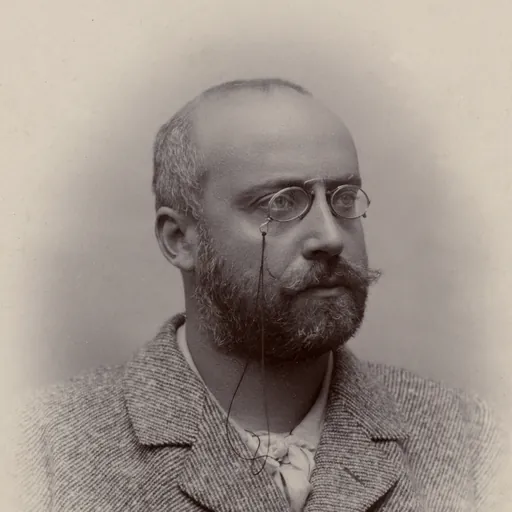
About Gustaf Fröding
Lived 1860 – 1911 (aged 50). Gustaf Fröding was a Swedish translator, journalist, poet and writer.
Gustaf Fröding (; 22 August 1860 – 8 February 1911) was a Swedish poet and writer from Alster, Värmland. The family moved to Kristinehamn in the year 1867. He later studied at Uppsala University and worked as a journalist in Karlstad.
Poetry His poetry combines formal virtuosity with a sympathy for the ordinary, the neglected and the down-trodden, sometimes written in his own regional dialect. It is highly musical and lends itself to musical setting; many of his poems have been set to music and recorded by Swedish singers such as Olle Adolphson, Monica Zetterlund, the Värmland group Sven-Ingvars and the Swedish band Mando Diao.
Fröding wrote openly about his personal problems with alcohol and women and had to face a trial for obscenity.
Sickness
The latter part of his life he spent in different mental institutions and hospitals to cure his mental illness and alcoholism, and eventually diabetes. During the first half of the 1890s he spent a couple of years at the Suttestad institution in Lillehammer, Norway, where he finished his work on his third book of poetry Stänk och flikar, which was published in 1896. He wrote much of the material at a mental institution in Görlitz, Germany. In 1896 he moved back to Sweden. But as the year neared Christmas, his sister Cecilia made the difficult decision to make him stay at a hospital in Uppsala. Under the care of professor Frey Svenson Fröding got away from liquor and women, except one, Ida Bäckman. Fröding never married Ida, but grew fond of a nurse named Signe Trotzig. When he left hospital in Uppsala she stayed with him to the day he died.
A play by Swedish playwright Gottfrid Grafström, called Sjung vackert om kärlek, about Fröding's time at the mental institution in Uppsala was first performed at the Royal Dramatic Theatre in 1973 and has had periodic revivals since.
Selected works Gitarr och dragharmonika (Guitar and concertina) 1891 Nya dikter (New poems) 1893 Räggler å paschaser (Tall tales and adventures) 1895 Stänk och flikar (Splashes and spray) 1896 Nytt och gammalt (New and old) 1897 Gralstänk (Splashes of the grail) 1898 Efterskörd (Gleanings) 1910 Reconvalescentia (Convalescence) 1914 Samlade skrifter 1–16 (Collected works 1–16) 1917–1922 Brev till en ung flicka (Letters to a young girl) 1952 Äventyr i Norge (Adventures in Norway) 1963 Gustaf Frödings brev, 2 vol. (Gustaf Fröding's letters, 2 vol.) 1981–1982 "23 Bojaere"*
His works in English Poems 1903 Selected Poems 1916 Guitar and Concertina 1925 Gustaf Fröding: His Life and Poetry 1986 Swedes On Love CD 1991 The Selected Poems of Gustaf Fröding 1993 The Complete Poems of Gustaf Fröding 1997–1999 The North! To the North! 2001
Don’t just read it —
keep it.
Full-length biographies made to live with: read them, listen on the way to work, watch them tonight.
- E-book
- Audio
- Video
Instant download · yours to keep · every purchase keeps this site free
Important facts
People in Gustaf Fröding's life
Named in this biography and alive at the same time

Related people
Same field, nearest in time



Contemporaries
People whose lives overlapped Gustaf Fröding's



Frequently asked questions
Who was Gustaf Fröding?
Swedish writer (1860-1911)
When was Gustaf Fröding born?
Gustaf Fröding was born on 22 August 1860 in Alsters herrgård.
When did Gustaf Fröding die?
Gustaf Fröding died on 8 February 1911 in Oscar Parish.
What was Gustaf Fröding's occupation?
Gustaf Fröding was a translator, journalist, poet and writer.
What nationality was Gustaf Fröding?
Gustaf Fröding was Swedish.
Sources & further reading
Cite this page
APA: Biography.guide. (2026). Gustaf Fröding. https://biography.guide/gustaf-froding/
MLA: "Gustaf Fröding." Biography.guide, https://biography.guide/gustaf-froding/.
Chicago: "Gustaf Fröding." Biography.guide. https://biography.guide/gustaf-froding/.
Data last updated: 2026-09-23 · Spot an error? Report a correction.
Portrait: Wikimedia Commons · author & licence
Page generated 2026-09-27 05:07 UTC