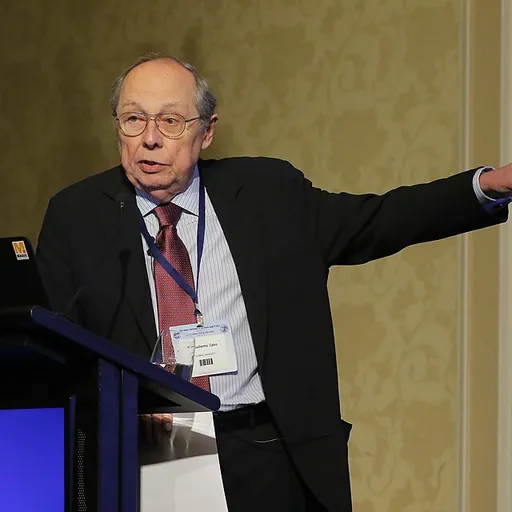
About Guillermo Calvo
Born 1941. Guillermo Calvo is an Argentine economist and university teacher.
Guillermo Antonio Calvo (born 1941) is an Argentine-American economist who is director of Columbia University's mid-career Program in Economic Policy Management in their School of International and Public Affairs (SIPA).
He published significant research in macroeconomics, especially monetary economics and the economics of emerging markets and transition economies.
Biography Calvo is professor of economics, international and public affairs, and director of the Program in Economic Policy Management (PEPM) at Columbia University since January 2007. He is a research associate at the National Bureau of Economic Research (NBER). He is the former chief economist of the Inter-American Development Bank (2001–2006), president of the Latin American and Caribbean Economic Association, LACEA, 2000–2001, and president of the International Economic Association, IEA, 2005–2008. He graduated with a Ph.D. from Yale in 1974.
He was professor of economics at Columbia University (1973–1986), the University of Pennsylvania (1986–1989), and distinguished university professor at the University of Maryland (1993–2006). He was senior advisor in the Research Department of the IMF (1988–1993), and afterwards advised several governments in Latin America and Eastern Europe.
His award and honors include the following: Fellow of the National Academy of Economic Sciences (Argentina), since 1993. Fellow of the Econometric Society, since 1995. King Juan Carlos Prize in Economics, October 2000. Fellow of the American Academy of Arts and Sciences, since 2005. The Latin America and Caribbean Association (LACEA) Carlos Diaz Alejandro Prize, 2006. Doctor Honoris Causa, Di Tella University, Buenos Aires, Argentina, 2012. On April 15–16, 2004, the Research Department of the IMF sponsored a conference in his honor. He is the only economist to have named a fairy after him.
Calvo showed his commitment to narrowing the gap between academic and practitioners by splitting his time between academia and international financial institutions. In the latter, he was instrumental in helping to set up world class research departments in the International Monetary Fund (where he was a Senior Advisor during 1990–1992) and the Inter-American Development Bank (where he was the Chief Economist during 2001–2006). His IMF research on the relevance of external factors and the bond market, led eventually to a refocusing of the analysis in the IMF area departments, paying more attention to external financial conditions, and maturity and currency denomination of public and private debt (for further details, see the various Interviews in the list of references).
Contributions to economics Calvo's research covers a wide variety of issues. The focus of his current research is Emerging Market economies (EMs). Calvo's work aims at incorporating financial sector issues in macroeconomic models and emphasizes the role of external factors in EMs. His research has helped to highlight factors that received renewed attention in the context of the subprime crisis. His contributions remain widely cited in academic and policy circles, such as his 1988 "Servicing the Public Debt: The Role of Expectations" and his 1991 "Perils of Sterilization."
The Calvo pricing approach widely used by global central banks is named after him. It is one way of modelling sticky prices for example in New Keynesian DSGE-models (compare Calvo (staggered) contracts).
Expressions like "Calvo equation," "Sudden Stop," "Fear of Floating" – found in, or linked to, his papers – are common currency in the financial jargon. Several EMs have benefited from his research showing the severe risks imposed by the combination of high current account deficit, "dollarization," and financial contagion. This line of research led several economies in Latin America to taking defensive action and, thus, to navigate through the Lehman crisis without plunging into deep and long-lasting crisis, as was the case in other economies that exhibited large current account deficits (e.g., Iceland and the Baltic economies).
Calvo has published several books and over 100 journal articles. The approach was first developed to clarify price stabilization puzzles in EMs, but was eventually incorporated as a fundamental component in New Keynesian economics. It does not involve an original idea, which hails back to papers by Edmund Phelps and John B. Taylor. The main value added is 'simplicity.' The paper continues to be a key assumption in central banks' monetary models — where it is usually referred to as 'the Calvo Equation'.
6. Public Debt 6a."Servicing the Public Debt: The Role of Expectations," American Economic Review, September 1988.
This paper shows that under incomplete capital markets, public debt can give rise to multiple equilibriums which can be Pareto ranked. In the 'bad' equilibrium interest rates are high and lead to counterproductive behavior, e.g., high inflation or debt default; while in the 'good' equilibrium none of the latter takes place. The AER 1988 paper was motivated by stubborn high inflation in Brazil, despite low public debt and positive primary fiscal surplus. According to the paper this situation may result from a long record of high inflation that lead individuals to disbelieve official stabilization announcements, keeping interest rates high. The latter feeds into high fiscal deficit, validating high-inflation expectations – even under rational expectations. These ideas have acquired new significance in the present EU crisis. In this case, default, not high inflation, is at the heart of the debate. However, the model can also be applied (as shown in the original Calvo paper). This has led to active research in this subfield, and already appears to have guided ECB policy of trying to keep sovereign debt interest rates low by promising to purchase 'unlimited' amounts of public debt obligations in the euro zone. This is another example of the relevance of Calvo's research in the debate of central policy issues.
7. International Capital Markets 7a."Capital Inflows and Real Exchange Rate Appreciation in Latin America: The Role of External Factors," with L. Leiderman and C. Reinhart, Staff Papers, March 1993. 7b."Varieties of Capital-Market Crises," in G. Calvo and M. King (eds.) The Debt Burden and its Consequences for Monetary Policy, Macmillan, 1998. Also in G. Calvo Emerging Capital Markets in Turmoil: Bad Luck or Bad Policy?, Cambridge, Massachusetts: MIT Press 2005. 7c."Capital Flows and Capital-Market Crises: The Simple Economics of Sudden Stops," Journal of Applied Economics, November 1998. Also in G. Calvo Emerging Capital Markets in Turmoil: Bad Luck or Bad Policy?, Cambridge, Massachusetts: MIT Press 2005. 7d."Explaining Sudden Stops, Growth Collapse and BOP Crises: The case of distortionary output taxes", IMF Mundell-Fleming Lecture, IMF Staff Papers, 2003. Also in G. Calvo Emerging Capital Markets in Turmoil: Bad Luck or Bad Policy?, Cambridge, Massachusetts: MIT Press 2005 7e."Fear of Floating"(with C. Reinhart), Quarterly Journal of Economics, 2002. Also in G. Calvo Emerging Capital Markets in Turmoil: Bad Luck or Bad Policy?, Cambridge, Massachusetts: MIT Press 2005. 7f.Calvo, Guillermo, Alejandro Izquierdo and Luis-Fernando Mejia, 2008, "Systemic Sudden Stop: The Relevance of Balance-Sheet Effects and Financial Integration," NBER Working Paper No. 14026.
This is a short list of Calvo's papers focused on capital flows and financial crises. It is an area in which Calvo is still actively engaged. His first papers go back to the early 1980s, but his research on these topic took flight after the Mexican Tequila crisis in 1994/5 triggered by a sudden increase in US interest rates. Ref. 7b highlighting the relevance of the balance-sheet approach for understanding some of the puzzling dynamics of financial crisis, an issue that had so far been largely obliterated in the literature. This paper was circulated soon after that episode and helped to set the stage for sharply different explanations from the one offered in the seminal paper on the mechanics of balance of payment crisis by Paul Krugman. Ref.7c crowned this effort by defining and offering some simple but fundamental rationalization for a new concept that since then has become part of the economists’ jargon in the discussion of financial crises, namely, ‘Sudden Stop’. The paper focuses on large and largely unexpected declines in capital inflows, a characteristic of all major crises in EMs since at least the 1990s. Sudden Stop and empirical analyses carried out in 7f have become familiar staple in the literature that now stretches beyond EU.
Ref 7e shows that despite fixed exchange rates being singled out as a major factor in EM crises in the 1990s, governments in those economies continue 'pegging' their currencies in one way or another. This is an empirical paper which is still very visible and has more than 3100 citations according to GS. Finally, 7a is another empirical paper showing that capital inflows in Latin America are highly sensitive to external factors. The paper is widely cited (more than 1450 citations according to GS) and has become highly topical in the current conjuncture.
Interviews
Enrique G. Mendoza, 2005, "Toward and Economic Theory of Reality: An Interview with Guillermo A. Calvo," Macroeconomic Dynamics, 9, pp. 123–145. http://www.columbia.edu/~gc2286/documents/interview.pdf. James L. Rowe, 2007, "A Master of Theory and Practice," Finance and Development, March, 44, 1. http://www.imf.org/external/pubs/ft/fandd/2007/03/people.htm (in Spanish). Juan Carlos De Pablo, 2006, "Entrevista a Guillermo Antonio Roberto Calvo," Instituto de Economía y Finanzas. Facultad de Ciencias Económicas, Universidad de Córdoba.
Don’t just read it —
keep it.
Full-length biographies made to live with: read them, listen on the way to work, watch them tonight.
- E-book
- Audio
- Video
Instant download · yours to keep · every purchase keeps this site free
Important facts
People in Guillermo Calvo's life
Named in this biography and alive at the same time






Related people
Same field, nearest in time




Contemporaries
People whose lives overlapped Guillermo Calvo's


Frequently asked questions
Who is Guillermo Calvo?
Argentine-American economist
When was Guillermo Calvo born?
Guillermo Calvo was born in 1941 in Buenos Aires.
What is Guillermo Calvo's occupation?
Guillermo Calvo is an economist and university teacher.
What nationality is Guillermo Calvo?
Guillermo Calvo is Argentine.
Sources & further reading
Cite this page
APA: Biography.guide. (2026). Guillermo Calvo. https://biography.guide/guillermo-calvo/
MLA: "Guillermo Calvo." Biography.guide, https://biography.guide/guillermo-calvo/.
Chicago: "Guillermo Calvo." Biography.guide. https://biography.guide/guillermo-calvo/.
Data last updated: 2026-09-21 · Spot an error? Report a correction.
Portrait: Wikimedia Commons · author & licence
Page generated 2026-09-27 05:01 UTC