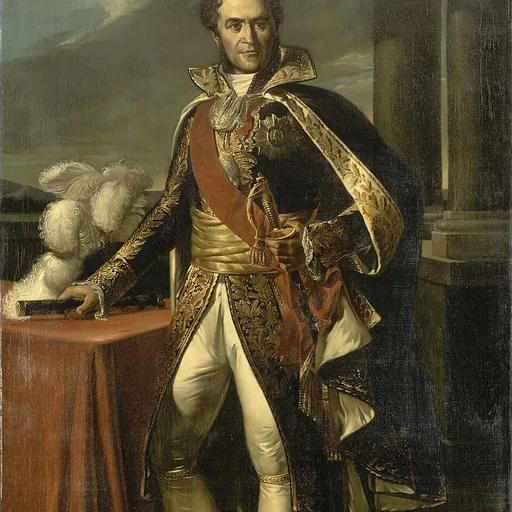
About Guillaume-Marie-Anne Brune
Lived 1763 – 1815 (aged 52). Guillaume-Marie-Anne Brune was a French diplomat, politician, military personnel, envoy extraordinary and minister plenipotentiary and governor.
Guillaume Marie Anne Brune, 1st Count Brune ( , ; 13 March 1764 – 2 August 1815) was a French military commander and Marshal of the Empire who served during the French Revolutionary Wars and the Napoleonic Wars.
Early life Brune was born in Brives (now called Brive-la-Gaillarde) in the province of Limousin, the son of Étienne Brune, a lawyer, and Jeanne Vielbains. He moved to Paris in 1785, studied law, He was subsequently removed from command. Brune commanded the French army that occupied Switzerland in 1798 and established the Helvetic Republic. In the following year, he was in command of the French troops in defence of Amsterdam against the Anglo-Russian invasion of Holland under the Duke of York, in which he was completely successful – the Anglo-Russian forces were defeated in the Battle of Castricum, and compelled, after a harsh retreat, to re-embark. He rendered further good service in Vendée and in the Italian Peninsula from 1799 to 1801, winning the 1800 Battle of Pozzolo.
In 1802, Napoleon dispatched Brune to Constantinople as ambassador to the Ottoman Empire. During his two-year diplomatic service, he initiated relations between France and Persia.
Napoleonic Wars
Following his coronation as Emperor of the French in 1804, Napoleon made Brune a Marshal of the Empire (Maréchal d'Empire) while he was still in Constantinople. During the campaigns against Austria during the War of the Third Coalition, Marshal Brune commanded the army in Boulogne from 1805 to 1807 overseeing drilling and keeping a watchful eye on the British. In 1807 Brune was appointed Governor General for the Hanseatic Ports and in 1808, Brune held a command of troops fighting in War of the Fourth Coalition and occupied Swedish Pomerania, taking Stralsund and the Island of Rugen. Despite these victories, his staunch republicanism and a meeting with Gustav IV Adolf of Sweden raised Napoleon's suspicions. These suspicions were only made worse by Brune, who refused to talk to Napoleon about the matter, claiming simply that "It's a lie". Brune made his biggest blunder while drafting a treaty between France and Sweden when he wrote "the French army" instead of "His Imperial Majesty's Army". Whether an intentional insult or act of incompetence, Napoleon was infuriated and Brune was removed from duty. He then spent the next years at his country estate in disgrace and was not re-employed until 1815. Fearing the Royalist mobs in Provence and aware of their hatred towards him, Brune asked Admiral Edward Pellew to sail him to Italy, but the request was rudely denied, with Pellew calling him "the prince of scamps" and a "blackguard". Brune then decided to travel to Paris over land with the promise of Royalist protection, although none was provided.
An inquiry compelled by his widow later made public that Brune's murder had been covered up by the royal authorities, and revealed that the mob responsible was led by baseless allegations that Brune was the one parading Marie Thérèse Louise of Savoy, Princesse de Lamballe' head on a pike around Paris during the September Massacres.
Don’t just read it —
keep it.
Full-length biographies made to live with: read them, listen on the way to work, watch them tonight.
- E-book
- Audio
- Video
Instant download · yours to keep · every purchase keeps this site free
Important facts
People in Guillaume-Marie-Anne Brune's life
Named in this biography and alive at the same time
Related people
Same field, nearest in time


Contemporaries
People whose lives overlapped Guillaume-Marie-Anne Brune's




Frequently asked questions
Who was Guillaume-Marie-Anne Brune?
French general (1763-1815)
When was Guillaume-Marie-Anne Brune born?
Guillaume-Marie-Anne Brune was born on 13 March 1763 in Brive-la-Gaillarde.
When did Guillaume-Marie-Anne Brune die?
Guillaume-Marie-Anne Brune died on 2 August 1815 in Avignon.
What was Guillaume-Marie-Anne Brune's occupation?
Guillaume-Marie-Anne Brune was a diplomat, politician, military personnel, envoy extraordinary and minister plenipotentiary and governor.
What nationality was Guillaume-Marie-Anne Brune?
Guillaume-Marie-Anne Brune was French.
Sources & further reading
· Wikipedia: Guillaume-Marie-Anne Brune
Cite this page
APA: Biography.guide. (2026). Guillaume-Marie-Anne Brune. https://biography.guide/guillaume-marie-anne-brune/
MLA: "Guillaume-Marie-Anne Brune." Biography.guide, https://biography.guide/guillaume-marie-anne-brune/.
Chicago: "Guillaume-Marie-Anne Brune." Biography.guide. https://biography.guide/guillaume-marie-anne-brune/.
Data last updated: 2026-09-21 · Spot an error? Report a correction.
Portrait: Wikimedia Commons · author & licence
Page generated 2026-09-27 05:01 UTC