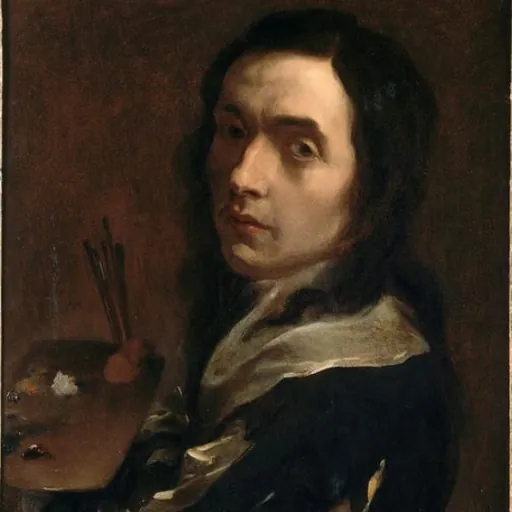
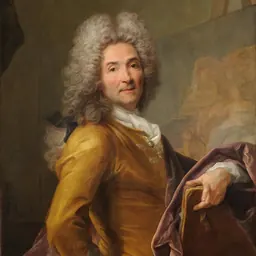
Guillaume Courtois
French painter of the Late Baroque
About Guillaume Courtois
Lived 1628 – 1679 (aged 50–51). Guillaume Courtois was a painter, draftsperson and graphic artist.
Guillaume Courtois or italianized as Guglielmo Cortese, called Il Borgognone or Le Bourguignon ('the Burgundian'), (1628 – 14 or 15 June 1679 ) was a Free Burgundian-Italian painter, draughtsman and etcher. He was mainly active in Rome as a history and staffage painter and worked for high-level private patrons as well as large public commissions. He was a skilled portraitist, manifesting realistic sensitivity and a peculiar expressiveness. He left a large number of preparatory drawings which testify to his productivity.
Life Guillaume Courtois was born in Saint-Hippolyte (Free County of Burgundy), Holy Roman Empire, as the son of the obscure painter Jean-Pierre Courtois. His two brothers Jacques (Giacomo Cortese) and Jean-François also became painters. Very little is known about Guillaume's youth and training. It is assumed that he received his initial art classes from his father. The father and his sons went to Italy circa 1636 when Guillaume was still a child. They travelled to Milan, Bologna, Venice, Florence and Siena. Another view of the movements of the brothers that has gained support with modern scholars is that Guillaume and Jacques remained together until the later 1640s and that Guillaume Courtois only came under the influence of da Cortona when he worked under him in 1656.
Guillaume Courtois spent most of his active life in Rome, where he died of gout on 14 or 15 June 1679. He collaborated with other artists on genre paintings. Some figures painted by Courtois in this Palace were previously attributed to Mola.
In 1661, he painted an Assumption for the church of San Tommaso da Villanova in Castelgandolfo in Ozzola.
In his mature work, he further showed the influence of Carlo Maratta, an artist who fused the Baroque and Classicist styles. This is reflected in the sweet faces of the female figures in works such as the Madonna of the Rosary for the St. George Church in Monte Porzio Catone made in 1666 on a commission by prince Giovanni Battista Borghese. He also collaborated frequently on public works with Bernini, who admired his work and recommended him for commissions, and Carlo Maratta.
In 1653, he painted the figures of St. Eustace, the Good Samaritan, a St. Mary of Egypt and St. Augustine in four large landscapes of Gaspard Dughet. This was one of the earliest documented commissions of Courtois and the patron was Camillo Francesco Maria Pamphili. The next year, Courtois and Dughet collaborated again for the same patron on works for the Palazzo Pamphilj.
Drawings
Guillaume Courtois was a very skilled draughtsman, as is testified by the many preparatory studies he left behind and which can be found, amongst others, in the Istituto Nazionale per la Grafica. Preparatory drawings are generally in chalk, whereas compositional designs tend to be in pen and ink and wash.
The preparatory studies in chalk (Nationalmuseum, Stockholm and the Museum Kunstpalast, Düsseldorf) for The Martyrdom of St Mark fresco in San Marco are very skilful and demonstrate a fluid technique and a firm grasp of form and chiaroscuro.
Don’t just read it —
keep it.
Full-length biographies made to live with: read them, listen on the way to work, watch them tonight.
- E-book
- Audio
- Video
Instant download · yours to keep · every purchase keeps this site free
Important facts
more
William Courtois, Guillaume Cortesi, Guglielmo Borgognoni, William Cortesi, Guglielmo Cortese Courtois, Guglielmo Borgognone, M. Guglielmo Borgognone, G. Cortese, Guilliaume Courtois, G. Cortesi, Gugliemo Cortese Borgoge, Gug. Borgognone, Mons.r Guglielmo Cortesi detto il Borgognone, Guillaume Cortese, G. Courtois, Guglielmo Cortese Borgogne, W. Courtois, Monsù GuglielPeople in Guillaume Courtois's life
Named in this biography and alive at the same time


Related people
Same field, nearest in time

Contemporaries
People whose lives overlapped Guillaume Courtois's




Frequently asked questions
Who was Guillaume Courtois?
French painter of the Late Baroque (1628-1679)
When was Guillaume Courtois born?
Guillaume Courtois was born in 1628 in Franche-Comté, Saint-Hippolyte.
When did Guillaume Courtois die?
Guillaume Courtois died on 15 June 1679 in Rome.
What was Guillaume Courtois's occupation?
Guillaume Courtois was a painter, draftsperson and graphic artist.
What nationality was Guillaume Courtois?
Guillaume Courtois's recorded nationality: County of Burgundy.
Sources & further reading
· Wikipedia: Guillaume Courtois
Cite this page
APA: Biography.guide. (2026). Guillaume Courtois. https://biography.guide/guillaume-courtois/
MLA: "Guillaume Courtois." Biography.guide, https://biography.guide/guillaume-courtois/.
Chicago: "Guillaume Courtois." Biography.guide. https://biography.guide/guillaume-courtois/.
Data last updated: 2026-09-21 · Spot an error? Report a correction.
Portrait: Wikimedia Commons · author & licence
Page generated 2026-09-27 04:59 UTC