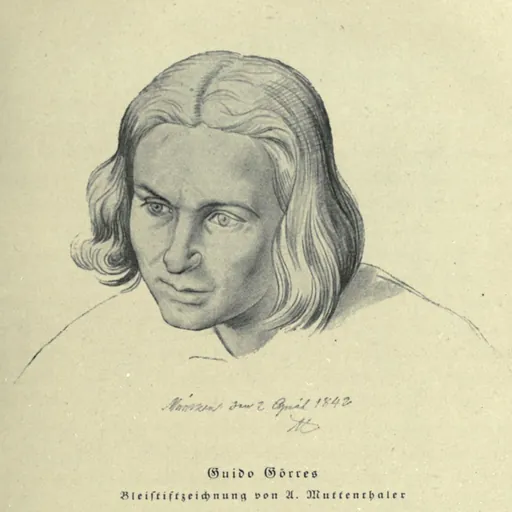
About Guido Görres
Lived 1805 – 1852 (aged 47). Guido Görres was a German poet, historian, writer and opinion journalist.
Guido Görres (28 May 1805 – 14 July 1852) was a German Catholic historian, publicist and poet.
Life Born in Koblenz, he was the son of Joseph Görres, and made his early classical studies in his native town. During his father's banishment he went to Aarau and Strasburg to pursue his education. Reaching the University of Bonn in 1824, he devoted himself chiefly to the study of philology and history.
In Munich he continued his linguistic studies, and in 1830 received a prize from the French Academy. In the meantime (1827) his father had received a call as professor of history to Munich, and Guido, influenced by his father's lectures, took up history as his chief study.
In 1844 Görres married the composer and writer Maria Vespermann, who gave him three daughters. But his conjugal happiness was not to last more than eight years, for he died at Munich at the age of forty-seven years. In doing research for his biography of Joan of Arc, he made a tour of investigation through France in search of material relating to the Maid of Orléans and became friends with Charles Forbes René de Montalembert.
Jointly with Count Franz Pocci, he published from 1834 to 1839 an illustrated serial on the festivals of the Church, the "Festkalender in Bildern und Liedern", the first illustrated magazine for the young in German. But before long his work took a different direction. He edited from 1838 the "Historisch-politische Blätter", a publication established to maintain the defense of the rights of the Catholic Church and to champion the Interests of German Catholics. Guido Görres took charge of the editorial management with George Phillips, and continued at this post until his death.
At the same time his talents as a poet found expression in many beautiful compositions. He became one of the foremost lyricists among the modern Catholic poets of Germany. Under the influence of Clemens Brentano, with whom he was friends, Görres wrote late-Romantic fairy tales, sagas and legends, but above all poems (poems for children, spiritual Marian songs), some of which went into popular songs and were used in the church. In 1840, he wrote a detailed account of the Oberammergau Passion Play.
In 1846 he began with Count Pocci, as he had formerly done in the case of the Feast Calendar, the publication of an illustrated magazine called the "Deutsches Hausbuch", which however appeared for two years only. On the death of Brentano, Görres edited his "Märchen" (2 volumes, Stuttgart, 1846). He also produced an excellent German translation of "The Imitation of Christ" (St. Pölten, 1839, with illustrations by Steinle).
Don’t just read it —
keep it.
Full-length biographies made to live with: read them, listen on the way to work, watch them tonight.
- E-book
- Audio
- Video
Instant download · yours to keep · every purchase keeps this site free
Important facts
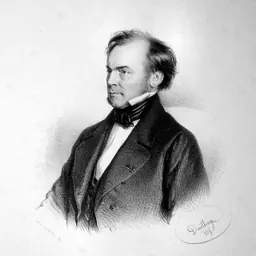
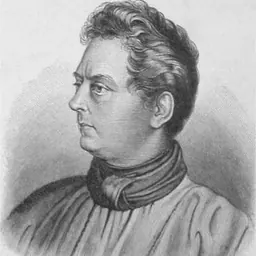
People in Guido Görres's life
Named in this biography and alive at the same time

Related people
Same field, nearest in time
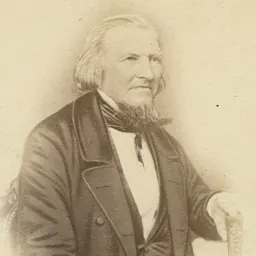

Contemporaries
People whose lives overlapped Guido Görres's





Frequently asked questions
Who was Guido Görres?
German historian and writer (1805–1852)
When was Guido Görres born?
Guido Görres was born on 28 May 1805 in Koblenz.
When did Guido Görres die?
Guido Görres died on 14 July 1852 in Munich.
What was Guido Görres's occupation?
Guido Görres was a poet, historian, writer and opinion journalist.
What nationality was Guido Görres?
Guido Görres was German.
Sources & further reading
Cite this page
APA: Biography.guide. (2026). Guido Görres. https://biography.guide/guido-gorres/
MLA: "Guido Görres." Biography.guide, https://biography.guide/guido-gorres/.
Chicago: "Guido Görres." Biography.guide. https://biography.guide/guido-gorres/.
Data last updated: 2026-09-21 · Spot an error? Report a correction.
Portrait: Wikimedia Commons · author & licence
Page generated 2026-09-27 05:00 UTC