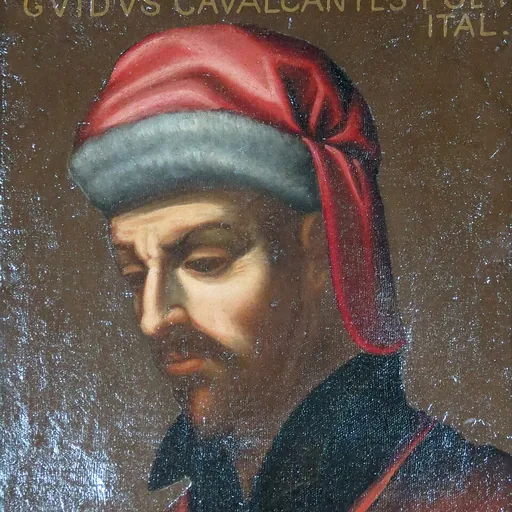
About Guido Cavalcanti
Lived 1258 – 1300 (aged 41–42). Guido Cavalcanti was an Italian poet and writer.
Guido Cavalcanti (between 1250 and 1259 – August 1300 ) was an Italian poet. He was a friend of Dante Alighieri, as well as one of his most notable intellectual influences.
Historical background
Cavalcanti was born in Florence at a time when the comune was beginning its economic, political, intellectual and artistic ascendancy into one of the most influential cities of the Renaissance. The disunited Italian peninsula was dominated by a political particularism that pitted city-states against one another, with this factionalism often contributing to the fractious and sometimes violent political environments of each comune. The domination of medieval religious interpretations of reality, morality and society was challenged by the rise of a new urban culture across Europe that gradually supplanted rural, local, ecclesiastical and feudal ways of thinking. There was an accompanying return to study, and to interpretation and emulation of the classics, known as a revival of antiquity. New secular and humanistic views laid the foundations for modern life in Western Civilization. As Jacob Burckhardt, Swiss historian and author of The Civilization of the Renaissance in Italy wrote, "It was not the revival of antiquity alone, but its union with the genius of the Italian people which achieved the conquest of the western world." Cavalcanti lived during and helped shape this time of great innovation that was spurred on by a desire to explore, create and experiment with new things.
The politics of Florence
Cavalcanti was the son of Cavalcante de' Cavalcanti, a Guelph whom Dante condemns to the sixth circle of his Inferno, where the heretics are punished. It is possible that, unlike Dante, Guido Cavalcanti was an atheist, sharing in his father's Epicurean philosophy. Giovanni Boccaccio (Decameron, VI, 9) wrote, over half a century after Cavalcanti's death, "Si diceva tralla gente volgare che queste sue speculazioni erano solo in cercare se trovar si potesse che Iddio non-fosse" (People commonly said his speculations were only in trying to find that God did not exist).
During his lifetime, Florence was politically torn by the struggle between the Guelphs and Ghibellines, factions supporting, respectively, the Pope and the Holy Roman Emperor in central and northern Italy during the 12th and 13th centuries. Although the struggle for power between the Papacy and the Holy Roman Empire had originally arisen with the Investiture Conflict of the 11th century, it was subsequently fed by a desire of either the Papacy or Holy Roman Emperor either to share in or to control the economic boom that was taking place in the leading cities of northern Italy during this time.
The division between Guelphs and Ghibellines was especially important in Florence, although the two sides frequently rebelled against each other and took power in many of the other northern Italian cities as well. Essentially, the two sides were now fighting either against German influence (in the case of the Guelphs), or against the temporal power of the Pope (in the case of the Ghibellines). In Florence and elsewhere the Guelphs usually included merchants and burghers, while the Ghibellines tended to be noblemen.
Towards the end of the 13th century, the Guelphs had secured their control of Florence through their multiple victories over the Ghibellines, including the battle at Benevento in 1266, and at Campaldino and Caprona in 1289. In 1267, as part of a political reconciliation, Guido married Beatrice, the daughter of Ghibelline party leader Farinata degli Uberti. Their marriage union proved unsuccessful, as the feuds between Guelph and Ghibelline families persisted.
By 1293, a rebellion of middle-class Florentine merchants toppled both sides of noble families. Nobles were then forbidden to claim public office, until 1295, when they were offered eligibility to join Florence's guilds. As a member of the Cavalcanti family, Guido had claimed ancestry dating back to the German barons of Charlemagne's court. He refused to occupy a position as a merchant, as he felt it offensive to his station and his heritage.
Guido's name arrives once more in Purgatory XI, mentioned by Oderisi da Gubbio to Dante on the terrace of pride. The former employs the fame of Guido Guinizelli, soon overpowered by that of Guido Cavalcanti, to justify the fleeting nature of fame in their larger discussion of vanity. Through Oderisi's words, Dante further asserts himself, as a poet, to be the next in line, replacing Guido in terms of public interest.
It has been suggested that Guido Cavalcanti's presence in Dante's Divine Comedy permeates further than Dante's two mentions of him by name. His cynical beliefs towards the subject of desire, demonstrated in Donna me prega with images of wrath and death, have been proposed as inspiration for Dante's contrapasso observed in Inferno V, where the carnal sinners are tossed uncontrollably by the winds of a never-ending storm. The difference between the two literary works, in their contexts, is in their treatment of love, since Guido believed that all love led to a loss of rationale. Dante, opposed to this belief, used Guido's definition for a perverted love instead, within the circle of lust.
Don’t just read it —
keep it.
Full-length biographies made to live with: read them, listen on the way to work, watch them tonight.
- E-book
- Audio
- Video
Instant download · yours to keep · every purchase keeps this site free
Important facts
People in Guido Cavalcanti's life
Named in this biography and alive at the same time

Related people
Same field, nearest in time




Contemporaries
People whose lives overlapped Guido Cavalcanti's



Frequently asked questions
Who was Guido Cavalcanti?
Italian poet (1258-1300)
When was Guido Cavalcanti born?
Guido Cavalcanti was born in 1258 in Florence.
When did Guido Cavalcanti die?
Guido Cavalcanti died on 29 August 1300 in Florence.
What was Guido Cavalcanti's occupation?
Guido Cavalcanti was a poet and writer.
What nationality was Guido Cavalcanti?
Guido Cavalcanti was Italian.
Sources & further reading
Cite this page
APA: Biography.guide. (2026). Guido Cavalcanti. https://biography.guide/guido-cavalcanti/
MLA: "Guido Cavalcanti." Biography.guide, https://biography.guide/guido-cavalcanti/.
Chicago: "Guido Cavalcanti." Biography.guide. https://biography.guide/guido-cavalcanti/.
Data last updated: 2026-09-23 · Spot an error? Report a correction.
Portrait: Wikimedia Commons · author & licence
Page generated 2026-09-27 05:05 UTC