
About Cecco d'Ascoli
Lived 1269 – 1327 (aged 57–58). Cecco d'Ascoli was a poet, physician, astrologer, astronomer, writer and teacher.
Francesco degli Stabili (1257 – 26 September 1327; sometimes given as Francesco degli Stabili Cichus), popularly called Cecco d'Ascoli, was an Italian encyclopaedist, physician and poet. Cecco (in Latin, Cichus) is the diminutive of Francesco. Ascoli was the place of his birth. The lunar crater Cichus is named after him.
Life
Born in Folignano, near Fonte a cagnà in Case di Coccia, he devoted himself to the study of mathematics and astrology. In 1322, he was made professor of astrology at the University of Bologna. It is alleged that he entered the service of Pope John XXII at Avignon, and that he cultivated the acquaintance of Dante only to quarrel with the great poet afterwards; but of this there is no evidence.
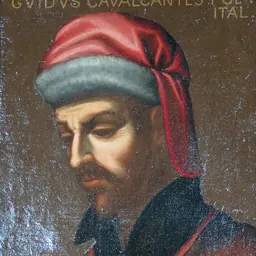
Having published a commentary on the Sphere of John de Sacrobosco, in which he propounded audacious theories concerning the employment and agency of demons, he got into difficulties with the clerical party, and was condemned in 1324 to certain fasts and prayers, and to the payment of a fine of seventy crowns. To elude this sentence, he went to Florence, where he was attached to the household of Carlo di Calabria. His pseudo-science and plain speaking had made him many enemies; he had attacked the Commedia of Dante, and the Canzone d'amore of Guido Cavalcanti. The physician Dino del Garbo was indefatigable in pursuit of him; and the old accusation of impiety being renewed, Cecco was again tried and sentenced for relapse into heresy. He was burned at Florence the day after the sentence, in his seventieth year.
Publications
Cecco d'Ascoli left many works in manuscript, most of which have never been published. The book by which he achieved his renown and which contributed to his execution was the Acerba (from acervus), an encyclopaedic poem, of which in 1546, the date of the last reprint, more than twenty editions had been issued. It is a compendium for the contemporary natural science of the time, including "the order and influences of the heavens, the characteristics and properties of animals and precious stones, the causes of phenomena such as meteors and earthquakes—and of commonplace moral philosophy". The work actually consists of four books in (six-line stanzas in a specific rhyming scheme). The first book treats of astronomy and meteorology; the second of astrology, of physiognomy, and of the vices and virtues; the third of minerals and of the love of animals; while the fourth propounds and solves a number of moral and physical problems. Of a fifth book, on theology, the initial chapter alone was completed.
Works
Don’t just read it —
keep it.
Full-length biographies made to live with: read them, listen on the way to work, watch them tonight.
- E-book
- Audio
- Video
Instant download · yours to keep · every purchase keeps this site free
Important facts
People in Cecco d'Ascoli's life
Named in this biography and alive at the same time
Related people
Same field, nearest in time





Contemporaries
People whose lives overlapped Cecco d'Ascoli's



Frequently asked questions
Who was Cecco d'Ascoli?
Italian physician and poet
When was Cecco d'Ascoli born?
Cecco d'Ascoli was born in 1269 in Ancarano.
When did Cecco d'Ascoli die?
Cecco d'Ascoli died on 16 September 1327 in Florence.
What was Cecco d'Ascoli's occupation?
Cecco d'Ascoli was a poet, physician, astrologer, astronomer, writer and teacher.
Sources & further reading
Cite this page
APA: Biography.guide. (2026). Cecco d'Ascoli. https://biography.guide/cecco-d-ascoli/
MLA: "Cecco d'Ascoli." Biography.guide, https://biography.guide/cecco-d-ascoli/.
Chicago: "Cecco d'Ascoli." Biography.guide. https://biography.guide/cecco-d-ascoli/.
Data last updated: 2026-09-26 · Spot an error? Report a correction.
Page generated 2026-09-27 05:15 UTC