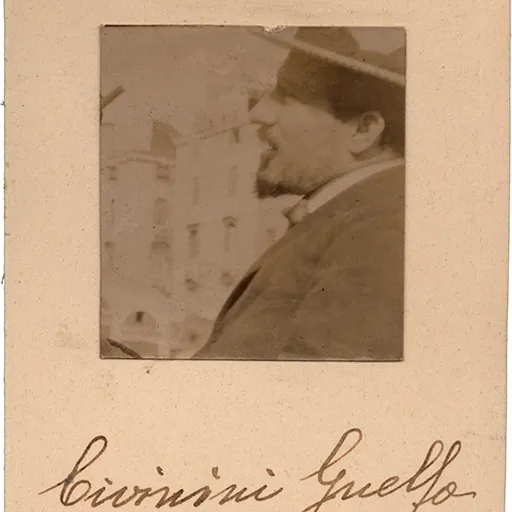
About Guelfo Civinini
Lived 1873 – 1954 (aged 80). Guelfo Civinini was an Italian writer, poet, journalist, librettist and explorer.
Guelfo Civinini (1 August 1873, Livorno – 10 April 1954, Rome) was an Italian poet, playwright, novelist, journalist, critic, opera librettist, academic, military combatant, Western explorer, documentary filmmaker, and archaeologist. Best known internationally as the co-author of the libretto for Giacomo Puccini's opera La fanciulla del West, Civinini began his career as a writer in the 1890s working as both a journalist and critic of literature and art for a variety of Italian newspapers and magazines. His first book of poetic verses, L'urna, was published in 1901 and was the recipient of a national literary prize. After this, he continued to work as a journalist and critic and publish and write poetry, but expanded his interests into writing numerous plays for theatres in Rome and Milan. In 1912 his novel, Gente di palude, was published. He was awarded several literary prizes, including the Mussolini Prize for literature in 1933; the Viareggio Prize in 1937; and the Marzotto Prize in 1953.
Civinini served as a "journalist-fighter", a term he coined, during World War I; simultaneously working as a war correspondent for the Corriere della Sera and as a military combatant. He wrote about his experience as a 'journalist-fighter' in the non-fiction autobiographical book Viaggio intornoalla guerra: dall'Egeo al Baltico (1919, Milan). An ardent nationalist and politically outspoken, he was a supporter of first Gabriele D'Annunzio and the Italian Regency of Carnaro just after World War I; and later became a supporter of Benito Mussolini as a member of the National Fascist Party. However, his relationship with the fascist party in Italy soured during World War II. Unhappy with the discriminatory Italian racial laws passed by the Italian Social Republic and opposed to the nation's alliance with Nazi Germany in the Pact of Steel, Civinini distanced himself from the fascist party and, as a result, his works were banned from being sold by the government of the Italian Social Republic.
In addition to his work as a writer, Civinini embarked on several exploratory expeditions on the continent of Africa in the 1920s and 1930s; the most notable of which was a 1926 expedition whose purpose was to locate the body of Italian explorer Vittorio Bottego. His experiences in Africa resulted in the publication of several auto-biographical non-fiction books and the creation of a documentary film in 1924. In 1934 he purchased the Tower of Santa Liberata in Monte Argentario where he performed his own excavations which resulted in the discovery of the Villa Enobarbi built at the time of the Roman Empire. This archeologic work led to his election to the membership of the Royal Academy of Italy, the highest society for academics in that nation, in 1939.
Early life and career Born in Livorno, Guelfo Civinini was the son of Francesco and Quintilia Lazzerini; one of six children born to that couple. This work was his first publication of poetic verses.
In the years between World War I and World War II, Civinini embarked on several Western exploration expeditions on the continent of Africa; notably making the 1924 documentary film Aethiopia for the Istituto Luce. In 1926 he embarked on an expedition whose goal was to locate and recover the body of Italian explorer Vittorio Bottego who had been murdered in 1897 while exploring regions unknown to the West in Africa. That expedition was largely funded by Francesco Ruspoli, 8th Prince of Cerveteri who accompanied him on the journey. The men were successful at locating the area in which Bottego was killed and were shown a place where he was allegedly buried, but their excavations of the site never recovered Bottego's body. In 1935 he served in the Second Italo-Ethiopian War as a volunteer and was awarded a war cross for military valor. The search for Bottego was chronicled in the non-fiction book Un viaggio attraverso l'Abissinia sulle orme di Vittorio Bottego (1951). His other experiences in Africa were chronicled in the autobiographical works Sotto le piogge equatoriali (1930, Rome) and Ricordi di carovana (1932, Milan).
In 1930 Civinini moved from Rome to Florence where he resided, when not travelling, until 1952 when he moved to Viareggio. In 1934 he purchased the Tower of Santa Liberata in Monte Argentario; a structure built by the Spanish in the 16th century. There he performed his own archaeological excavations which uncovered the Villa Enobarbi built at the time of the Roman Empire. In 1939 he was elected as a member of the Royal Academy of Italy and was named "Honorary Inspector for Monuments, Excavations and Works of Antiquity and Art for Monteargentario and Orbetello" by that institution.
Civinini died in Rome on 10 April 1954, after suffering a stroke in 1953 which left him paralyzed.
Don’t just read it —
keep it.
Full-length biographies made to live with: read them, listen on the way to work, watch them tonight.
- E-book
- Audio
- Video
Instant download · yours to keep · every purchase keeps this site free
Important facts
People in Guelfo Civinini's life
Named in this biography and alive at the same time


Related people
Same field, nearest in time




Contemporaries
People whose lives overlapped Guelfo Civinini's


Frequently asked questions
Who was Guelfo Civinini?
Italian poet, writer and journalist (1873-1954)
When was Guelfo Civinini born?
Guelfo Civinini was born on 1 August 1873 in Livorno.
When did Guelfo Civinini die?
Guelfo Civinini died on 10 April 1954 in Rome.
What was Guelfo Civinini's occupation?
Guelfo Civinini was a writer, poet, journalist, librettist and explorer.
What nationality was Guelfo Civinini?
Guelfo Civinini was Italian.
Sources & further reading
Cite this page
APA: Biography.guide. (2026). Guelfo Civinini. https://biography.guide/guelfo-civinini/
MLA: "Guelfo Civinini." Biography.guide, https://biography.guide/guelfo-civinini/.
Chicago: "Guelfo Civinini." Biography.guide. https://biography.guide/guelfo-civinini/.
Data last updated: 2026-09-22 · Spot an error? Report a correction.
Portrait: Wikimedia Commons · author & licence
Page generated 2026-09-27 05:04 UTC