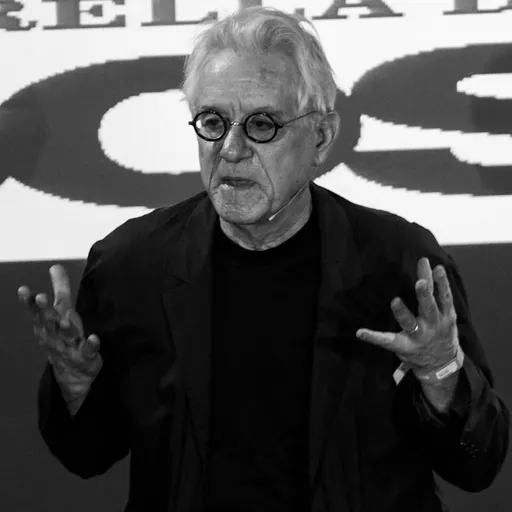
About Greil Marcus
Born 1945. Greil Marcus is an American historian, music historian, writer, journalist, music critic and music journalist, known for Creem, Pitchfork (website) and Rolling Stone.
Greil Marcus (né Gerstley; born June 19, 1945) is an American author, music journalist and cultural critic. He is notable for producing scholarly and literary essays that place rock music in a broader framework of culture and politics.
Biography Marcus was born Greil Gerstley in San Francisco, California, the only son of Greil Gerstley and Eleanor Gerstley (née Hyman). Marcus is Jewish. His father, a naval officer, died in December 1944, when a Philippine typhoon sank the USS Hull, on which he was serving as second-in-command. and, despite the crew's urging, Gerstley refused to disobey the order, arguing that there had never been a mutiny in the history of the U.S. Navy and that "somebody had to die". The incident inspired the novel The Caine Mutiny.
His wife is Jennelle Marcus (née Berstein). He often cited as a major influence a Berkeley political science professor, Michael Rogin, of whom he said: "That course had more to do with putting me on the path I've followed ever since, for good or ill, than anything else."
He has been a rock critic and columnist for Rolling Stone (where he was the first reviews editor) and other publications, including Creem, the Village Voice, Artforum, and Pitchfork. From 1983 to 1989, he was on the board of directors of the National Book Critics Circle.
His book Mystery Train (published in 1975 and in its sixth revised and updated edition in 2015) is notable for placing rock and roll in the context of American cultural archetypes, from Moby-Dick to The Great Gatsby to Stagger Lee. Marcus's "recognition of the unities in the American imagination that already exist" inspired countless rock journalists. On August 30, 2011, Time magazine published a list of its selection of the 100 best nonfiction books since 1923, when the magazine was first published; Mystery Train was on the list, one of only five books dealing with culture and the only one on the subject of American music. Writing for The New York Times, Dwight Garner said, "Mystery Train is among the few works of criticism that can move me to something close to tears. It reverberated in my young mind like the E major chord that ends the Beatles' "A Day in the Life."
His next book, Lipstick Traces: A Secret History of the 20th Century (1989), stretched his trademark riffing across a century of Western civilization. Positing punk rock as a transhistorical cultural phenomenon, Marcus examined philosophical connections between subjects as diverse as medieval heretics, Dada, the Situationists, and the Sex Pistols.
Marcus published Dead Elvis, a collection of writings about Elvis Presley, in 1991, and Ranters and Crowd Pleasers (reissued as In the Fascist Bathroom: Punk in Pop Music), an examination of post-punk political pop, in 1993.
Using bootleg recordings of Bob Dylan as a starting point, he dissected the American subconscious in Invisible Republic: Bob Dylan's Basement Tapes, published in 1997.
He writes the column "Elephant Dancing" for Interview and "Real Life Rock Top Ten" for The Believer. He occasionally teaches graduate courses in American Studies at the University of California, Berkeley, During the fall of 2008, he held the Winton Chair in the College of Liberal Arts at the University of Minnesota, where he taught and lectured on the history of American pop culture.
His book When That Rough God Goes Riding: Listening to Van Morrison was published in March 2010. It focuses on "Marcus's quest to understand Van Morrison's particular genius through the extraordinary and unclassifiable moments in his long career". The title is derived from Morrison's 1997 song "Rough God Goes Riding".
He subsequently published Bob Dylan by Greil Marcus: Writings 1968–2010 (2010) and The Doors: A Lifetime of Listening to Five Mean Years (2011).
In 2012, the Los Angeles Review of Books published a 20,000-word interview with Marcus about his life by Simon Reynolds. A collection of his interviews, edited by Joe Bonomo, was published by the University Press of Mississippi in 2012.
Don’t just read it —
keep it.
Full-length biographies made to live with: read them, listen on the way to work, watch them tonight.
- E-book
- Audio
- Video
Instant download · yours to keep · every purchase keeps this site free
Important facts
People in Greil Marcus's life
Named in this biography and alive at the same time






Related people
Same field, nearest in time





Contemporaries
People whose lives overlapped Greil Marcus's


Frequently asked questions
Who is Greil Marcus?
American author, music journalist and cultural critic
When was Greil Marcus born?
Greil Marcus was born on 19 June 1945 in San Francisco.
What is Greil Marcus's occupation?
Greil Marcus is a historian, music historian, writer, journalist, music critic and music journalist.
What is Greil Marcus known for?
Greil Marcus is known for Creem, Pitchfork (website), Rolling Stone and The Village Voice.
What nationality is Greil Marcus?
Greil Marcus is American.
Sources & further reading
Cite this page
APA: Biography.guide. (2026). Greil Marcus. https://biography.guide/greil-marcus/
MLA: "Greil Marcus." Biography.guide, https://biography.guide/greil-marcus/.
Chicago: "Greil Marcus." Biography.guide. https://biography.guide/greil-marcus/.
Data last updated: 2026-09-21 · Spot an error? Report a correction.
Portrait: Wikimedia Commons · author & licence
Page generated 2026-09-27 04:59 UTC