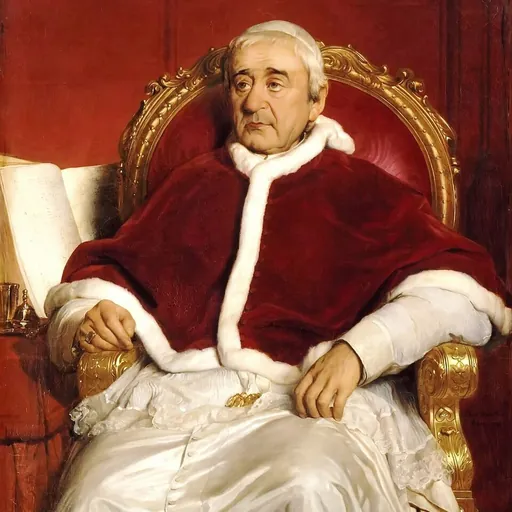
Gregory XVI
Pope of the Catholic Church from 1831 to 1846
About Gregory XVI
Lived 1765 – 1846 (aged 80). Gregory XVI was an Italian catholic priest and catholic bishop.
Pope Gregory XVI (; ; born Bartolomeo Alberto Cappellari; 18 September 1765 – 1 June 1846) was head of the Catholic Church and leader of the Papal States from 2 February 1831 to his death in June 1846. He had adopted the name Mauro upon entering the religious order of the Camaldolese. He is the most recent pope to take the pontifical name "Gregory", the last to govern the Papal States for the whole duration of his pontificate, and the most recent not to have been a bishop when elected.
Born in Belluno, Cappellari joined the order of Camaldolese when he was eighteen. Ordained as a priest in 1787, he was a teacher of both philosophy and theology. Cappellari was made a cardinal, and, in 1831, he was elected as pope, taking the papal name Gregory XVI. A staunch defender of traditional doctrine against new ideas, he worked to protect the Papal States from attacks by Italian patriotic movements. His pontificate saw a renewed commitment to missionary work overseas. In his 1839 papal brief In supremo apostolatus, Pope Gregory XVI condemned both the slave trade and the continuance of the institution of slavery. He died of erysipelas in June 1846.
Biography
Early life Bartolomeo Alberto Cappellari was born at Belluno in the Republic of Venice, on 18 September 1765, as the last of five children, to a local Italian lower noble family, notable since the 16th century, aggregated to the local Nobility Council in 1670 and traditionally linked to liberal professions but not to the consecrated life. He was baptized at the parish of Bolzano Bellunese by his uncle Antonio Capellari. His parents were from a small village named Pesariis, in Friuli. His father, Giovanni Battista Capellari, was a notary. His mother, Giulia Cesa was a daughter of a notary. At the age of eighteen, Bartolomeo Cappellari joined the order of the Camaldolese (part of the Benedictine monastic family) and entered the Monastery of San Michele in Murano, near Venice. He was ordained a priest in 1787. As a Camaldolese monk, Cappellari rapidly gained distinction for his theological and linguistic skills, and was assigned to teach philosophy and theology at San Michele in 1787, at the age of 22.
In 1790, at the age of 25, he was appointed censor librorum for his Order, as well as for the Holy Office at Venice. which passed through various editions in Italy and was translated into several European languages. In 1800, he became a member of the Academy of the Catholic Religion, founded by Pope Pius VII (1800–1823), to which he contributed memoirs on theological and philosophical questions. In 1805, at the age of 40, he was appointed abbot of the Monastery of San Gregorio on Rome's Caelian Hill.
When the army of the French Emperor Napoleon took Rome and arrested and deported Pius VII to France in 1809, Cappellari fled to Murano, where he taught in the Monastery of St. Michele of his Order, where he had first become a monk. From there he and a group of monks moved their little college to Padua in 1814. After Napoleon's final defeat, the Congress of Vienna re-established the sovereignty of the Papal States over central Italy and Cappellari was called back to Rome to assume the post of vicar general of the Camaldolese Order. He was then appointed as Counsellor to the Inquisition, and later promoted to be Consultor (29 February 1820) and then, on 1 October 1826, Prefect of the Congregation of Propaganda Fide ("Propagation of the Faith"), which dealt with all missionary work outside of the Spanish Empire, including missions to the non-Catholic states in Europe. Twice he was offered a bishopric and twice he refused.
Cappellari had never travelled outside Italy and was most familiar with Venice and Rome. He spoke Italian and Latin fluently, but no other European languages, and did not understand European politics. However, he was proficient in Armenian, and Haruti'iwn Awgerian (Pascal Aucher)'s 1827 Venice edition of works attributed to Severian of Gabala and translated into Armenian was dedicated to him.
Pontificate
Papal election
On 2 February 1831, after a fifty-day conclave, Cappellari was unexpectedly chosen to succeed Pope Pius VIII (1829–30). His election was influenced by the fact that the cardinal considered the most papabile, Giacomo Giustiniani, was vetoed by King Ferdinand VII of Spain.
At the time of election, Cardinal Cappellari was not yet a bishop; he is the most recent man to be elected pope prior to his episcopal consecration. He was consecrated as bishop by Bartolomeo Pacca, Cardinal Bishop of Ostia and Velletri and dean of the Sacred College of Cardinals, with Pietro Francesco Galleffi, Cardinal Bishop of Porto e Santa Rufina and sub-dean of the Sacred College of Cardinals, and Tommasso Arezzo, Cardinal Bishop of Sabina, acting as co-consecrators.
The choice of Gregory XVI as his regnal name was influenced by the fact that he had been abbot of the Monastery of San Gregorio on the Coelian Hill for more than twenty years, and in honour of Gregory XV, the founder of the Congregation for the Propagation of the Faith. In the course of the struggle that ensued, the Pope found it necessary more than once to call in Austrian troops to fight the red-shirted republicans engaged in a guerrilla campaign. The conservative administration of the Papal States postponed their promised reforms after a series of bombings and assassination attempts. The replacement of Tommaso Bernetti by Luigi Lambruschini as Cardinal Secretary of State in 1836 did nothing to appease the situation.
In the northern territories, the leaders of the revolt were middle-class gentry opposed to the general inefficiency of the government. these were:
No. Title (Latin) Title or English translation Subject Date1. Quel Dio "That God ..." End of the insurrection in the Papal States 5 April 18312. Le armi valorose "The Valiant Weapons" On the pacification of the Papal States 12 July 18313. Cum primum "When the First [report]" Condemnation of the November Uprising in Kingdom of Poland 9 July 18324. Mirari vos "That You Wonder" The conditions of the time as Gregory saw them, and condemnation of liberalism and indifferentism 15 August 18325. Singulari Nos "Us in Particular" Condemnation of the ideas of Félicité de La Mennais 25 June 18346. Commissum divinitus "Divinely Commissioned" Condemnation of certain doctrinal errors being adopted especially in parts of Switzerland 17 May 18357. Augustissimam beatissimi "Most August, Most Blessed" Restoration of the Basilica of Saint Paul Outside the Walls 21 December 18408. Inter ea "Among These [concerns]" Condemnation of anti-clerical laws in the Swiss Confederation 1 April 18429.Inter praecipuas "Among the Special Schemes" Condemnation of non-Catholic Bible translations 8 May 1844
Other activities Apostolic letters In supremo apostolatus, an apostolic letter or papal bull, was issued by Pope Gregory XVI regarding the institution of slavery. Issued on 3 December 1839, as a result of a broad consultation among the College of Cardinals, the bull resoundingly denounced both the slave trade and the continuance of the institution of slavery.
He wrote to four Bohemian bishops in 1845 affirming the liturgical use of the term "Immaculate Conception" in relation to the Virgin Mary.
Canonizations and beatifications Gregory XVI canonized Veronica Giuliani, an Italian mystic, during his papacy. During his reign, five saints were canonized (notably Alphonsus Liguori) and thirty-three Servants of God were declared Blessed (including the Augustinian Simon of Cascia). In addition, many new religious orders were founded or supported and the devotion of the faithful to the Blessed Virgin Mary increased, both in private and public life.
Death and burial On 20 May 1846, he felt himself failing in health. A few days later, he was taken ill with facial erysipelas. At first, the attack was not thought to be very serious, but on 31 May, his strength suddenly failed, and it was seen that the end was near.
Don’t just read it —
keep it.
Full-length biographies made to live with: read them, listen on the way to work, watch them tonight.
- E-book
- Audio
- Video
Instant download · yours to keep · every purchase keeps this site free
Important facts
more
pape Grégoire XVI, Papa Gregorio XVIPeople in Gregory XVI's life
Named in this biography and alive at the same time



Related people
Same field, nearest in time


Contemporaries
People whose lives overlapped Gregory XVI's





Frequently asked questions
Who was Gregory XVI?
Pope of the Catholic Church from 1831 to 1846 (1765–1846)
When was Gregory XVI born?
Gregory XVI was born on 18 September 1765 in Belluno.
When did Gregory XVI die?
Gregory XVI died on 1 June 1846 in Rome.
What was Gregory XVI's occupation?
Gregory XVI was a catholic priest and catholic bishop.
What nationality was Gregory XVI?
Gregory XVI was Italian.
Sources & further reading
Cite this page
APA: Biography.guide. (2026). Gregory XVI. https://biography.guide/gregory-xvi/
MLA: "Gregory XVI." Biography.guide, https://biography.guide/gregory-xvi/.
Chicago: "Gregory XVI." Biography.guide. https://biography.guide/gregory-xvi/.
Data last updated: 2026-09-22 · Spot an error? Report a correction.
Portrait: Wikimedia Commons · author & licence
Page generated 2026-09-27 05:02 UTC