
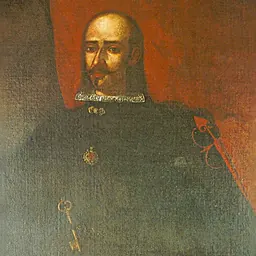
Gregory Dexter
Rhode Island colonial president
About Gregory Dexter
Lived 1610 – 1700. Gregory Dexter was an American politician, book printer and list of colonial governors of Rhode Island.
Gregory Dexter (1610 – c. 1700) was a renowned printer of important and controversial books and pamphlets in London. In New England, he assumed various roles including serving as a consultant to printers, a Baptist minister, an owner of a limestone quarry, and a political figure elected as president of the combined towns of Providence and Warwick in colonial Rhode Island. He is best known as the printer of Roger Williams's book A Key into the Language of America in 1643, the first English translation of a Native American language.
England Gregory Dexter was born in the year 1610 in Old, Northamptonshire, England.
Gregory Dexter was incarcerated by the House of Commons in 1641 at Gatehouse Prison, where he was ordered to stay "during the Pleasure of this House" for releasing a pamphlet called "The Protestation Protested," which was authored by Puritan Henry Burton. In October 1642, while Gregory was serving in the military, his wife, Abigail Dexter (née Fullerton), was apprehended by the House of Lords for printing prohibited literature and for refusing to disclose the names of the authors. She was jailed at King's Bench until "the Pleasure of this House be further known."
Following their imprisonments, the Dexters continued to publish works by notable authors such as John Milton, John Goodwin, Lawrence Sanders, and Andrew Perne. In 1643, they published A Key into the Language of America, a translation of the Narragansett dialect of Algonquin by Roger Williams. In 1644, they anonymously (but identified by the Dexters' damaged type) released several works by Roger Williams on religious liberty and soul freedom including Mr. Cotton's Letter Lately Printed and Queries of Highest Consideration. Williams's book The Bloudy Tenent is sometimes attributed to the Dexters, but a typeface analysis points to the printers Thomas Paine and Matthew Simmons.
In 1644, the Stationers' Company conducted a raid on the Dexters' shop, which resulted in the confiscation of their printing equipment and presses, leaving them unable to continue their printing business in London.
New England leftThe Dexters moved to New England, where they joined Roger Williams at Providence. There, Gregory Dexter was granted a slender five-acre plot of land that extended from present-day North Main Street to Hope Street, along Olney Street.
Following his relocation to Providence, Gregory Dexter provided consultation services to some of the earliest printers who emerged in the American colonies. He aided Matthew Daye in Cambridge, Massachusetts, and subsequently assisted Samuel Green after he acquired Daye's printing shop in 1648. Dexter made annual visits to support Green and requested only a copy of the almanac in exchange for his services.
Subsequently, Dexter turned his focus towards religion and became a pastor at the First Baptist Church in Providence, where he remained from 1654 until his passing in 1700. He took over from Thomas Olney, who resigned from his position in 1652 due to a disagreement regarding the "laying on of hands." Dexter worked alongside co-pastor William Wickenden until 1669, when he became the head minister. The demand for limestone was high due to its applications in leather tanning, candle-making, and as a component of plaster and mortar. In August 1669, Roger Williams sent a letter to John Winthrop Jr., the governor of Connecticut, endorsing Dexter's enterprise: Sir, I have encouraged Mr. Dexter to send you a limestone, and to salute you with this enclosed. He is an intelligent man, a master printer of London and conscionable (though a Baptist), therefore maligned and traduced by William Harris (a doleful generalist). Sir, if there be any occasion of yourself (or others) to use any of this stone, Mr. Dexter hath a lusty team and lusty sons, and very willing heart (being a sanguine, cheerful man), to do yourself or any (at your word especially) service upon very honest and cheap considerations. In 1676, during King Philip's War, the Dexters took refuge in Long Island. During the attack Dexter's Providence home was burned down.
Dexter died in 1700 and was buried in Providence on his home lot near the present day intersection of Benefit and North Main Streets. His wife Abigail died in 1706.
Although the younger Gregory Dexter's baptismal record has not been found, historian Bradford Swan argues that it can be safely assumed he was born in Old, rather than in Olney, Buckinghamshire, as some older genealogies suggest. A further reference can be found in Gregory's Bible, which remains in the possession of his descendants.
Don’t just read it —
keep it.
Full-length biographies made to live with: read them, listen on the way to work, watch them tonight.
- E-book
- Audio
- Video
Instant download · yours to keep · every purchase keeps this site free
Important facts
People in Gregory Dexter's life
Named in this biography and alive at the same time



Related people
Same field, nearest in time

Contemporaries
People whose lives overlapped Gregory Dexter's





Frequently asked questions
Who was Gregory Dexter?
Rhode Island colonial president
When was Gregory Dexter born?
Gregory Dexter was born in 1610 in Northamptonshire.
When did Gregory Dexter die?
Gregory Dexter died in 1700 in Providence.
What was Gregory Dexter's occupation?
Gregory Dexter was a politician, book printer and list of colonial governors of Rhode Island.
What nationality was Gregory Dexter?
Gregory Dexter was American.
Sources & further reading
Cite this page
APA: Biography.guide. (2026). Gregory Dexter. https://biography.guide/gregory-dexter/
MLA: "Gregory Dexter." Biography.guide, https://biography.guide/gregory-dexter/.
Chicago: "Gregory Dexter." Biography.guide. https://biography.guide/gregory-dexter/.
Data last updated: 2026-09-20 · Spot an error? Report a correction.
Page generated 2026-09-27 05:05 UTC