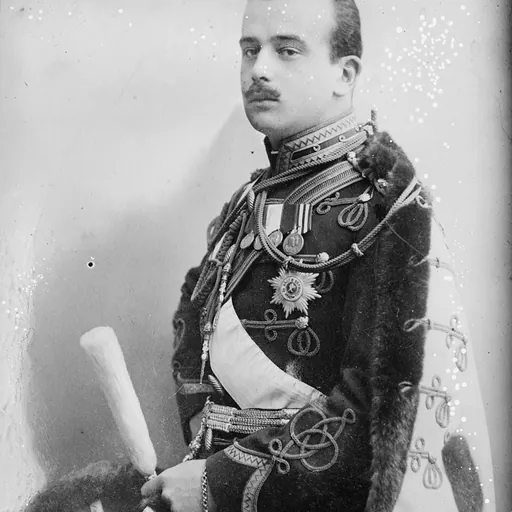
Grand Duke Boris Vladimirovich of Russia
Russian grand duke (1877–1943); son of Grand Duke Vladimir Alexandrovich of Russia, a grandson of Tsar Alexander II of Russia, and a first cousin of Tsar Nicholas II
About Grand Duke Boris Vladimirovich of Russia
Lived 1877 – 1943 (aged 65). Grand Duke Boris Vladimirovich of Russia was a Russian military personnel.
Grand Duke Boris Vladimirovich of Russia (; 24 November 1877 – 9 November 1943) was a son of Grand Duke Vladimir Alexandrovich of Russia, a grandson of Tsar Alexander II of Russia and a first cousin of Tsar Nicholas II.
He followed a military career. After graduating from the in 1896, he served as cornet in the Life Guards Hussar regiment. He took part in the Russo-Japanese War in 1904 and became a major general in the Russian Army in 1914. During World War I, he commanded the regiment of the Ataman Cossacks in 1915. He was known in Imperial Russia for his restless behavior and as a notorious playboy.
After the fall of the Russian monarchy, he was put under house arrest in Petrograd by the provisional government in March 1917, but he managed to escape the former Imperial capital in September that year and joined his mother and younger brother in the Caucasus. He departed revolutionary Russia in March 1919 with his longtime mistress, whom he married in exile. Eventually, he settled in France where he spent the rest of his life. He died in Occupied Paris in 1943.
Early life Grand Duke Boris Vladimirovich was born on at his parents' palace in Saint Petersburg. He was the third child and second surviving son among the five children of Grand Duke Vladimir Alexandrovich of Russia and his wife Grand Duchess Maria Pavlovna, née Duchess Marie Alexandrine of Mecklenburg-Schwerin.
His parents were very wealthy and lived in the luxurious Vladimir Palace in Saint Petersburg. His father, Vladimir Alexandrovich, a brother of Tsar Alexander III of Russia, was a renowned patron of the arts; his mother, Maria Pavlovna, one of the greatest hostesses of Russian society. Boris, more extroverted than his siblings, was his mother's favorite.
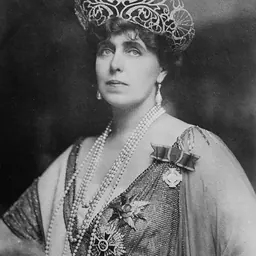
Grand Duke Boris was educated at home. He initially was raised by a British nanny, the first language he spoke was English. As was customary in the Russian Imperial family, Boris and his siblings also have a sailor "nanny", a male attendant from the Imperial navy, who served as the children's companion looking after them. The four siblings spent most of their time at their parents villa in Tsarkoe Selo where they had a lot of freedom and were able to visit a park with a pond. All the materials were imported from England and construction was finished in less than a year. Boris Vladimirovich lived in Wolf Garden all year round while still serving in the army. The property was run as a modern farm and in 1899 a small house was added for the servants. In 1896 during the coronation ceremonies of Tsar Nicholas II, he flirted with Crown Princess Marie of Romania, who was his first cousin and was already married. The next year, he visited her in Bucharest, fueling more rumors. She said that "he had an attractive, rather husky voice, kind eyes, and humorous smile, which crinkled his forehead into unexpected lines. Not exactly handsome, he had nevertheless great charm." His trips abroad became legendary, his escapades in doubtful taste. He drank in the company of spongers and prostitutes. His mother protected him from the wrath of the family.
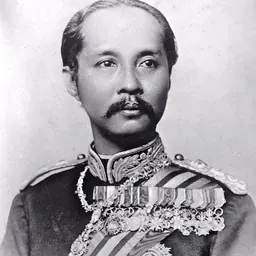
In 1901, Grand Duke Boris, age twenty five, had a liaison with a Frenchwoman, Jeanne Aumont-Lacroix, and had a son by her, born in Paris. The child, Jean Boris Lacroix (1902–1984), was not recognized. He visited Egypt and later India. He was a guest of Maharaja Surjyakanta Acharya Chowdhury of Muktagacha, Mymensingh now in Bangladesh. He was a guest of the Maharaja of Kapurthala in his kingdom near Punjab where he went tiger hunting. His trip continued with stops in Ceylon and French Indochina. He spent eight days in Siam as guest of King Chulalongkorn. After that, he visited Japan, and on his way to the United States, he stopped in Honolulu.
On 1 August 1902, Grand Duke Boris arrived in San Francisco where he toured the city; attended the opera and went to a boxing match. His visit to the United States drew a great deal of attention from American newspapers. A journalist in California described him as "a handsome young man of very pleasant manner who spoke good English." In Newport, Boris Vladimirovich was invited to dinners and parties, he played tennis and even learned to play golf. He continued his trip sailing to New York City in Cornelius Vanderbilt's yacht. The grand duke was favorably impressed with the city's skyline and the modern use of electricity Boris visited President Theodore Roosevelt at his estate Sagamore Hill, on the North Shore of Long Island. Because his bad reputation had preceded him, First Lady Edith Roosevelt, who regarded his presence as both "a scandal and an insult" was conspicuously absent. After six hectic weeks in America, Grand Duke Boris sailed back to Europe.
In October 1903, he enlisted in the Tsar's retinue. On 26 February, he left Russia for the Far East to take part in the Russo-Japanese War. He served under the command of the Russian governor in the Far East at the headquarters of the commander in chief of the Army, General A.N. Kuropatkin, taking part in combat
On the morning of 31 March 1904, while galloping from the heights of Dacha Hill on the rim of Port Arthur, he witnessed the sinking of the Russian battleship Petropavlovsk in which more than 600 men died; his brother Grand Duke Kirill was among the few survivors. In December 1904, for his bravery in battle, he was awarded a golden sword with the inscription For Courage and was promoted to staff captain. On his way back to Europe, he visited Egypt and Greece.
War Grand Duke Boris with the Imperial family. From left to right:Grand Duchess Tatiana, Duchess Marie Antoinette of Mecklenburg Schwerin, Grand Duchess Victoria Feodorovna, Grand Duchess Olga, Grand Duke Kirill, Princess Elizabeth of Greece, Princess Olga of Greece, Grand Duchess Anastasia, Grand Duchess Maria. In the foreground : Grand Duchess Maria Pavlovna, Empress Alexandra, Tsar Nicholas II, Grand Duchess Elena, Princess Marina of Greece, Grand Duke Boris, Grand Duke Andrei. When World War I broke out, Boris Vladimirovich was put in command of the Guards regiment of the Ataman Cossacks. It was a nominal position, and he managed to stay away from the fighting. He commanded this regiment during the War between 1914 and 1915. Thereafter, he was attached to the general headquarters and was made Field Ataman for the commander in chief on 17 September 1915. He served in the army without real distinction. His military responsibilities were only vaguely defined and he did not change his ways during the war, continuing his life of pleasure and idleness. Military service was a burden to Boris, who sought every opportunity that would make him return to St. Petersburg. Even during the war Grand Duke Boris gave many parties at his luxurious mansion, furnished in the English style, which at night was a gathering place for the "golden youth" of St. Petersburg. The grand duke was famous for his hospitality, cheerful disposition, passion for entertainment, gourmet cuisine and excellent wines.
In spite of Boris' reputation, his ambitious mother wanted to arrange a splendid marriage for him. In February 1916, she tried to marry him to Grand Duchess Olga Nikolaevna, Tsar Nicholas II's eldest daughter. She was his first cousin once removed. Olga, overprotected by her parents, was an inexperienced girl of twenty. Boris was thirty-eight with a long line of mistresses linked to his name.
Boris' Anglophobia got him into trouble during the War. In June 1916, he was having supper at military headquarters while drunk, and in the presence of several officers of the British Military mission, he lambasted Great Britain. His behavior was so insulting that the British Ambassador made a formal protest, and Boris was forced by the Emperor to apologize. Zinaida, a vivacious brunette twenty years younger than Boris, belonged to the minor Russian nobility. In late 1916, Zinaida was pregnant.
Revolution
During the period of the provisional government Boris Vladimirovich was living in Tsarskoye Selo. In March 1917, he was put under house arrest because of compromising correspondence with his mother. In July his arrest was lifted. In late August he was still in his dacha in Tsarskoe Selo.
Before the Bolsheviks took power, Boris escaped the former Imperial capital to the Caucasus with his mistress Zinaida Rachevskaya. In September 1917, he joined his mother and younger brother Grand Duke Andrei Vladimirovich in Kislovodsk, a spa and resort town in the Caucasus. For the next year they lived quietly away from danger, The Bolshevik commander sent to execute them had once been a struggling artist in Paris before the war whom Boris had helped by buying some of his paintings. The Bolshevik recognized him and, risking his own life, returned them to their villa the next day. Since they were no longer safe and would probably be arrested again, the two grand dukes decided to flee.
On 26 August 1918, armed with false papers stating they were on a mission for the soviets, Boris and Andrei escaped heading for Kabarda, where the chief Circassian tribe, the Kabards, lived on the north slope of the mountain. For a time they wandered from village to village.
Exile Grand Duke Boris and his wife during their visit to the US, 1925. Once safe in exile in Constantinople, Boris tried to get permission to go to Britain but was refused passage on a British warship. In 1922, they moved to a large residence at 18 Rue de Marignan, near the Champs-Élysées, with his wife, mother-in-law and a private secretary. Boris inherited his mother's emeralds, the most valuable items of the Grand Duchess' jewel collection. He sold most of them. The emeralds included a famous necklace which at some point was bought by Cartier, and in turn resold to Barbara Hutton. They subsequently reset the stones and created an even more famous piece, which could be worn as a necklace or a tiara. With the money from the emeralds, and from an account with an American bank which he had opened prior to the Revolution, Boris bought a chateau, "Sans Souci", in Meudon near Paris, living comfortably with his wife. The couple had no children, but raised Zinaida's niece, Natasha.
In the winter of 1925 he and his wife, who claimed an interest in dress-making, sailed to New York City. He said that he just wanted to visit some friends and have a good time. When asked by a reporter whether Henry Ford was a financial supporter of the effort to restore the monarchy in Russia, Boris did not know who Henry Ford was. His brother, Grand Duke Kirill, wanted to restore the Russian monarchy and in 1924 proclaimed himself czar-in-exile, but Boris was largely uninterested in politics.
Nonetheless, there was a large turnout for the funeral, held at St Alexander Nevsky Russian-Orthodox Cathedral in Paris, where his body was placed in the crypt. He was later reburied next to his mother in the Russian Orthodox chapel at Contrexéville, Vosges.
In popular culture Grand Duke Boris was well known before the war as an international playboy, and appears in many memoirs and novels of the period. A representative mention is found in Arthur Train’s 1911 transatlantic liner thriller C.Q., or, In the Wireless House. A military man is seeking aid from an international adventuress in catching a criminal attempting to flee London to New York:
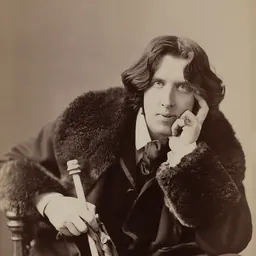
"My dear Mrs. Trevelyan," said he reprovingly, "I didn't mean to suggest that this criminal might be your friend, — I only said you might know him. That's an entirely different matter, isn't it? You might know Jack Johnson, the prize-fighter, or Nan Patterson, or Oscar Wilde — "
"What a delightful circle of acquaintances!" laughed Lily, amused in spite of herself. "If you'd only throw in Harry Thaw, Tod Sloan, Abe Hummel, and Grand Duke Boris it would be really chic, — a real salon!”
Ancestry
Don’t just read it —
keep it.
Full-length biographies made to live with: read them, listen on the way to work, watch them tonight.
- E-book
- Audio
- Video
Instant download · yours to keep · every purchase keeps this site free
Important facts
Family & relationships
People in Grand Duke Boris Vladimirovich of Russia's life
Named in this biography and alive at the same time


Related people
Same field, nearest in time
Contemporaries
People whose lives overlapped Grand Duke Boris Vladimirovich of Russia's

Frequently asked questions
Who was Grand Duke Boris Vladimirovich of Russia?
Russian grand duke (1877–1943); son of Grand Duke Vladimir Alexandrovich of Russia, a grandson of Tsar Alexander II of Russia, and a first cousin of Tsar Nicholas II
When was Grand Duke Boris Vladimirovich of Russia born?
Grand Duke Boris Vladimirovich of Russia was born on 12 November 1877 in Saint Petersburg.
When did Grand Duke Boris Vladimirovich of Russia die?
Grand Duke Boris Vladimirovich of Russia died on 9 November 1943 in Paris.
What was Grand Duke Boris Vladimirovich of Russia's occupation?
Grand Duke Boris Vladimirovich of Russia was a military personnel.
What nationality was Grand Duke Boris Vladimirovich of Russia?
Grand Duke Boris Vladimirovich of Russia was Russian.
Sources & further reading
· Wikipedia: Grand Duke Boris Vladimirovich of Russia
· DBpedia: Grand Duke Boris Vladimirovich of Russia
Cite this page
APA: Biography.guide. (2026). Grand Duke Boris Vladimirovich of Russia. https://biography.guide/grand-duke-boris-vladimirovich-of-russia/
MLA: "Grand Duke Boris Vladimirovich of Russia." Biography.guide, https://biography.guide/grand-duke-boris-vladimirovich-of-russia/.
Chicago: "Grand Duke Boris Vladimirovich of Russia." Biography.guide. https://biography.guide/grand-duke-boris-vladimirovich-of-russia/.
Data last updated: 2026-09-25 · Spot an error? Report a correction.
Portrait: Wikimedia Commons · author & licence
Page generated 2026-10-04 09:21 UTC