
Grace Thorpe
World War II veteran, environmentalist, tribal court judge, and Native rights activist
About Grace Thorpe
Lived 1921 – 2008 (aged 86). Grace Thorpe was an American environmentalist and paralegal.
Grace Frances Thorpe
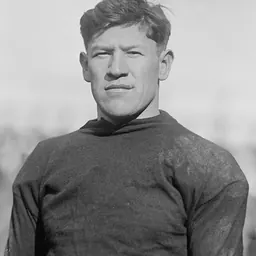
Her father was well-known American football player and Olympic athlete Jim Thorpe. The Grace F. Thorpe Collection is held by the National Museum of the American Indian Archives Center.
Personal life Thorpe was born on December 10, 1921, to parents James (Jim) Francis Thorpe (Sac and Fox) and Iva Margaret Miller. Her tribal heritage included Potawatomi, Kickapoo, Sac and Fox, and Menominee ancestry, and she was a direct descendant of Sac and Fox chief Black Hawk. Grace was the youngest of four; her oldest sister Gail Margaret was born in 1917, her brother James in 1918, and her sister Charlotte Marie in 1919. Her brother James died from polio before reaching adolescence. Though she had envisioned herself in places like Paris or Athens, she was assigned to serve as a corporal in the Philippines, Japan, and New Guinea from 1944 to 1945. Following an Honorable Discharge in 1945, she remained in Japan. She began work in Japan at General MacArthur Headquarters as Chief of the Recruitment Section, Department of Army Civilians, Tokyo. In June 1946, she married Lieutenant Fred W. Seely (1918-2008). Together they had two children, Dagmar Thorpe (1946) and Paul Thorpe (1948–1964), both born in Japan. In 1950, the couple divorced, and Thorpe and her children left Japan and returned to the United States to live in Pearl River, New York, near her father's home.
Native rights activism Alcatraz occupation In late 1969 and 1970, Grace Thorpe joined a group of Native activists in their occupation of Alcatraz Island off the coast of San Francisco. This occupation called national attention to a long history of Native grievances that the activists felt the federal government was too slow in addressing. This occupation represented a watershed moment for Native activism. Thorpe recalled in a radio interview, "Alcatraz was the catalyst and the most important event in the Indian movement to date. It made me put my furniture into storage and spend my life savings." During the occupation she managed publicity for the group and acted as a negotiator between the activists and the federal government. She successfully secured a generator, water barge, and ambulance service for the group. After Alcatraz, Thorpe remained involved in agitation for Native rights, participating in further occupations of Fort Lawton, Washington in March 1970 and Nike Missile Base near Davis, California in November 1970.
National Congress of American Indians After her participation in the occupations of 1969 and 1970, Thorpe went on to be a lobbyist on behalf of the National Congress of American Indians, working especially to further economic opportunities for Native families on reservations by pushing factories to locate on Native land.
National Indian Women's Action Corps In 1971 Thorpe cofounded the National Indian Women's Action Corps, a group that focused on empowering Native women and strengthening indigenous family units. She told a journalist in March 1971, "We Indian women decided to start beating the drum for ourselves… We want all Indian women who want to be active to join us in finding solutions to our problems." The group's focus on family units derived in part from the history of the American government removing Native children from their families and sending them to live in white households or in boarding schools.
Legal career Thorpe earned a paralegal degree from Antioch School of Law in 1974 and earned her bachelor's degree in American Indian Law at the University of Tennessee, Knoxville, in 1980. The Sac and Fox, as well as sixteen other Native American tribes, accepted the grant, believing that the money would come without strings attached and would help alleviate their high unemployment.
Thorpe researched nuclear waste and its hazards, as well as the details of the funding, most of which in fact went to lawyers and consultants. She started working to convince her tribe to withdraw from the program, and went through the process outlined in the Sac and Fox constitution to reverse the decision of the elected tribal leaders; she gathered signatures of 50 tribe members on a petition calling for a special meeting, and at that meeting on February 29, 1992, 70 out of 75 members present voted to withdraw from the MRS program. The only five in favor were the five elected officials. The Sac and Fox were the first tribe to withdraw from the MRS program. She helped found the National Environmental Coalition of Native Americans (NECONA) in 1993 and served as its president, traveling around the country and working to educate tribes about the dangers of storing nuclear waste and persuade them to refuse the MRS. Part of this work also involved persuading tribe leaders to rewrite their constitutions and revert their government to democracy rather than elected tribal councils, which were established under the Bureau of Indian Affairs in 1934 and were more susceptible to government pressure. Also in 1993, NECONA joined forces with Nuclear Free America, an international clearinghouse for information about Nuclear Free Zones. Together they created the Nuclear Free Indian Lands Project, which urged tribal governments to pass Nuclear Free Zone laws banning the dumping of nuclear waste and transportation of nuclear residue through tribal lands. Within three years of learning of the MRS, Thorpe had persuaded 15 out of the 17 tribes that had initially accepted the grant to withdraw, In 1999, she received a Nuclear-Free Future Award for this work.
Don’t just read it —
keep it.
Full-length biographies made to live with: read them, listen on the way to work, watch them tonight.
- E-book
- Audio
- Video
Instant download · yours to keep · every purchase keeps this site free
Important facts
People in Grace Thorpe's life
Named in this biography and alive at the same time



Related people
Same field, nearest in time






Contemporaries
People whose lives overlapped Grace Thorpe's




Frequently asked questions
Who was Grace Thorpe?
World War II veteran, environmentalist, tribal court judge, and Native rights activist (1921-2008)
When was Grace Thorpe born?
Grace Thorpe was born on 10 December 1921 in Yale.
When did Grace Thorpe die?
Grace Thorpe died on 1 April 2008 in Claremore.
What was Grace Thorpe's occupation?
Grace Thorpe was an environmentalist and paralegal.
What nationality was Grace Thorpe?
Grace Thorpe was American.
Sources & further reading
Cite this page
APA: Biography.guide. (2026). Grace Thorpe. https://biography.guide/grace-thorpe/
MLA: "Grace Thorpe." Biography.guide, https://biography.guide/grace-thorpe/.
Chicago: "Grace Thorpe." Biography.guide. https://biography.guide/grace-thorpe/.
Data last updated: 2026-09-26 · Spot an error? Report a correction.
Page generated 2026-09-27 05:14 UTC