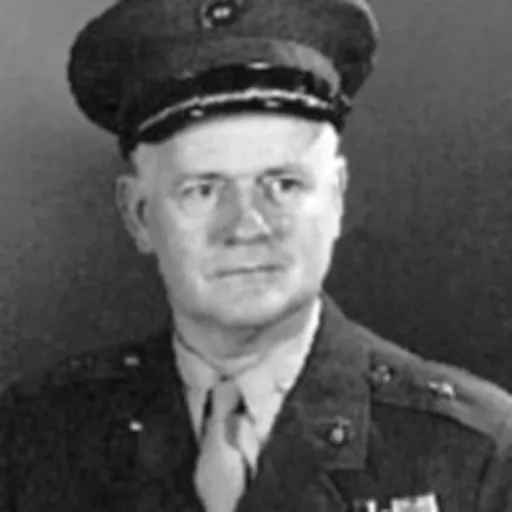
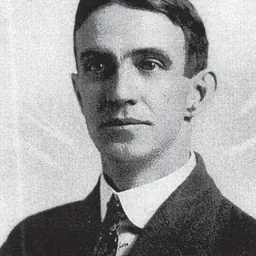
Gordon D. Gayle
Retired United States Marine Corps brigadier general
About Gordon D. Gayle
Lived 1917 – 2013 (aged 95). Gordon D. Gayle was an American military officer and historian.
Gordon Donald Gayle (September 13, 1917 – April 21, 2013) was an American officer in the United States Marine Corps with the rank of brigadier general and historian. A veteran of World War II and Korea, he distinguished himself as commanding officer, 2nd Battalion, 5th Marines and received Navy Cross, the United States military's second-highest decoration awarded for valor in combat.
He later served as chairman, Long Range Study Panel which was tasked with the developing of concepts for the Marine Corps operational, organizational, logistical and Research and Development needs for the 1985 period. The study was a catalyst in forming a coherent Marine Corps vision of its future.
Early career
Gordon D. Gayle was born on September 13, 1917, in Tulsa, Oklahoma, as the son of businessman with the oil-field equipment, Maurice Rowe Gayle and his wife Frances Madge. He completed the grammar school in Shreveport, Louisiana, in summer 1930 and subsequently graduated from the Sunset High School in Dallas, Texas, in June 1934. Gayle then enrolled the Southern Methodist University in Dallas, but left after one year, when received appointment to the United States Naval Academy at Annapolis, Maryland.
Following heavy ship losses during the Battle of Savo Island, Vice Admiral Richmond K. Turner temporarily withdrew naval forces from the immediate Guadalcanal area, including the transports holding key undelivered Marine supplies and equipment. Until naval units, under the inspirational leadership of Admiral William "Bull" Halsey returned to continue their ultimately successful but heavily contested and heroic support for the 1st Marine Division on Guadalcanal, the only means of long-range communication available to the hard-pressed Division was the Japanese radio Gayle had identified and safeguarded. Major Gayle (center) plots the field map with general William H. Rupertus (right) and Colonel John T. Selden, commanding the 5th Marines near Mount Martha, Australia, in July 1943. His battalion was then ordered to Pavuvu, Russell Islands in June 1944 for rest and refit, but the island of Pavuvu, which at that point had not been prepared to receive troops, was anything but a paradise. The island was rain-soaked and rat-infested and instead of participating in a gradual rehabilitation-training program, the 5th Marines had to construct bivouac areas from scratch. Soon morale reached a low point, for with all the work, there was little material for rebuilding the mental and physical strength of Gayle's Marines. The food consisted mostly of rations similar to those consumed in New Britain campaign and visits to sick call became more numerous.
In the early morning of September 15, 1944, Gayle and his battalion (2/5) sailed for Peleliu, Palau Islands to capture the large Japanese airfield there, which was seen as a threat to General MacArthur's lines of communication for his upcoming invasion of the Philippines. The 5th Marine Regiment was charged to land, drive across the airfield, cut the island in two, and then re-orient north and drive to secure the eastern half of the island. During the heavy fighting for the airfield, Gayle and his battalion, along with other Marine units, repulsed a strong Japanese counterattack which included light tanks and subsequently led his battalion in the assault across the airfield—over fourteen hundred yards of open ground—in the face of intense rifle mortar, artillery and machine-gun fire. Although later wounded in a mortar blast which killed much of his command unit, Gayle refused evacuation and remained in command, thereby speeding 2/5's seizure and securing of the major portion of the airfield against fanatical enemy resistance and fierce counterattacks.
For his leadership and heroism in action on Peleliu, Gayle was decorated with Navy Cross, the United States military's second-highest decoration awarded for valor in combat. He also received the Purple Heart for his combat wound and was ordered to back to the United States for treatment.
Postwar career
In May 1947, Gayle became military plans and assistant operations officer on the staff of the commander, Amphibious Group One and Transport Squadron One, in San Diego, California, and served in this capacity until December 1948. Gayle was then ordered to Headquarters Marine Corps in Washington, D.C., and served with the Division of Plans and Policies until June 1949, when he was appointed assistant director of Marine Corps History Division and deputy to Brigadier General Clayton C. Jerome. During his service in this capacity, he wrote the Marine Corps official history of the Peleliu battle and several other history publications. He also authored in later years the Marine Corps official monograph Bloody Beaches: The Marines at Peleliu.
He was then transferred to divisional staff under Major General Gerald C. Thomas and assumed duty as assistant chief of staff for operations (G-3). The division was sent to western Korea in March 1952, where it took over a sector of the extreme left of the UN line with the responsibility of blocking the historic invasion route to Seoul. Gayle remained in that capacity until the end of April 1952 and then returned to the United States for a severe family medical emergency. For his service on the staff of 1st Marine Division, Gayle received the Legion of Merit with Combat "V".
Don’t just read it —
keep it.
Full-length biographies made to live with: read them, listen on the way to work, watch them tonight.
- E-book
- Audio
- Video
Instant download · yours to keep · every purchase keeps this site free
Important facts
People in Gordon D. Gayle's life
Named in this biography and alive at the same time

Related people
Same field, nearest in time



Contemporaries
People whose lives overlapped Gordon D. Gayle's

Frequently asked questions
Who was Gordon D. Gayle?
Retired United States Marine Corps brigadier general
When was Gordon D. Gayle born?
Gordon D. Gayle was born on 13 September 1917 in Tulsa.
When did Gordon D. Gayle die?
Gordon D. Gayle died on 21 April 2013 in Farnham.
What was Gordon D. Gayle's occupation?
Gordon D. Gayle was a military officer and historian.
What nationality was Gordon D. Gayle?
Gordon D. Gayle was American.
Sources & further reading
Cite this page
APA: Biography.guide. (2026). Gordon D. Gayle. https://biography.guide/gordon-d-gayle/
MLA: "Gordon D. Gayle." Biography.guide, https://biography.guide/gordon-d-gayle/.
Chicago: "Gordon D. Gayle." Biography.guide. https://biography.guide/gordon-d-gayle/.
Data last updated: 2026-09-21 · Spot an error? Report a correction.
Portrait: Wikimedia Commons · author & licence
Page generated 2026-09-27 04:59 UTC