About Gordian I
Lived 159 – 238 (aged 78–79). Gordian I was a Roman military personnel.
Early life Gordian steadily climbed the Roman imperial hierarchy when he became part of the Roman Senate. His political career started relatively late in his life and his early years were probably spent in rhetoric and literary studies. As a military man, Gordian commanded the Legio IV Scythica when the legion was stationed in Syria. He served as governor of Roman Britain in 216 and was a suffect consul sometime during the reign of Elagabalus. Inscriptions in Roman Britain bearing his name were partially erased suggesting some form of imperial displeasure during this role.
While he gained unbounded popularity on account of the magnificent games and shows he produced as aedile, his prudent and retired life did not excite the suspicion of Caracalla, in whose honor he wrote a long epic poem called "Antoninias". Gordian certainly retained his wealth and political clout during the chaotic times of the Severan dynasty which suggests a personal dislike for intrigue. Philostratus dedicated his work Lives of the Sophists to either him or his son, Gordian II.
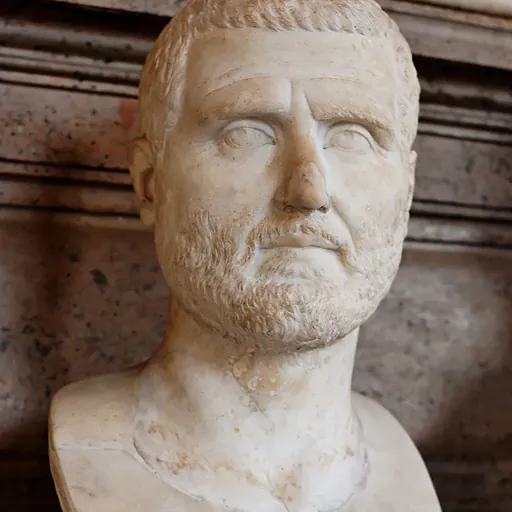
Rise to power Early 3rd-century portrait head on a modern bust, labeled as Gordian I in the Capitoline Museums, Rome. The identification is uncertain. Bust of an emperor in the Bardo National Museum (Tunis) labeled as Gordian I. Some authors call him Decius.
During the reign of Alexander Severus, Gordian I (who was by then in his late sixties), after serving his suffect consulship prior to 223, drew lots for the proconsular governorship of the province of Africa Proconsularis which he assumed in 237. However, prior to the commencement of his promagistrature, Maximinus Thrax killed Alexander Severus at Mogontiacum in Germania Inferior and assumed the throne.
Maximinus was not a popular emperor and universal discontent increased due to his oppressive rule. It culminated in a revolt in Africa in 238 (the exact month is unknown). After Maximinus' fiscal curator was murdered in a riot, people turned to Gordian and demanded that he accept the dangerous honor of the imperial throne. Gordian, who was about 80 years according to Herodian, eventually yielded to the popular clamour and assumed both the purple and the cognomen "Africanus".
Due to his advanced age, he insisted that his son be associated with him. A few days later, Gordian entered the city of Carthage with the overwhelming support of the population and local political leaders. Gordian I sent assassins to kill Maximinus' praetorian prefect, Publius Aelius Vitalianus, and the rebellion seemed to be successful. Gordian, in the meantime, had sent an embassy to Rome, under the leadership of Publius Licinius Valerianus, to obtain the Senate's support for his rebellion. The Senate confirmed the new emperor and many of the provinces gladly sided with Gordian. This event is sometimes dated to 2 April, but this is only based on a passage of the Historia Augusta, nowadays considered highly unreliable, that told about an eclipse presaging the imminent fall of the Gordians. and invaded the African province with the only legion stationed in the region, III Augusta, and other veteran units. Gordian II, at the head of a militia army of untrained soldiers, lost the Battle of Carthage and was killed, and Gordian I killed himself by hanging himself with his belt. The Gordians had ruled only 22 days, the shortest reign of any Roman emperor. Gordian I was also the first emperor to commit suicide since Otho in 69 during the Year of the Four Emperors.
Legacy Gordian's positive reputation can be attributed to his reportedly amiable character. Both he and his son were said to be fond of literature, even publishing their own voluminous works. While they were strongly interested in intellectual pursuits, they possessed neither the necessary skills nor resources to be considered able statesmen or powerful rulers. Having embraced the cause of Gordian, the Senate was obliged to continue the revolt against Maximinus following Gordian's death, appointing Pupienus and Balbinus as joint emperors. Nevertheless, by the end of 238, the recognised emperor would be Gordian III, Gordian I's maternal grandson.
Family tree
Don’t just read it —
keep it.
Full-length biographies made to live with: read them, listen on the way to work, watch them tonight.
- E-book
- Audio
- Video
Instant download · yours to keep · every purchase keeps this site free
Important facts
Family & relationships
People in Gordian I's life
Named in this biography and alive at the same time





Related people
Same field, nearest in time


Contemporaries
People whose lives overlapped Gordian I's


Frequently asked questions
Who was Gordian I?
Roman Emperor
When was Gordian I born?
Gordian I was born in 159 in Phrygia.
When did Gordian I die?
Gordian I died on 12 April 238 in Roman Carthage.
What was Gordian I's occupation?
Gordian I was a military personnel.
What nationality was Gordian I?
Gordian I was Roman.
Sources & further reading
Cite this page
APA: Biography.guide. (2026). Gordian I. https://biography.guide/gordian-i/
MLA: "Gordian I." Biography.guide, https://biography.guide/gordian-i/.
Chicago: "Gordian I." Biography.guide. https://biography.guide/gordian-i/.
Data last updated: 2026-09-21 · Spot an error? Report a correction.
Portrait: Wikimedia Commons · author & licence
Page generated 2026-09-27 04:59 UTC