
About Elagabalus
Lived 203 – 222 (aged 18). Elagabalus was a Roman politician.
Marcus Aurelius Antoninus (born Sextus Varius Avitus Bassianus, 204 – 13 March 222), better known by his posthumous nicknames Elagabalus and Heliogabalus , was Roman emperor from 218 to 222, while he was still a teenager. His short reign was notorious for religious controversy and alleged sexual debauchery. A close relative to the Severan dynasty, he came from a prominent Syrian Arab family in Emesa (Homs), Syria, where he served as the head priest of the sun god Elagabal from a young age. After the death of his cousin, the emperor Caracalla, Elagabalus was raised to the Principate at 14 years of age in an army revolt instigated by his grandmother Julia Maesa against Caracalla's short-lived successor, Macrinus. He only posthumously became known by the Latinised name of his god.
Elagabalus is largely known from accounts by the contemporary senator Cassius Dio who was hostile to him, Herodian, who likely relied extensively on Dio, and the much later Historia Augusta. The reliability of the accounts of Cassius Dio and the Historia Augusta, particularly their most salacious elements, has been questioned. Elagabalus showed a disregard for Roman religious traditions. He brought the cult of Elagabal (including the large baetyl stone that represented the god) to Rome, making it a prominent part of religious life in the city. He forced leading members of Rome's government to participate in religious rites celebrating this deity, presiding over them in person. According to the accounts of Cassius Dio and the Augusta, he married four women, including a Vestal Virgin, in addition to lavishing favours on male courtiers they suggested to have been his lovers, and prostituted himself. His behaviour estranged the Praetorian Guard, the Senate, and the common people alike. Amidst growing opposition, at just 18 years of age he was assassinated and replaced by his cousin Severus Alexander in March 222. The assassination plot against Elagabalus was devised by Julia Maesa and carried out by disaffected members of the Praetorian Guard.
Elagabalus developed a posthumous reputation for extreme eccentricity, decadence, zealotry, and sexual promiscuity. Among writers of the early modern age, he endured one of the worst reputations among Roman emperors. Edward Gibbon, notably, wrote that Elagabalus "abandoned himself to the grossest pleasures with ungoverned fury". According to Barthold Georg Niebuhr, "the name of Elagabalus is branded in history above all others; […] "Elagabalus had nothing at all to make up for his vices, which are of such a kind that it is too disgusting even to allude to them". An example of a modern historian's assessment is Adrian Goldsworthy's: "Elagabalus was not a tyrant, but he was an incompetent, probably the least able emperor Rome had ever had". Despite near-universal condemnation of his reign, some scholars write warmly about his religious innovations, including the 6th-century Byzantine chronicler John Malalas, as well as Warwick Ball, a modern historian who described him as "a tragic enigma lost behind centuries of prejudice".
Modern scholars have questioned the accuracy of Roman accounts of his reign, with suggestions that the reports of his salacious behaviour and sexual excess likely reflected a desire to politically discredit him in the immediate aftermath of his death, as well as reflecting Roman stereotypes regarding people from the Orient as effeminate.
Family and priesthood
Elagabalus was born in 203 or 204, to Sextus Varius Marcellus and Julia Soaemias Bassiana, who had probably married around the year 200 (and no later than 204). Elagabalus's full birth name was probably (Sextus) Varius Avitus Bassianus, the last name being apparently a cognomen of the Emesene dynasty. Marcellus was an equestrian, later elevated to a senatorial position . Julia Soaemias was a cousin of the emperor Caracalla, and there were rumors (which Soaemias later publicly supported) that Elagabalus was Caracalla's child.
Marcellus's tombstone attests that Elagabalus had at least one sibling, possibly a brother, about whom nothing is known. Elagabalus's grandmother, Julia Maesa, was the widow of the consul Julius Avitus Alexianus, the sister of Julia Domna, and the sister-in-law of the emperor Septimius Severus. Other relatives included Elagabalus's aunt Julia Avita Mamaea and her son Severus Alexander.
Elagabalus's family held hereditary rights to the priesthood of the sun god Elagabal, of whom Elagabalus was the high priest at Emesa (modern Homs) in Roman Syria as part of the Arab Emesene dynasty. The deity's Latin name, "Elagabalus", is a Latinized version of the Arabic إِلٰهُ الْجَبَلِ Ilāh al-Jabal, from ilāh ("god") and jabal ("mountain"), meaning "God of the Mountain", the Emesene manifestation of Ba'al.
Initially venerated at Emesa, the deity's cult spread to other parts of the Roman Empire in the second century; a dedication has been found as far away as Woerden (in the Netherlands), near the Roman limes. The god was later imported to Rome and assimilated with the sun god known as Sol Indiges in the era of the Roman Republic and as Sol Invictus during the late third century. In Greek, the sun god is Helios, hence Elagabal was later known as "Heliogabalus", a hybrid of "Helios" and "Elagabalus".
Rise to power Herodian writes that when the emperor Macrinus came to power, he suppressed the threat to his reign from the family of his assassinated predecessor, Caracalla, by exiling them—Julia Maesa, her two daughters, and her eldest grandson Elagabalus—to their estate at Emesa in Syria.
Maesa spread a rumor, which Soaemias publicly supported, that Elagabalus was the illegitimate child of Caracalla During a banquet to celebrate this at Apamea, however, a messenger presented Macrinus with the severed head of his defeated prefect Julianus. Macrinus made for Italy, but was intercepted near Chalcedon and executed in Cappadocia, while Diadumenian was captured at Zeugma and executed. and the memory of Macrinus was expunged by the Senate. (Elagabalus's imperial artifacts assert that he succeeded Caracalla directly.) Comazon was appointed commander of the Praetorian Guard. Elagabalus was named Pater Patriae by the Senate before 13 July 218. On 14 July, Elagabalus was inducted into the colleges of all the Roman priesthoods, including the College of Pontiffs, of which he was named pontifex maximus.
Emperor (218–222)
Journey to Rome and political appointments
Elagabalus stayed for a time at Antioch, apparently to quell various mutinies. Dio outlines several , which historian Fergus Millar places prior to the winter of 218–219. These included one by Gellius Maximus, who commanded the Fourth Legion and was executed, and one by Verus, who commanded the Third Legion Gallica, which was disbanded once the revolt was put down.
Next, according to Herodian, Elagabalus and his entourage spent the winter of 218–219 in Bithynia at Nicomedia, and then traveled through Thrace and Moesia to Italy in the first half of 219, the year of Elagabalus's second consulship. Herodian says that Elagabalus had a painting of himself sent ahead to Rome to be hung over a statue of the goddess Victoria in the Senate House so people would not be surprised by his Eastern garb, but it is unclear if such a painting actually existed, and Dio does not mention it. If the painting was indeed hung over Victoria, it put senators in the position of seeming to make offerings to Elagabalus when they made offerings to Victoria. fired by his unbridled passion for circuses and his habit of driving chariots inside the villa. He raced chariots under the family name of Varius.
Dio states that Elagabalus wanted to marry a charioteer named Hierocles and to declare him caesar, just as (Dio says) he had previously wanted to marry Gannys and name him caesar. The athlete Aurelius Zoticus is said by Dio to have been Elagabalus's lover and cubicularius (a non-administrative role), while the Augustan History says Zoticus was a husband to Elagabalus and held greater political influence.
Elagabalus's relationships to his mother Julia Soaemias and grandmother Julia Maesa were strong at first; they were influential supporters from the beginning, and Macrinus declared war on them as well as Elagabalus. Accordingly, they became the first women allowed into the Senate, and both received senatorial titles: Soaemias the established title of Clarissima, and Maesa the more unorthodox Mater Castrorum et Senatus ("Mother of the army camp and of the Senate"). though antoniniani had a higher metal content than under Caracalla.
Religious controversy Reverse of an aureus of Elagabalus, with the baetyl transported in a quadriga. Inscription: ("to the Holy Sun God El-Gabal")
Since the reign of Septimius Severus, sun worship had increased throughout the Empire. At the end of 220, Elagabalus instated Elagabal as the chief deity of the Roman pantheon, possibly on the date of the winter solstice. In his official titulature, Elagabalus was then entitled in . That a foreign god should be honored above Jupiter, with Elagabalus himself as chief priest, shocked many Romans.
As a token of respect for Roman religion, however, Elagabalus joined either Astarte, Minerva, Urania, or some combination of the three to Elagabal as consort. A union between Elagabal and a traditional goddess would have served to strengthen ties between the new religion and the imperial cult. There may have been an effort to introduce Elagabal, Urania, and Athena as the new Capitoline Triad of Rome—replacing Jupiter, Juno, and Minerva.
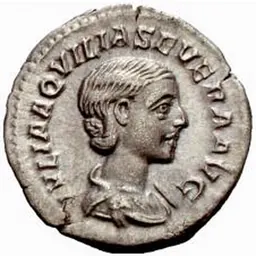
He aroused further discontent when he married the Vestal Virgin Aquilia Severa, Vesta's high priestess, claiming the marriage would produce "godlike children". This was a flagrant breach of Roman law and tradition, which held that any Vestal found to have engaged in sexual intercourse was to be buried alive.
A lavish temple called the Elagabalium was built on the east face of the Palatine Hill to house Elagabal, who was represented by a black conical meteorite from Emesa. This was a baetyl. Herodian wrote "this stone is worshipped as though it were sent from heaven; on it there are some small projecting pieces and markings that are pointed out, which the people would like to believe are a rough picture of the sun, because this is how they see them".
Dio writes that in order to increase his piety as high priest of Elagabal atop a new Roman pantheon, Elagabalus had himself circumcised and swore to abstain from swine. He forced senators to watch while he danced circling the altar of Elagabal to the accompaniment of drums and cymbals. Each summer solstice he held a festival dedicated to the god, which became popular with the masses because of the free food distributed on these occasions. During this festival, Elagabalus placed the black stone on a chariot adorned with gold and jewels, which he paraded through the city:
The most sacred relics from the Roman religion were transferred from their respective shrines to the Elagabalium, including the emblem of the Great Mother, the fire of Vesta, the Shields of the Salii, and the Palladium, so that no other god could be worshipped except in association with Elagabal. Although his native cult was widely ridiculed by contemporaries, sun-worship was popular among the soldiers and would be promoted by several later emperors.
Marriages, sexual orientation and gender identity Denarius depicting Aquilia Severa, the second wife of Elagabalus. The marriage caused a public outrage because Aquilia was a Vestal Virgin, sworn by Roman law to celibacy for 30 years. Inscription:
The question of Elagabalus's sexual orientation and gender identity is disputed, owing to salacious and unreliable sources. Cassius Dio states that Elagabalus was married to women five times (twice to the same woman). His first wife was Julia Cornelia Paula, whom he married prior to 29 August 219; between then and 28 August 220, he divorced Paula, took the Vestal Virgin Julia Aquilia Severa as his second wife, divorced her, and took a third wife, who Herodian says was Annia Aurelia Faustina, a descendant of Marcus Aurelius and the widow of a man Elagabalus had recently executed, Pomponius Bassus. In the last year of his reign, Elagabalus divorced Annia Faustina and remarried Aquilia Severa.
Dio states that another "husband of this woman [Elagabalus] was Hierocles", an ex-slave and chariot driver from Caria. The Historia Augusta claims that Elagabalus also married a man named Zoticus, an athlete from Smyrna, while Dio says only that Zoticus was his cubicularius. Dio says that Elagabalus prostituted himself in taverns and brothels.
Some writers suggest that Elagabalus may have identified as female or been transgender, and may have sought sex reassignment surgery. Dio states that Elagabalus came to be called "woman, lady, empress" after marrying Hierocles. The emperor reportedly wore makeup and wigs, preferred to be called a lady and not a lord, and supposedly offered vast sums to any physician who could provide him with a vagina by means of incision (Cassius Dio, Roman History, 80.16.7).
Fall from power Elagabalus alienated the Roman elites and the Praetorian Guard through his perceptibly foreign conduct and his religious provocations. When Elagabalus's grandmother Julia Maesa perceived that popular support for the emperor was waning, she decided that he and his mother, who had encouraged his religious practices, had to be replaced. As alternatives, she turned to her other daughter, Julia Avita Mamaea, and her daughter's son, the fifteen-year-old Severus Alexander.
Prevailing on Elagabalus, she arranged that he appoint his cousin Alexander as his heir and that the boy be given the title of Caesar. Alexander was elevated to Caesar in June 221, possibly on 26 June. Elagabalus and Alexander were each named consul designatus for the following year, probably on 1 July. Elagabalus took up his fourth consulship for the year of 222. Alexander shared the consulship with the emperor that year. Elagabalus reconsidered this arrangement when he began to suspect that the Praetorian Guard preferred his cousin to him.
Elagabalus ordered attempts on Alexander's life, after failing to obtain approval from the Senate for stripping Alexander of his shared title. According to Dio, Elagabalus invented the rumor that Alexander was near death to see how the Praetorians would react. A riot ensued, and the Guard demanded to see Elagabalus and Alexander in the Praetorian camp.
On 13 March, the emperor complied and publicly presented his cousin along with his own mother, Julia Soaemias. On their arrival the soldiers started cheering Alexander while ignoring Elagabalus, who ordered the summary arrest and execution of anyone who had taken part in this display of insubordination. In response, members of the Praetorian Guard attacked Elagabalus and his mother:
Following his assassination, many associates of Elagabalus were killed or deposed. His lover Hierocles was executed. His religious edicts were reversed and the stone of Elagabal was sent back to Emesa. Women were again barred from attending meetings of the Senate. The practice of damnatio memoriae—erasing from the public record a disgraced personage formerly of note—was systematically applied in his case. Several images, including an over-life-size statue of him as Hercules now in Naples, were re-carved with the face of Alexander Severus.
Don’t just read it —
keep it.
Full-length biographies made to live with: read them, listen on the way to work, watch them tonight.
- E-book
- Audio
- Video
Instant download · yours to keep · every purchase keeps this site free
Important facts
more
Varius Avitus BassianusFamily & relationships
People in Elagabalus's life
Named in this biography and alive at the same time


Related people
Same field, nearest in time



Frequently asked questions
Who was Elagabalus?
Roman Emperor (218-222)
When was Elagabalus born?
Elagabalus was born on 20 March 203 in Rome, Emesa.
When did Elagabalus die?
Elagabalus died on 11 March 222 in Rome.
What was Elagabalus's occupation?
Elagabalus was a politician.
What nationality was Elagabalus?
Elagabalus was Roman.
Sources & further reading
Cite this page
APA: Biography.guide. (2026). Elagabalus. https://biography.guide/elagabalus/
MLA: "Elagabalus." Biography.guide, https://biography.guide/elagabalus/.
Chicago: "Elagabalus." Biography.guide. https://biography.guide/elagabalus/.
Data last updated: 2026-09-20 · Spot an error? Report a correction.
Page generated 2026-09-27 05:24 UTC