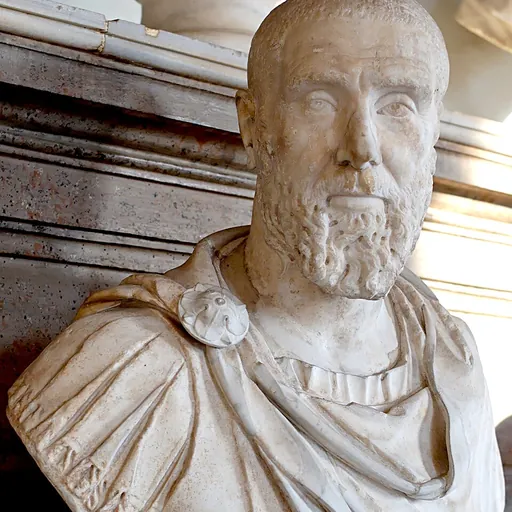
About Pupienus
Lived 170 – 238 (aged 67–68). Pupienus was a Roman politician.
Origins and early career
The Historia Augusta, whose testimony is not to be trusted unreservedly, paints Pupienus as an example of advancement through the cursus honorum due to military success. It claims he was the son of a blacksmith, was adopted by one Pescennia Marcellina (otherwise unknown), and who started his career as a Centurio primus pilus before becoming a tribunus militum, and then a praetor. Pupienus's career was allegedly impressive, serving a number of important posts during the reign of the Severan dynasty throughout the late 2nd and early 3rd centuries. This included assignment as Proconsul of the senatorial propraetorial provinces of Bithynia et Pontus, Achaea, and Gallia Narbonensis.
In fact Pupienus was part of the aristocracy, albeit a minor member, and his family had possibly been elevated only recently. Hailing from the Etruscan city of Volterra, it has been speculated that Pupienus was the son of Marcus Pupienus Maximus, a senator who was the first member of his family to enter the Senate, and wife Clodia Pulchra.
The claim in the Historia Augusta that Pupienus held three praetorian proconsular governorships is unlikely. For one thing, as Bernard Rémy points out, during Pupienus' lifetime the province of Bithynia et Pontus was an imperial one, governed by an imperial legatus. Remy points out another problem: that being awarded three praetorian proconsular governorships violates what is known of Roman practice, and lacks any similar cases. Remy pointedly quotes the opinion of André Chastagnol, who recommended "to admit an information provided by the Augustan History only if it is confirmed by another document" and considers that, faced with such an unreliable source, one must permit "methodical doubt and hypercritical attitude to prevail."
After his consulship (around the year 222), his cursus honorum is much more reliable. Pupienus was later assigned as imperial legate to one of the German provinces, most probably after his first suffect consulship, circa 207 AD. While governor he scored military victories over the Sarmatians and German tribes. At some point after he concluded his duties in the German province, the sortition awarded him proconsular governorship of Asia.
In 234, during the last years of Severus Alexander's reign, he was installed as consul for the second time. In that same year he was also appointed Urban Prefect of Rome and gained a reputation for severity, to the extent that he became unpopular with the Roman mob.
Reign
When Gordian I and his son were proclaimed emperors in Africa, the Senate appointed a committee of twenty men, including the elderly senator Pupienus, to co-ordinate operations against Maximinus Thrax until the arrival of the Gordians. On the news of the Gordians' defeat and deaths, however, the Senate met in closed session in the Temple of Jupiter Capitolinus and voted for two members of the committee to be installed as co-emperors: Pupienus and Balbinus.
According to Edward Gibbon (drawing on the narratives of Herodian and the Historia Augusta), the choice was sensible, as:
the mind of Maximus [Pupienus] was formed in a rougher mould [than that of Balbinus]. By his valour and abilities he had raised himself from the meanest origin to the first employments of the state and army. His victories over the Sarmatians and the Germans, the austerity of his life, and the rigid impartiality of his justice whilst he was prefect of the city, commanded the esteem of a people whose affections were engaged in favour of the more amiable Balbinus. The two colleagues had both been consul... and, since the one was sixty and the other seventy-four years old, they had both attained the full maturity of age and experience.
Denarius of Pupienus. Inscription: "IMP C M CLOD PUPIENUS AUG" However, factions within the Senate who had hoped to profit from the accession of the Gordians manipulated the people and the Praetorian Guard to agitate for the elevation of Gordian III as their imperial colleague. Leaving his senior colleague Balbinus in charge of the civil administration at Rome, sometime during late April, Pupienus marched to Ravenna, where he oversaw the campaign against Maximinus, recruiting German auxiliary troops who had served under him whilst he was in Germania.
Balbinus, in the meantime, had failed to keep public order in the capital. The sources suggest that Balbinus suspected Pupienus of using his German bodyguard to supplant him, and they were soon living in different parts of the Imperial palace. This meant that they were at the mercy of disaffected elements in the Praetorian Guard, who resented serving under Senate-appointed emperors, and now plotted to kill them. Pupienus, becoming aware of the threat, begged Balbinus to call for the German bodyguard. Balbinus, believing that this news was part of a plot by Pupienus to have him assassinated, refused, and the two began to argue just as the Praetorians burst into the room. Both emperors were seized and dragged back to the Praetorian barracks where they were tortured and hacked to death in the bath house.
Family and other Emperors of the era Three individuals have been identified as his children. Titus Clodius Pupienus Pulcher Maximus, consul suffectus c. 235, and patron of the town of Tibur outside Rome, has been identified as his oldest son. Marcus Pupienus Africanus Maximus, consul ordinarius in 236 as the colleague of the Emperor Maximinus Thrax, has been identified as his youngest son. These consulships in the family, across the reigns of Severus Alexander and Maximinus Thrax, suggest that the family was influential and in high regard. Pupienus also had a daughter named Pupiena Sextia Paulina Cethegilla, wife of Marcus Ulpius Eubiotus Leurus.
Don’t just read it —
keep it.
Full-length biographies made to live with: read them, listen on the way to work, watch them tonight.
- E-book
- Audio
- Video
Instant download · yours to keep · every purchase keeps this site free
Important facts
People in Pupienus's life
Named in this biography and alive at the same time


Related people
Same field, nearest in time

Contemporaries
People whose lives overlapped Pupienus's





Frequently asked questions
Who was Pupienus?
Roman Emperor
When was Pupienus born?
Pupienus was born in 170 in Rome.
When did Pupienus die?
Pupienus died on 29 July 238 in Rome.
What was Pupienus's occupation?
Pupienus was a politician.
What nationality was Pupienus?
Pupienus was Roman.
Sources & further reading
Cite this page
APA: Biography.guide. (2026). Pupienus. https://biography.guide/pupienus/
MLA: "Pupienus." Biography.guide, https://biography.guide/pupienus/.
Chicago: "Pupienus." Biography.guide. https://biography.guide/pupienus/.
Data last updated: 2026-09-21 · Spot an error? Report a correction.
Portrait: Wikimedia Commons · author & licence
Page generated 2026-09-27 05:00 UTC