
About Go-Toba
Lived 1180 – 1239 (aged 58). Go-Toba was a Japanese waka poet and writer.
was the 82nd emperor of Japan, according to the traditional order of succession. His reign spanned the years from 1183 through 1198.
This 12th-century sovereign was named after Emperor Toba, and (, "later") and thus, he is sometimes called the "Later Emperor Toba". The word has also been translated to mean the "second one"; and in some older sources, this emperor may be identified as "Toba the Second" or as "Toba II".
Genealogy Before his ascension to the Chrysanthemum Throne, his personal name (his ) was . He was also known as Takanari-shinnō
He was the fourth son of Emperor Takakura, and thus grandson of Emperor Go-Shirakawa. His mother was Bōmon Shokushi (, Empress Dowager Shichijō-in, ), daughter of Bōmon Nobutaka of the Fujiwara clan.
Consorts and children Empress (chūgū): Fujiwara no Ninshi / Takako, later Gishūmon-in , Kujō Kanezane's daughter First Daughter: Imperial Princess Shōshi, later Shunkamon-in (, 1195–1211) – unmarried Empress as adopted mother of Emperor Juntoku Consort: Minamoto no Zaishi / Ariko later Shomeimon-in (; 1171–1257), Minamoto no Michichika's adopted daughter and priest Nōen's daughter First Son: Imperial Prince Tamehito later Emperor Tsuchimikado Consort: Fujiwara no Shigeko later Shumeimon-in (; 1182–1264), Takakura Norisue's daughter Third Son: Imperial Prince Morinari later Emperor Juntoku Imperial Prince Masanari (, exiled after Jōkyū War) Imperial Prince Priest Sonkai (, 1204–1246) – Head Priest of Enryaku-ji Temple (Tendai Zasu, ) Court lady: Bōmon no Tsubone , Bōmon Nobukiyo's daughter Imperial Prince Nagahito (, 1196–1249) later Imperial Prince Priest Dōjo , become 8th Head priest of Ninna-ji Temple Third Daughter: Imperial Princess Reishi (礼子内親王; 1200–1273) later Kayōmon-in Imperial Prince Yorihito (, 1201–1264) (exiled after Jōkyū Incident) Court lady: Hyōe-no-kami no Tsubone , Minamoto no Nobuyasu's daughter Second Daughter: Imperial Princess Shukushi (; b.1196) (Takatsuji Saigū, ) – Saiō at Ise Shrine 1199–1210 Court lady: Owari no Tsubone (, d.1204), priest Kensei's daughter Imperial Prince Dōkaku (; 1204–1250) – Head Priest of Enryaku-ji Temple (, ) Court lady: Ōmiya no Tsubone , Fujiwara no Sadayoshi's daughter Imperial Prince Son'en (; 1207–1231) – Head Priest of Miidera Temple Gyōetsu – priest in Emryakuji Temple Court lady: Shonagon no Suke Dōshu – priest Court lady: Kamegiku , a dancer (Shirabyōshi) Court lady: Taki (; d.1265), a dancer (Shirabyōshi) Imperial Prince Kakunin (; 1198–1266) – Head priest of Onjō-ji Temple Court lady: Tamba no Tsubone , Ishi , a dancer (Shirabyōshi) Imperial Princess Hiroko (, b.1205) – Saiō served at Ise Shrine during the reigns of Emperor Juntoku and Emperor Chūkyō 1215–1221 Court lady: Himehōshi , a dancer (Shirabyōshi) Kakuyo – priest Dōi – priest in Onjō-ji Temple Dōen – priest in Ninna-ji Temple Mother Unknown: Son: Prince Ichijo (, 1201–1213) princess (1202–1207)
Events of Go-Toba's life Go-Toba took the throne at the age of three. 8 September 1183 (Juei 2, 20th day of the 8th month) : In the 3rd year of Antoku-tennōs reign , the emperor fled the capital rather than give in to pressures for his abdication. In Antoku's absence, the cloistered former-Emperor Go-Shirakawa then elevated Antoku's younger brother by decree; and the young child was given the acceptance of abdication (juzen) rites. The anti-Taira faction intended that the succession (senso) was received; and shortly thereafter, Emperor Go-Toba is said to have acceded to the throne (sokui).
Although these formal rites and ceremonies were taking place in Heian-kyō, the imperial regalia were still held by Antoku. Thus, the senso and sokui of Go-Toba became the first in history to omit the ritual transmission of the sacred treasures from a sovereign to his successor.
In 1198, Go-Toba abdicated in favor of his son, Emperor Tsuchimikado.
Go-Toba reigned as cloistered Emperor from 1198 till 1221 during reigns of three emperors, but his power was more limited than former cloistered Emperors in the Heian period.
It was during this time that Go-Toba decreed that the followers of the Pure Land sect in Kyōto, led by Hōnen, be banished or in some cases executed. Originally this was prompted by complaints of clergy in Kyoto who were concerned about the rise in popularity of the new sect, but Go-Toba personally ordered the decree after two of his ladies in waiting converted to the sect without his knowledge.
In 1221, the shōgun installed Go-Toba's three-year-old grandson, Emperor Chūkyō, as emperor, but Go-Toba chose to stage a rebellion in an attempt to reclaim the throne and overthrow the Kamakura shogunate. This conflict is known as the Jōkyū War, named after the era in which it occurred.
Despite the limits on his political powers, he developed skills as a calligrapher, painter, musician, poet, critic, and editor, although the majority of his activities took place after his abdication aged 18 (as the abdication freed him from 'the ceremonial prison of the imperial palace').
Besides his enthusiasm for archery, equestrianism, and swordsmanship, Go-Toba was a great lover of swords. He summoned swordsmiths to his court where they were given honorary titles. They taught the emperor their craft. As a result he became a respectable swordsmith himself. It was his patronage and encouragement of this art that gave birth to Japan's 'Golden Age' of bladesmithing. His contribution to the art is still held in high esteem. Even today a tradition maintains how in sword literature he is the first and foremost swordsmith discussed.
His greatest contribution to literature is the Shin Kokinshū (The New Anthology of Ancient and Modern Waka), which Japanese has considered one of three major influential waka anthologies along Man'yōshū and Kokin Wakashū. He ordered its creation and took part in the working group as an editor. He revived the Office of Waka and made it the headquarters of this edition. He held many utakai (waka parties) and utaawase (waka competitions). Not only the creator and organizer, he acted as a critic, and wrote the style of waka in general and criticism of his contemporary poets.
During his exile, he continued to compose hundreds of waka and to edit both anthologies from his creation in Oki Islands and a private edition of Shin Kokinshū for 18 years, getting rid of around 400 wakas from the former edition, while its edition had been officially declared to be completed in 1204, and further elaborations finished even in 1216. While he declared his private edition should be authentic, today the 1216 version is considered as the authentic and others as variants. His edition is today called Oki-bon Shin Kokinshū (Oki edition). It is probable that during his exile, he also wrote his Go-Toba no in gokuden ("Secret Teachings"), a short work on aesthetic criticism; the "Secret Teachings" are particularly valuable as a major source on Go-Toba's complicated relationships with his former client, the greatest poet of the age – Fujiwara no Teika.
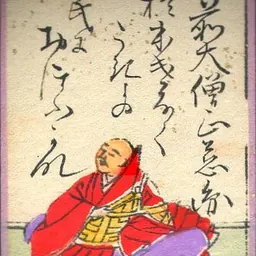
One of his 31-syllable poems was chosen by Fujiwara no Teika as Number 99 in the popular anthology Hyakunin Isshu.
Kugyō Kugyō is a collective term for the very few most powerful men attached to the court of the Emperor of Japan in pre-Meiji eras.
In general, this elite group included only three to four men at a time. These were hereditary courtiers whose experience and background would have brought them to the pinnacle of a life's career. During Go-Toba's reign, this apex of the Daijō-kan included: Sesshō, Konoe Motomichi, 1160–1233. Sesshō, Matsu Morie, 1172–1238. Sadaijin, Ōimikado Tsunemune, 1119–1189. Sadaijin, Sanjō Sanefusa, 1147–1225. Dainagon
Eras of Go-Toba's reign The years of Go-Toba's reign are more specifically identified by more than one era name or nengō. Juei (1182–1184) Genryaku (1184–1185) Bunji (1185–1190) Kenkyū (1190–1199)
Ancestry
Don’t just read it —
keep it.
Full-length biographies made to live with: read them, listen on the way to work, watch them tonight.
- E-book
- Audio
- Video
Instant download · yours to keep · every purchase keeps this site free
Important facts
more
Gotoba Jōkō, Gotoba-inFamily & relationships
People in Go-Toba's life
Named in this biography and alive at the same time



Related people
Same field, nearest in time



Contemporaries
People whose lives overlapped Go-Toba's




Frequently asked questions
Who was Go-Toba?
Emperor of Japan
When was Go-Toba born?
Go-Toba was born on 6 August 1180 in Kyoto.
When did Go-Toba die?
Go-Toba died on 28 March 1239 in Nakanoshima.
What was Go-Toba's occupation?
Go-Toba was a waka poet and writer.
What nationality was Go-Toba?
Go-Toba was Japanese.
Sources & further reading
Cite this page
APA: Biography.guide. (2026). Go-Toba. https://biography.guide/go-toba/
MLA: "Go-Toba." Biography.guide, https://biography.guide/go-toba/.
Chicago: "Go-Toba." Biography.guide. https://biography.guide/go-toba/.
Data last updated: 2026-09-20 · Spot an error? Report a correction.
Page generated 2026-09-27 05:34 UTC