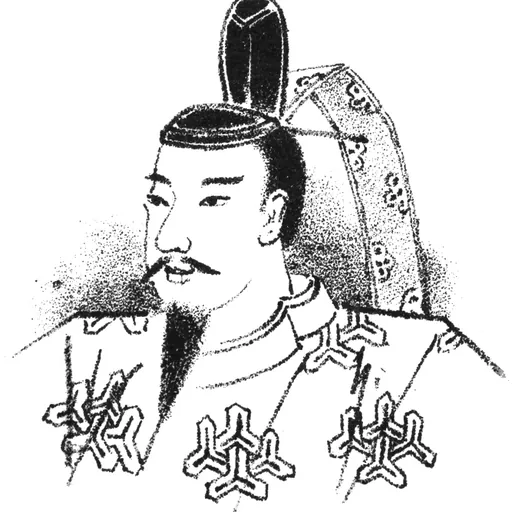
About Go-Sanjō
Lived 1032 – 1073 (aged 40). Go-Sanjō was a Japanese ruler.
was the 71st emperor of Japan, according to the traditional order of succession. His given name was .
This 11th century sovereign was named after his grandfather Emperor Sanjō and go- (後), translates literally as "later;" and thus, he is sometimes called the "Later Emperor Sanjō", or, in some older sources, may be identified as "Sanjō, the second" or as "Sanjō II."
It was during, and due to, Go-Sanjo's reign that the Fujiwara grip on power was broken; following Go-Sanjo's rule, their power continued to wane until 1150, when any semblance of their power disappeared.
Biography
Before his ascension to the Chrysanthemum Throne, his personal name (諱, imina) was Takahito-shinnō (尊仁親王, たかひとしんのう).
Takahito-shinnō was the second son of Emperor Go-Suzaku. His mother was Empress (kōgō) Sadako (禎子内親王), the third daughter of Emperor Sanjō, making him the first Emperor in 170 years (since Emperor Uda) whose mother was not of Fujiwara descent paternally. His father and mother were grandchildren of Fujiwara no Michinaga maternally. The Empress mother of the future Emperor Go-Sanjō was also known as Teishi, and a Yōmei-mon In (1012–94). His lack of connection with the Fujiwara meant he owed them no special loyalty—meaning that he could afford to oppose them.
Events of Go-Sanjō's life Because Prince Takahito was not of Fujiwara descent, the Kampaku, Fujiwara no Yorimichi neglected him, but Emperor Go-Suzaku decreed that upon his elder brother Chikahito's enthronement (as Emperor Go-Reizei), that Takahito would become the heir (kōtaitei). As Emperor Go-Reizei had no children of his own, upon his death, Takahito became emperor.
May 22, 1068 (Jiryaku 4, 19th day of the 4th month) : In the 4th year of Emperor Go-Reizei's reign (後冷泉天皇四年), he died at age 44; and the succession (senso) was received by his younger half-brother. Shortly thereafter, Emperor Go-Sanjo is said to have acceded to the throne (sokui).
Yorimichi's younger brother Norimichi became kampaku, but Go-Sanjō was determined to rule personally.
1069 (Enkyū 1): Go-Sanjō issued the Enkyū Shōen Regulation Decree (Enkyū is the name of the era in which the decree was issued); and the emperor called for the establishment of a government office to certify Shōen records. 1070 (Enkyū 2): Go-Sanjō ordered a preliminary system of laws and a bureaucracy for regulating silk. 1072 (Enkyū 4): As the Ritsuryō system of centralized authority had largely failed by this time, Go-Sanjō became interested in strengthening the finances of the Imperial Household. January 18, 1073 (Enkyū 4, 8th day of the 12th month) : In the 6th year of Emperor Go-Sanjō's reign (桓武天皇六年), the emperor abdicated in favor of his son, and the succession (senso) was received by his son. Shortly thereafter, Emperor Shirakawa is said to have acceded to the throne (sokui). May 11, 1073 (Enkyū 5, 21st day of the 4th month) : Go-Sanjō entered the Buddhist priesthood; and his new priestly name became Kongō-gyō. June 15, 1073 (Enkyū 5, 7th day of the 5th month) : The former-Emperor Go-Sanjō died at the age of 40.
The actual site of Go-Sanjō's grave is known.
The mound which commemorates the Hosokawa Emperor Go-Sanjō is today named Shu-zan. The emperor's burial place would have been quite humble in the period after Go-Sanjō died.
These tombs reached their present state as a result of the 19th century restoration of imperial sepulchers (misasagi) which were ordered by Emperor Meiji. Jiryaku (1065–1069) Enkyū (1069–1074)
Consorts Go-Sanjō had three consorts. Emperor Go-Ichijō‘s daughter Consort: Fujiwara Shigeko (藤原茂子; d.1062), Fujiwara Kinnari‘s daughter and Fujiwara Yoshinobu‘s adopted daughter First Daughter: Imperial Princess Satoko (聡子内親王; 1050-1131) First son: Imperial Prince Sadahito (貞仁親王) later Emperor Shirakawa Second Daughter: Imperial Princess Toshiko (俊子内親王; 1056-1132) Third Daughter: Imperial Princess Yoshiko (佳子内親王; 1057-1130) Fourth Daughter: Imperial Princess Tokushi (篤子内親王; 1060–1114) married Emperor Horikawa Consort: Minamoto Motoko (源基子; 1047-1134), Minamoto Motohira‘s daughter Second son: Imperial Prince Sanehito (実仁親王; 1071-1085), a descendant of the Minamoto clan - Go-Sanjō Genji. Third son: Imperial Prince Sukehito (輔仁親王; 1073-1119), a descendant of the Minamoto clan - Go-Sanjō Genji.
Consort: Fujiwara Akiko (藤原昭子), Fujiwara Yorimune’s daughter Lady-in-waiting: Taira Chikako (平親子), Taira Tsunakuni’s daughter Son: Fujiwara Arisuke (藤原有佐; d.1131), adopted by Fujiwara no Akitsuna
Ancestry
Don’t just read it —
keep it.
Full-length biographies made to live with: read them, listen on the way to work, watch them tonight.
- E-book
- Audio
- Video
Instant download · yours to keep · every purchase keeps this site free
Important facts
Family & relationships
People in Go-Sanjō's life
Named in this biography and alive at the same time

Related people
Same field, nearest in time

Contemporaries
People whose lives overlapped Go-Sanjō's





Frequently asked questions
Who was Go-Sanjō?
Emperor of Japan
When was Go-Sanjō born?
Go-Sanjō was born on 3 September 1032 in Heian-kyō.
When did Go-Sanjō die?
Go-Sanjō died on 15 June 1073 in Heian-kyō.
What was Go-Sanjō's occupation?
Go-Sanjō was a ruler.
What nationality was Go-Sanjō?
Go-Sanjō was Japanese.
Sources & further reading
Cite this page
APA: Biography.guide. (2026). Go-Sanjō. https://biography.guide/go-sanjo/
MLA: "Go-Sanjō." Biography.guide, https://biography.guide/go-sanjo/.
Chicago: "Go-Sanjō." Biography.guide. https://biography.guide/go-sanjo/.
Data last updated: 2026-09-22 · Spot an error? Report a correction.
Portrait: Wikimedia Commons · author & licence
Page generated 2026-09-27 05:01 UTC