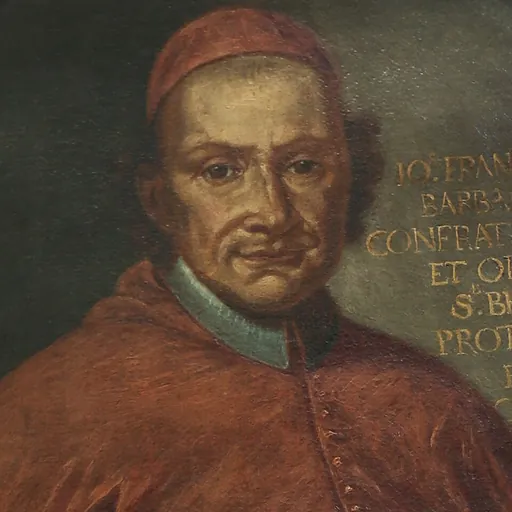
About Giovanni Francesco Barbarigo
Lived 1658 – 1730 (aged 71). Giovanni Francesco Barbarigo was an Italian catholic priest and catholic bishop.
Giovanni Francesco Barbarigo (29 April 1658 at Venice – 1730) was an Italian cardinal and nephew of Saint Gregorio Barbarigo (1625–97).
Biography Born to a patrician family of Venice on 29 April 1658, Giovanni Francesco Barbarigo was the nephew of Cardinal Gregorio Barbarigo. Giovanni Francesco first entered the diplomatic service and was twice sent as representative of the Venetian Republic to the court of King Louis XIV of France. However, he soon turned to an ecclesiastical career, where, if not the great ardor of his vocation, at least illustrious family traditions called him.
In 1674, he became Primicerius of the Church of St. Mark at Venice, and the same year, was named Bishop of Verona by Pope Innocent XII. Faced with the difficulties and practical problems of his daily apostolic work, he always returned to the great model that could not help but occupy his mind, that of his great uncle Gregory Barbarigo, who in turn, had taken Charles Borromeo as his model. Thus, in his religious action and in his ecclesiastical activity, the methods and themes that dominated the Venetian Church in its counter-reformation action are seen again. He greatly increased the number of clerics; paying particular attention to the seminaries of the diocese.
Devoted to prayer, preaching, personal witness of faith, as practical ideals of action of the Counter-Reformation, he was able to translate and apply with commitment and dedication to his episcopal see. He personally visited hospitals and provided relief in the most diverse situations, such as during an epidemic that struck his diocese in 1702. He provided for the rest of the territories entrusted many missions, which he assigned entirely to the fathers of the Society of Jesus. On every occasion he became a strong supporter of the rights and prerogatives of the Church with regard to power and civil order, defending ecclesiastical immunities with particular attention. He was zealous in promoting the cause of beatification of his uncle, and lent his patronage to the production of literary works. For example, he commissioned the Jesuit scholar Giovanni Saverio Valcavi (1701-1781) with publishing the elegy of his family: Nuraismata vivorum illustrium ex Barabadica Gente in 1732 in Pavia. To his suggestion was due the inception of the ecclesiastical history of Verona, and the works of St. Zeno, Bishop of Verona (362-380), were reprinted at his expense in Padua, in 1710.
Giovanni Francesco Barbarigo died in 1730.
Don’t just read it —
keep it.
Full-length biographies made to live with: read them, listen on the way to work, watch them tonight.
- E-book
- Audio
- Video
Instant download · yours to keep · every purchase keeps this site free
Important facts
People in Giovanni Francesco Barbarigo's life
Named in this biography and alive at the same time
Related people
Same field, nearest in time



Contemporaries
People whose lives overlapped Giovanni Francesco Barbarigo's




Frequently asked questions
Who was Giovanni Francesco Barbarigo?
Catholic cardinal
When was Giovanni Francesco Barbarigo born?
Giovanni Francesco Barbarigo was born on 29 April 1658 in Venice.
When did Giovanni Francesco Barbarigo die?
Giovanni Francesco Barbarigo died on 26 January 1730 in Padua.
What was Giovanni Francesco Barbarigo's occupation?
Giovanni Francesco Barbarigo was a catholic priest and catholic bishop.
What nationality was Giovanni Francesco Barbarigo?
Giovanni Francesco Barbarigo was Italian.
Sources & further reading
· Wikipedia: Giovanni Francesco Barbarigo
· DBpedia: Giovanni Francesco Barbarigo
Cite this page
APA: Biography.guide. (2026). Giovanni Francesco Barbarigo. https://biography.guide/giovanni-francesco-barbarigo/
MLA: "Giovanni Francesco Barbarigo." Biography.guide, https://biography.guide/giovanni-francesco-barbarigo/.
Chicago: "Giovanni Francesco Barbarigo." Biography.guide. https://biography.guide/giovanni-francesco-barbarigo/.
Data last updated: 2026-09-22 · Spot an error? Report a correction.
Portrait: Wikimedia Commons · author & licence
Page generated 2026-09-27 05:02 UTC