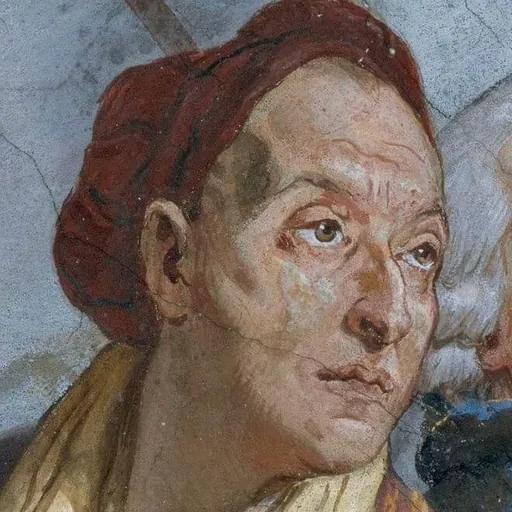
About Giovanni Battista Tiepolo
Lived 1696 – 1770 (aged 74). Giovanni Battista Tiepolo was an Italian fresco painter, printmaker, architectural drafter, painter, graphic artist and printer.
Giovanni Battista Tiepolo ( , ; 5 March 1696 – 27 March 1770), also known as Giambattista (or Gianbattista) Tiepolo, was an Italian painter and printmaker from the Republic of Venice who painted in the Rococo style, considered an important member of the 18th-century Venetian school. He was prolific, and worked not only in Italy, but also in Germany and Spain.
Giovan Battista Tiepolo, together with Giambattista Pittoni, Canaletto, Giovan Battista Piazzetta, Giuseppe Maria Crespi, and Francesco Guardi are considered the traditional Old Masters of that period.
Successful from the beginning of his career, he has been described by Michael Levey as "the greatest decorative painter of eighteenth-century Europe, as well as its most able craftsman".
Biography
Scipio Africanus Freeing Massiva shows Massiva, the nephew of a prince of Numidia, being released after capture by Scipio Africanus. Walters Art Museum.
Early life (1696–1726) Born in Venice, he was the youngest of six children of Domenico and Orsetta Tiepolo. His father was a small shipping merchant who belonged to a family that bore the prestigious patrician name of Tiepolo without claiming any noble descent. Some of the children acquired noble godparents, and Giambattista was originally named after his godfather, a Venetian nobleman called Giovanni Battista Dorià. He was baptised on 16 April 1696 in the local church, San Pietro di Castello (then still officially the cathedral of Venice). His father died about a year later, leaving his mother to bring up a family of young children, presumably in somewhat difficult circumstances. ), Villa Cordellina Molin, Montecchio Maggiore (1743–1744) and for the ballroom of the Palazzo Labia in Venice (now a television studio), showing the Story of Cleopatra (1745–1750).
Etchings Tiepolo produced two sets of etchings, the Capricci (c. 1740–1742) and the Scherzi di fantasia (c. 1743–1757). The ten capricci were first published by Anton Maria Zanetti, incorporated into the third edition of a compilation of woodcuts after Parmigianino. They were not published separately until 1785. The subject matter is often bizarre and fantastical, and the works owe a lot to the example of Salvator Rosa and Giovanni Benedetto Castiglione. The 23 Scherzi were etched over more than ten years and privately circulated, only being commercially published after Tiepolo's death, with numbers and titles added by his son, Giandomenico. Subjects include mysterious Eastern figures, and, in some of the later prints, scenes of necromancy.
Würzburg Residenz (1750–1753) By 1750, Tiepolo's reputation was firmly established throughout Europe, with the help of his friend Francesco Algarotti, an art dealer, critic and collector. That year, at the behest of Prince-Bishop Karl Philipp von Greifenclau zu Vollraths, he traveled to Würzburg where he arrived in November 1750. He remained there for three years during which he executed ceiling paintings in the New Residenz palace (completed 1744). He frescoed the Kaisersaal salon in collaboration with his sons Giandomenico and Lorenzo and was then invited to deliver a design for the grandiose entrance staircase (Treppenhaus) designed by Balthasar Neumann. It is a massive ceiling fresco at , and was completed in November 1753. His Allegory of the Planets and Continents depicts Apollo embarking on his daily course; deities around him symbolize the planets; allegorical figures (on the cornice) represent the four continents. He included several portraits in the Europe section of this fresco, including a self-portrait; one of his son Giandomenico; one of the prince-bishop von Greiffenklau; one of the painter Antonio Bossi; and one of the architect, Balthasar Neumann.
Return to Venice and the Veneto (1753–1770)
Tiepolo returned to Venice in 1753. He was now in demand locally, as well as abroad where he was elected President of the Academy of Padua. He went on to complete theatrical frescoes for churches; the Triumph of Faith for the Chiesa della Pietà; panel frescos for Ca' Rezzonico (which now also houses his ceiling fresco from the Palazzo Barbarigo); and paintings for patrician villas in the Venetian countryside, such as Villa Valmarana in Vicenza and an elaborate panegyric ceiling for the Villa Pisani in Stra.
In some celebrated frescoes at the Palazzo Labia, he depicted two scenes from the life of Cleopatra: Meeting of Anthony and Cleopatra and Banquet of Cleopatra, as well as, in a central ceiling fresco, the Triumph of Bellerophon over Time. Here he collaborated with Girolamo Mengozzi Colonna. This connection with Colonna, who also designed sets for opera, highlights the increasing tendency towards composition as a staged fiction in Tiepolo's frescoes. The architecture of the Banquet fresco also recalls that of Veronese's Wedding at Cana. In 1757, he painted an altar piece for the Thiene family, representing the apotheosis of Saint Cajetan. It is in the church of hamlet of Rampazzo in the Camisano Vicentino.
Madrid
In 1761, King Charles III of Spain commissioned Tiepolo to create a ceiling fresco to decorate the throne room of the Royal Palace of Madrid. The panegyric theme is the Apotheosis of Spain and has allegorical depictions recalling the dominance of Spain in the Americas and across the globe.
He also painted two other ceilings in the palace, and carried out many private commissions in Spain. However, he suffered from the jealousy and the bitter opposition of the rising champion of Neoclassicism, Anton Raphael Mengs; at the instigation of Mengs' supporter, the King's confessor Joaquim de Electa, had Tiepolo's series of canvases for the church of San Pascual at Aranjuez replaced by works by his favourite.
Death Tiepolo died in Madrid on 27 March 1770. He is buried in Madonna dell'Orto in Venice.
After his death, the rise of a stern Neoclassicism and the post-revolutionary decline of absolutism led to the slow decline of the Rococo style associated with his name, but failed to dent his reputation. In 1772, Tiepolo's son was sufficiently respected to be painter to Doge Giovanni II Cornaro, in charge of the decoration of Palazzo Mocenigo in the sestiere of San Polo, Venice.
Gallery
List of works
Paintings before 1740
Works from 1740–1750
Works after 1750
Legacy In 1878, Mark Twain wrote in his diary: "Tiepolo is my artist."
Roberto Calasso's Tiepolo Pink (Italian: Il Rosa Tiepolo), which takes its name from an epithet Marcel Proust uses to describe several of his female characters, is an interpretation of Tiepolo's life as the last artist of the ancien régime, depicting his work as "the last breath of happiness in Europe." It contains detailed analysis of Tiepolo's mysterious Capricci and Scherzi.
Don’t just read it —
keep it.
Full-length biographies made to live with: read them, listen on the way to work, watch them tonight.
- E-book
- Audio
- Video
Instant download · yours to keep · every purchase keeps this site free
Important facts
more
Tiepoli, Gio. Battista Tiepolo, J. B. Tiepolo le père, giov. batt. tiepolo, g. b. tiepolo, Diepolo, Juan Bautista Tiépolo, j. b. tiepolo, Tiopalo, Tiopoli, Tippoli, Giovanni Battista Thenpholus, G.B. Tiepolo, C. B. Tiepolo, Giovanni Battista Tiepoli, Tipolo, Giovanni Batista Tiepolo, Tripolo, Johann Baptista Tiepolo, F. B. Tiepolo, j.b. tiepolo, Dzhovanni Battista Tʹepolo, J. BatistaPeople in Giovanni Battista Tiepolo's life
Named in this biography and alive at the same time



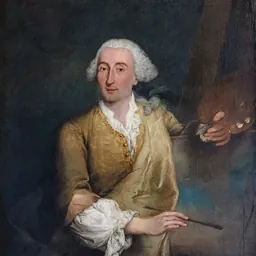

Related people
Same field, nearest in time
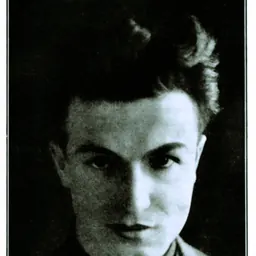

Contemporaries
People whose lives overlapped Giovanni Battista Tiepolo's




Frequently asked questions
Who was Giovanni Battista Tiepolo?
Italian painter (1696–1770)
When was Giovanni Battista Tiepolo born?
Giovanni Battista Tiepolo was born on 5 March 1696 in Venice.
When did Giovanni Battista Tiepolo die?
Giovanni Battista Tiepolo died on 27 March 1770 in Madrid.
What was Giovanni Battista Tiepolo's occupation?
Giovanni Battista Tiepolo was a fresco painter, printmaker, architectural drafter, painter, graphic artist and printer.
What nationality was Giovanni Battista Tiepolo?
Giovanni Battista Tiepolo was Italian.
Sources & further reading
· Wikipedia: Giovanni Battista Tiepolo
· DBpedia: Giovanni Battista Tiepolo
Cite this page
APA: Biography.guide. (2026). Giovanni Battista Tiepolo. https://biography.guide/giovanni-battista-tiepolo/
MLA: "Giovanni Battista Tiepolo." Biography.guide, https://biography.guide/giovanni-battista-tiepolo/.
Chicago: "Giovanni Battista Tiepolo." Biography.guide. https://biography.guide/giovanni-battista-tiepolo/.
Data last updated: 2026-09-23 · Spot an error? Report a correction.
Portrait: Wikimedia Commons · author & licence
Page generated 2026-09-27 05:06 UTC