
Giovanni Antonio Grassi
Italian Jesuit missionary, educator, and superior
About Giovanni Antonio Grassi
Lived 1775 – 1849 (aged 74). Giovanni Antonio Grassi was an Italian and American catholic priest, missionary, academic administrator, astronomer and teacher.
Giovanni Antonio Grassi (anglicized as John Anthony Grassi; 10 September 1775 – 12 December 1849) was an Italian Catholic priest and Jesuit who led many academic and religious institutions in Europe and the United States, including Georgetown College in Washington, D.C., and the Pontificio Collegio Urbano de Propaganda Fide in Rome.
Born in the Republic of Venice, Grassi was a promising student of mathematics and the natural sciences, especially astronomy. He completed his studies at the Jesuit College in Polotsk, in the Russian Empire, in 1804 and was appointed rector of the Institute for Nobles. The following year, he was ordered to replace the last remaining Jesuit missionary in China; this began a five-year journey across Europe in which he was ultimately unable to secure passage to the distant country. He instead began teaching at Stonyhurst College in England.
Grassi was sent to the United States in 1810, where he became the superior of the Jesuits' Maryland Mission and the president of Georgetown College. For significantly improving its curriculum and public reputation, as well as obtaining its congressional charter, Grassi became known as Georgetown's "second founder". He returned to Rome in 1817 as Archbishop Leonard Neale's representative before the Congregation de Propaganda Fide. He later became the rector of the College of the Holy Martyrs in Turin and provincial superior of the Jesuits' Turin Province. Grassi became a close confidant of King Charles Felix of Sardinia and spent time in Naples as confessor to Charles Felix's widow, Queen Maria Cristina. He also intervened on behalf of Charles Albert to allow him to succeed Charles Felix on the throne. In 1835, Grassi moved to Rome as the rector of the Pontificio Collegio Urbano de Propaganda Fide, a school for missionaries, and was later named the Jesuit Superior General's assistant for Italy.
Early life and education
Giovanni Antonio Grassi was born on 10 September 1775 in Schilpario, Lombardy, in the Republic of Venice. He studied under the Somaschi Fathers, before going to the diocesan seminary of Bergamo, where he studied theology for two years and was ordained a priest. He proceeded to the Jesuit novitiate in Colorno, on 21 November 1799, becoming one of the novitiate's first students. the order fled Western Europe and survived in the Russian Empire, and Polotsk (in present-day Belarus) became the order's center. Grassi went to the Jesuit College in Polotsk in 1801 to complete his priestly education, while the master of novices of the Colorno novitiate, Joseph Pignatelli, assured him that he would eventually return to Italy. Grassi was an excellent student in the natural sciences,
European voyage Upon completing his education, Grassi began preparing for an assignment to minister to Armenians in Astrakhan, and was studying Armenian. He and two others were then summoned to Saint Petersburg by Gabriel Gruber, the Jesuit Superior General. indeed, Grassi was the first president who had not been elected by the board of directors or appointed by Carroll. Nonetheless, Carroll did not oppose Grassi's assumption of leadership, and the board unanimously elected Grassi, but did not confer on him all the powers normally associated with the office. The following year, he went to St. Inigoes, Maryland, to complete his retreat before pronouncing his final vows, where he contracted a fever that lasted for a year.
When Grassi assumed office, Georgetown was struggling financially, with just 31 students enrolled, and Carroll was considering closing the school. Grassi immediately instituted a significant reform of the faculty and curriculum, hiring talented faculty and firing those who were inferior. He also improved discipline among the students. The number of subjects taught at the college increased, and the number of enrolled students increased four-fold. During his presidency, he continued to teach algebra, mensuration, and arithmetic. He also instructed students in astronomy, using instruments he had brought from Stonyhurst. and the timing of eclipses. He also wrote of how Black people were children of God and spoke positively of their faith. While he opposed slavery in the abstract, Grassi's appointment as superior of the Maryland Jesuits thrust him into a world in which slavery was accepted and quotidian. As superior, he was responsible for managing the slaves owned by the Maryland Jesuits.
After the pope restored the Society of Jesus in 1814, Grassi negotiated a concordat with Carroll's successor, Archbishop Leonard Neale (a brother of Charles and Francis) regarding the division of parishes in the United States between the Jesuits and the secular clergy. He took advantage of the enrollment of the sons of various members of Congress at Georgetown to obtain, through the assistance of William Gaston (a Georgetown alumnus and the only Catholic member of Congress), a congressional charter for Georgetown College on 1 March 1815, which raised the institution to university status.
In Archbishop Carroll's estimation, Grassi had "revived the College of Ge-Town, which [had] received great improvement in the number of students and course of studies." For this, Grassi has been described as Georgetown's "second founder". With this great number of students came an increase in the religious and ethnic diversity of students, including more Protestant, French and Irish students. His presidency ended on 28 June 1817, and he was succeeded by Benedict Joseph Fenwick. His term as superior of the Maryland Mission also ended, where he was replaced by Anthony Kohlmann on 10 September. Archbishop Neale sent Grassi to Rome to persuade the Congregation de Propaganda Fide to reverse a previous order to reinstate several priests in Charleston, South Carolina, whom Neale had removed from ministry.
His removal from the United States was lamented by many of the church leaders, including one Bishop Benedict Joseph Flaget, who had proposed Grassi to become the Bishop of Detroit. Grassi remained in Italy, as his physicians told him that he would not survive a voyage across the Atlantic due to a hernia. While in Rome, he successfully pleaded before the Propaganda Fide for the full canonical restoration of the Jesuit order in England.
Provincial superior and royal confessor
Grassi became the procurator (approximately equivalent to a treasurer) of the Jesuit province of Italy, as well as the (assistant) to the Jesuit provincial superior of Italy. During his rectorship, the school prospered and became the premier Jesuit boarding school on the Italian peninsula.
In March 1821, Charles Felix's cousin, Charles Albert, had encouraged a revolt against Charles Felix's predecessor and brother, Victor Emmanuel I, that had forced Victor Emmanuel to abdicate. When Charles Felix ascended to the throne, he quashed the revolt. He later discovered the role that Charles Albert played in instigating the plot and intended to remove him from the line of succession. Grassi persuaded Charles Felix not to take this action against Charles Albert.
On 10 May 1831, Grassi was appointed the first provincial superior of the newly created Jesuit Province of Turin as well as the rector of the College of the Holy Martyrs. During this time, he was permitted to continue serving as confessor to Maria Cristina, even though it required that he reduce his duties as provincial. Eventually, he moved to Naples without first notifying the Superior General, and he became the rector of the San Sebastian boarding school. He then served as the assistant to the Superior General for Italy from 1842 to 1849, and was the archivist of the Jesuit generalate house in Rome. His transfer to Rome was made despite strong protests from Filiberto Avogadro di Collobiano, a Sardinian senator, on the grounds that it would be cruel to Maria Cristina. Grassi also assisted in writing the biography of Joseph Pignatelli, his former novice master, and testified in 1842 during his cause for beatification. By virtue of his American citizenship, he was permitted to remain in Rome—as well as even wear his cassock in public and teach classes—during the revolution of 1848 and under the government of the Roman Republic in 1849. Grassi died on 12 December 1849 in the house of Cardinal Angelo Mai in Rome.
Don’t just read it —
keep it.
Full-length biographies made to live with: read them, listen on the way to work, watch them tonight.
- E-book
- Audio
- Video
Instant download · yours to keep · every purchase keeps this site free
Important facts
People in Giovanni Antonio Grassi's life
Named in this biography and alive at the same time

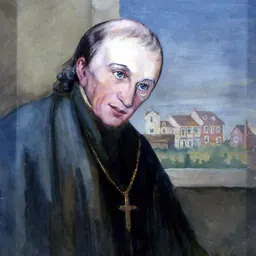

Related people
Same field, nearest in time

Contemporaries
People whose lives overlapped Giovanni Antonio Grassi's



Frequently asked questions
Who was Giovanni Antonio Grassi?
Italian Jesuit missionary, educator, and superior
When was Giovanni Antonio Grassi born?
Giovanni Antonio Grassi was born on 10 September 1775 in Schilpario.
When did Giovanni Antonio Grassi die?
Giovanni Antonio Grassi died on 12 December 1849 in Rome.
What was Giovanni Antonio Grassi's occupation?
Giovanni Antonio Grassi was a catholic priest, missionary, academic administrator, astronomer and teacher.
What nationality was Giovanni Antonio Grassi?
Giovanni Antonio Grassi was Italian and American.
Sources & further reading
· Wikipedia: Giovanni Antonio Grassi
· DBpedia: Giovanni Antonio Grassi
Cite this page
APA: Biography.guide. (2026). Giovanni Antonio Grassi. https://biography.guide/giovanni-antonio-grassi/
MLA: "Giovanni Antonio Grassi." Biography.guide, https://biography.guide/giovanni-antonio-grassi/.
Chicago: "Giovanni Antonio Grassi." Biography.guide. https://biography.guide/giovanni-antonio-grassi/.
Data last updated: 2026-09-26 · Spot an error? Report a correction.
Page generated 2026-09-27 05:13 UTC