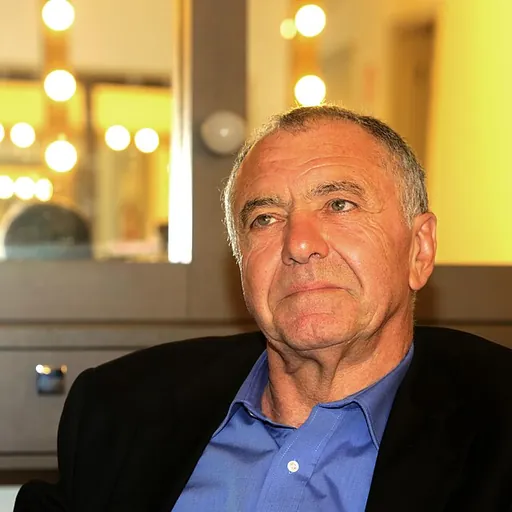
About Gilles Lipovetsky
Born 1944. Gilles Lipovetsky is a French philosopher, sociologist and writer.
Gilles Lipovetsky (; born 24 September 1944) is a French philosopher, writer, and sociologist.
Life and career Lipovetsky was born in Millau in 1944. He studied philosophy at the University of Paris, and participated in the 1968 student uprising in Paris to change the French educational model. However, he criticizes the model that came from that as producing alienated individuals with fragile personalities prone to emotional disorder due to hedonism and immediate gratification.
He began his academic career teaching classes with his alma mater. With the success of his first book, he became well-known in many parts of the world and became one of the most important French intellectuals of the latter 20th century.
Along with tenure, he has received two honorary doctorates from the Université de Sherbrooke in Québec (Canada) and from the New Bulgarian University in Sofia, membership in the Conseil d'analyse de la société of the French government, knighthood in the Legion of Honor, membership in the National Council of Programs and is a consultant with the Association of Management Progress. In 2015, 2016 and 2017, he was a member of the Prix Versailles judges panel.
Thought Lipovetsky began his philosophical career as a Marxist, similar to many others in the 1960s. He joined the Socialisme ou Barbarie group – Lipovetsky wrote "We want the world and we want it now, but not to transform it, but to swallow it up." However, since then, his philosophy has changed significantly, including the acceptance of capitalism as "the only legitimate economic model." In 1987 he wrote L'Empire de l'éphémère : la mode et son destin dans les sociétés modernes continuing the argument of the 1983 work focusing on fashion as a reflection of individualism and hyper consumerism. It also indicates the desire to be young forever and that only the here-and-now exists.
Lipovetsky has made provocative statements on modern life and elements related to it, which have been often at odds with intellectual trends of the last decades. He has compared fashion with democracy as unstable, ephemeral and superficial, but states it as a positive and more workable than a more interdependent society. He states that the focus of modern life is the new, which then quickly becomes old and we look for something else, leading to his notion of "hyper" as this need for new becomes faster in the age of Internet and social media, which also breaks down traditional institutions such as nation and family. However, he makes a distinction between hyper-consumerism and consumerism. He does not criticize the latter, which he says has had positives in rising living standards. He believes that consumption should be a means to an end, not an end in itself and believes that concerns such as ecology are not incompatible with capitalism.
Lipovetsky does not have a well-defined style of presentation, varying among manners of speaking similar to that of a psychologist or sociologist as well as a philosopher often gesturing emphatically. His methodology varies as well, often dealing with paradoxes. His approach to issues is almost nonexistent epistemologically. There is also a strong influence in his writing from French literature although he does not write fiction.
Publications L'ère du vide : Essais sur l'individualisme contemporain, Gallimard, 1983 L'Empire de l'éphémère : la mode et son destin dans les sociétés modernes, Gallimard, 1987 Le Crépuscule du devoir, Gallimard, 1992 La Troisième femme, Gallimard, 1997 Métamorphoses de la culture libérale – Éthique, médias, entreprise, Montréal, Édition Liber, 2002 Le luxe éternel (with Elyette Roux), éditions Gallimard, 2003 Les temps hypermodernes, éditions Grasset, 2004 Le bonheur paradoxal. Essai sur la société d'hyperconsommation, éditions Gallimard, 2006 La société de déception, éditions Textuel, 2006 L'écran global. Culture-médias et cinéma à l'âge hypermoderne (with Jean Serroy), Seuil, 2007 La Culture-monde. Réponse à une société désorientée, Paris, Odile Jacob, 2008 (with Jean Serroy) L'Occident mondialisé : Controverse sur la culture planétaire, Paris, Grasset, 2010 (with Hervé Juvin)
Don’t just read it —
keep it.
Full-length biographies made to live with: read them, listen on the way to work, watch them tonight.
- E-book
- Audio
- Video
Instant download · yours to keep · every purchase keeps this site free
Important facts
People in Gilles Lipovetsky's life
Named in this biography and alive at the same time
Related people
Same field, nearest in time


Contemporaries
People whose lives overlapped Gilles Lipovetsky's



Frequently asked questions
Who is Gilles Lipovetsky?
French philosopher, writer and sociologist
When was Gilles Lipovetsky born?
Gilles Lipovetsky was born on 24 September 1944 in Millau.
What is Gilles Lipovetsky's occupation?
Gilles Lipovetsky is a philosopher, sociologist and writer.
What nationality is Gilles Lipovetsky?
Gilles Lipovetsky is French.
Sources & further reading
· Wikipedia: Gilles Lipovetsky
Cite this page
APA: Biography.guide. (2026). Gilles Lipovetsky. https://biography.guide/gilles-lipovetsky/
MLA: "Gilles Lipovetsky." Biography.guide, https://biography.guide/gilles-lipovetsky/.
Chicago: "Gilles Lipovetsky." Biography.guide. https://biography.guide/gilles-lipovetsky/.
Data last updated: 2026-09-20 · Spot an error? Report a correction.
Page generated 2026-09-27 05:09 UTC