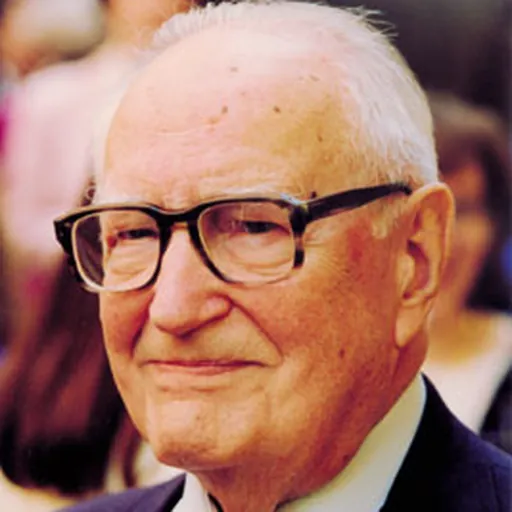
About Giles Sutherland Rich
Lived 1904 – 1999 (aged 95). Giles Sutherland Rich was an American judge.
Giles Sutherland Rich (May 30, 1904 – June 9, 1999) was an associate judge of the United States Court of Customs and Patent Appeals (CCPA) and later on was a United States Circuit Judge of the United States Court of Appeals for the Federal Circuit (CAFC), and had enormous impact on patent law. He was the first patent attorney appointed to any federal court since Benjamin Robbins Curtis was appointed to the Supreme Court in 1851.
Early life
Rich was born May 30, 1904, in Rochester, New York. on patent practices and the anti-monopoly laws, and particularly, on contributory infringement and misuse. He was very active in the work of the New York Patent Law Association, and eventually became its vice president in 1948 and 1949, and its president in 1950 and 1951. all while continuing to practice law full-time. After four years of work, Rich and Federico's draft statute was introduced in the Congress by Joseph Bryson (D-SC) in 1951. After passing both houses without substantial debate, as part of a "consent bill", it was signed into law by President Truman in 1952, to take effect in 1953. It was the first full revision of U.S. patent law since the Patent Act of 1870.
Federal judicial service
Rich was nominated by President Dwight D. Eisenhower on May 17, 1956, to an Associate Judge seat on the United States Court of Customs and Patent Appeals vacated by Judge Noble J. Johnson. At 95, he had become the oldest active federal judge in the history of the United States; His service terminated on June 9, 1999, due to his death.
Chakrabarty, Diehr, State Street
Judge Rich's judicial opinions include were very groundbreaking, influential, and controversial to modern U.S. patent law. He wrote opinions in which the court struck down prior rulings from the United States Patent and Trademark Office against the patenting of genetically engineered micro-organisms (essentially giving birth to the bio-tech industry) (In re Chakrabarty), software-implemented inventions (In re Diehr), and business methods (State Street Bank v. Signature Financial Group), saying the inventions covered in those patent applications had a proper basis in the current patent statute (the 1952 Patent Act of which he was one of the principal drafters).
Controversy over those cases
In re Diehr and especially State Street Bank v. Signature Financial Group were highly controversial decisions. Many in the academic and legal community thought that the cases were wrongly decided and examples of judicial activism on the basis of a pro-patentee agenda, and the legal reasoning utilized in these decisions has been severely criticized. For example, in State Street Bank v. Signature Financial Group, Judge Rich justified his conclusion on the basis that the business method exception to patentability was abolished by the 1952 Patent Act. However, this line of reasoning is contradicted by Judge Rich himself, among others. He had earlier stated, in a law review article written not long after the passage of the 1952 Patent Act, that Section 101 of the Act denied patent protection to business methods, observing that the diaper service, "one of the greatest inventions of our times," was patent-ineligible because it was a business method. The State Street decision was substantially overruled in the Federal Circuit's 2008 decision in In re Bilski. The Supreme Court's decisions in the Bilski-Mayo-Alice trilogy even more definitively rejected the line of doctrine that culminated in the State Street decision.
Outspoken critic
Judge Rich was an outspoken critic of the Supreme Court and Justice Department when they took positions on patent law in opposition to those which he advocated. For example, in his opinion on remand in the case In re Bergy, after the Supreme Court vacated the judgment of the CCPA that he had authored for that court, and remanded the case to the CCPA "for further consideration in light of" the Supreme Court's decision in Parker v. Flook, he wrote a second Bergy opinion for the CCPA. In it he reached the same result and said that Flook shed no light and that the United States Patent and Trdaemark Office had misled the Supreme Court to reach its decision.
Controversy over interpretation of 1952 Act
This episode was part of a long-running controversy about how the 1952 Patent Act should be interpreted − was it a mere re-codification of prior law without substantive change or did it break new ground? Judge Rich took the position that it broke new ground and that special deference should be given his views because of his relation to the process as one of the principal draftsmen of the bill (the co-draftsmen were Henry Ashton and P.J. Federico, then the Examiner-in-Chief of the United States Patent and Trademark Office). A contrary view – that Congress intended no major substantive change – is reflected in the concurring opinion of Justice Hugo Black in Aro Mfg. Co. v. Convertible Top Replacement Co.
Recognition and legacy
In 1992 Rich earned special recognition from President Bush for his contributions to the U.S. patent code. That same year, Rich was also honored with an American Inn of Court established in his name to foster professionalism, ethics, civility, and legal skills in the area of intellectual property.
Upon learning of Judge Rich's death, the Acting Commissioner of Patents and Trademarks, Q. Todd Dickinson, remarked: Judge Rich was the single most important figure in twentieth century intellectual property law...Judge Rich leaves a rich legacy in his voluminous body of judicial opinions and in the 1952 Patent Act which he helped to draft. We have lost the dean of the twentieth century patent system.
A prominent annual intellectual property moot court competition, the Giles Rich I.P. Moot Court Competition , run by the American Intellectual Property Law Association, starting in 1974, was named after him.
In 2006 Judge Rich was inducted into the IP Hall of Fame. and they had a daughter, Verity Sutherland, born in 1940.
"He was said to be an accomplished photographer,
Rich died of lymphoma on June 9, 1999, at Sibley Memorial Hospital in Washington, D.C.
Don’t just read it —
keep it.
Full-length biographies made to live with: read them, listen on the way to work, watch them tonight.
- E-book
- Audio
- Video
Instant download · yours to keep · every purchase keeps this site free
Important facts
People in Giles Sutherland Rich's life
Named in this biography and alive at the same time


Related people
Same field, nearest in time


Contemporaries
People whose lives overlapped Giles Sutherland Rich's





Frequently asked questions
Who was Giles Sutherland Rich?
American judge (1904–1999)
When was Giles Sutherland Rich born?
Giles Sutherland Rich was born on 30 May 1904 in Rochester.
When did Giles Sutherland Rich die?
Giles Sutherland Rich died on 15 June 1999 in Washington, D.C..
What was Giles Sutherland Rich's occupation?
Giles Sutherland Rich was a judge.
What nationality was Giles Sutherland Rich?
Giles Sutherland Rich was American.
Sources & further reading
· Wikipedia: Giles Sutherland Rich
Cite this page
APA: Biography.guide. (2026). Giles Sutherland Rich. https://biography.guide/giles-sutherland-rich/
MLA: "Giles Sutherland Rich." Biography.guide, https://biography.guide/giles-sutherland-rich/.
Chicago: "Giles Sutherland Rich." Biography.guide. https://biography.guide/giles-sutherland-rich/.
Data last updated: 2026-09-20 · Spot an error? Report a correction.
Portrait: Wikimedia Commons · author & licence
Page generated 2026-09-27 04:57 UTC