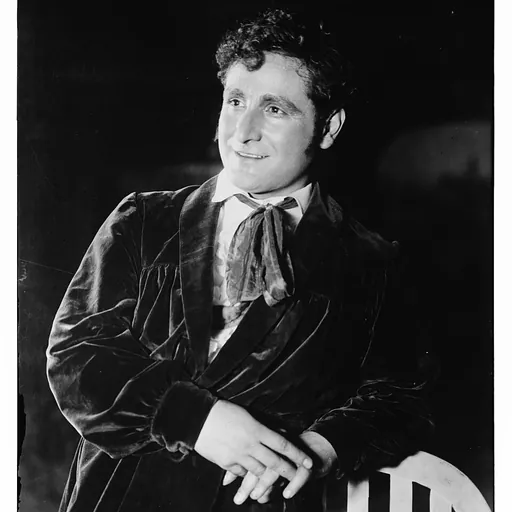
About Giacomo Lauri-Volpi
Lived 1892 – 1979 (aged 86). Giacomo Lauri-Volpi was an Italian opera singer.
Giacomo Lauri-Volpi (11 December 1892 – 17 March 1979) was an Italian tenor with a lyric voice of exceptional range and technical facility. He performed throughout Europe and the Americas in a top-class career that spanned 40 years.
Career and assessment
Born in Lanuvio, Italy, he was orphaned at the age of 11. After completing his secondary education at the seminary at Albano and graduating from the University of Rome La Sapienza, —performing under the name Giacomo Rubini, after Bellini's favourite tenor, Giovanni Battista Rubini. Four months later, on 3 January 1920, he scored another success, at the Teatro Costanzi in Rome, this time performing under his own name opposite Rosina Storchio and Ezio Pinza in Massenet's Manon.
Lauri-Volpi was widely acclaimed for his performances at Italy's most celebrated opera house, La Scala, Milan, between the two world wars. A highlight of his Milan seasons occurred in 1929 when he was chosen to sing Arnoldo in La Scala's centenary production of Rossini's Guglielmo Tell. During this 10-year period he sang opposite Maria Jeritza in the American premiere of Puccini's Turandot and opposite Rosa Ponselle in the Met premiere of Verdi's Luisa Miller. His Met career was terminated prematurely after a dispute with the opera house's management. They wanted him to take a pay cut to help tide the theatre through the economic privations being caused by the Great Depression, but he refused to cooperate and left New York for Italy.
Lauri-Volpi's most notable appearances outside Italy also included two seasons at the Royal Opera House, Covent Garden—in 1925 and 1936. By the latter date, he had broadened his repertoire, progressing from lyric roles to more taxing dramatic parts. His voice began to show consequent signs of wear in the 1940s, losing homogeneity. His thrilling top notes remained remarkably intact, however, right through until the 1950s.
During the Second World War, Lauri-Volpi was based in Italy and was particularly admired by the country's dictator, Benito Mussolini. His last public performance in a full opera came in 1959, as Manrico, in a production of Verdi's Il Trovatore staged at Rome.
Lauri-Volpi recorded a number of opera arias and duets for European and American gramophone companies during the height of his fame. His voice was an instrument at its zenith: bright, flexible and ringing in tone. He had easy and penetrating high notes and possessed a vibrato which made his voice instantly recognisable both on disc and in the theatre.
He sang roles as diverse as Arturo (in Bellini's I Puritani) and Otello (in Verdi's Otello). In the process, he cemented his position as one of the supreme opera singers of the 20th century, even though he faced stiff competition from a remarkable crop of rival Mediterranean tenors during his prime in the 1925-1940 period. (They included Beniamino Gigli, Giovanni Martinelli, Aureliano Pertile, Francesco Merli, Galliano Masini, Tito Schipa, Antonio Cortis and Renato Zanelli—as well as the young Alessandro Ziliani and Giovanni Malipiero.)
Lauri-Volpi was a cultured, intelligent man with a fiery temperament and firm opinions. He retired to Spain after World War II and died in Burjassot, near Valencia, at the age of 86.
Recordings and writings During the 1920s and 1930s, Lauri-Volpi made a number of 78-rpm recordings of operatic arias and duets for the following companies: Fonotipia, Brunswick, Victor and, finally, HMV. The discs that he cut for Victor and HMV are considered to be his finest. They are readily available on CD reissues. In 1947, he recorded in Italy a series of extended scenes from Rigoletto. Later, in the 1950s, he participated in the recording of some complete operas that do not capture his voice anywhere like its peak. They included:
La bohème, Il trovatore and Luisa Miller (all made in 1951); Il trovatore and La favorita (both made in 1954, both live); and Gli Ugonotti (1955). In addition, there is a live recording of Il trovatore from Naples in 1951, in which he is partnered by Maria Callas, under the baton of Tullio Serafin. All these recordings have been reissued on CD.
In 1974, aged 81, Lauri-Volpi released a final operatic recital record, but this particular LP has novelty value only. There are bits of newsreel footage of him performing on stage, too, and he appeared in the 1933 German film Das Lied der Sonne playing himself.
Lauri-Volpi wrote several books. The best known of them is Voci Parallele—a revealing study of singers and their vocal techniques that is frequently cited by historians. His main published works are:
L'equivoco (Così è, e non vi pare) (Corbaccio, Milano, 1938); Cristalli viventi (Atlantica, Roma, 1948); A viso aperto, (Corbaccio, Milano, 1953); Voci parallele (Garzanti, Milano, 1955); Misteri della voce umana (Dall'Oglio, Roma, 1957); and Incontri e scontri (Bonavita, Roma, 1971);
Parallel Voices, an English translation of Voci Parallele, has been published by Bongiovanni, Bologna, in 2022.
Don’t just read it —
keep it.
Full-length biographies made to live with: read them, listen on the way to work, watch them tonight.
- E-book
- Audio
- Video
Instant download · yours to keep · every purchase keeps this site free
Important facts
People in Giacomo Lauri-Volpi's life
Named in this biography and alive at the same time




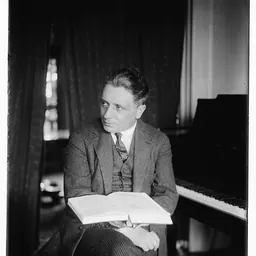
Related people
Same field, nearest in time
Contemporaries
People whose lives overlapped Giacomo Lauri-Volpi's

Frequently asked questions
Who was Giacomo Lauri-Volpi?
Italian opera singer (1892-1979)
When was Giacomo Lauri-Volpi born?
Giacomo Lauri-Volpi was born on 11 December 1892 in Lanuvio.
When did Giacomo Lauri-Volpi die?
Giacomo Lauri-Volpi died on 17 March 1979 in Valencia, Burjassot.
What was Giacomo Lauri-Volpi's occupation?
Giacomo Lauri-Volpi was an opera singer.
What nationality was Giacomo Lauri-Volpi?
Giacomo Lauri-Volpi was Italian.
Sources & further reading
· Wikipedia: Giacomo Lauri-Volpi
· DBpedia: Giacomo Lauri-Volpi
Cite this page
APA: Biography.guide. (2026). Giacomo Lauri-Volpi. https://biography.guide/giacomo-lauri-volpi/
MLA: "Giacomo Lauri-Volpi." Biography.guide, https://biography.guide/giacomo-lauri-volpi/.
Chicago: "Giacomo Lauri-Volpi." Biography.guide. https://biography.guide/giacomo-lauri-volpi/.
Data last updated: 2026-09-22 · Spot an error? Report a correction.
Portrait: Wikimedia Commons · author & licence
Page generated 2026-09-27 05:03 UTC