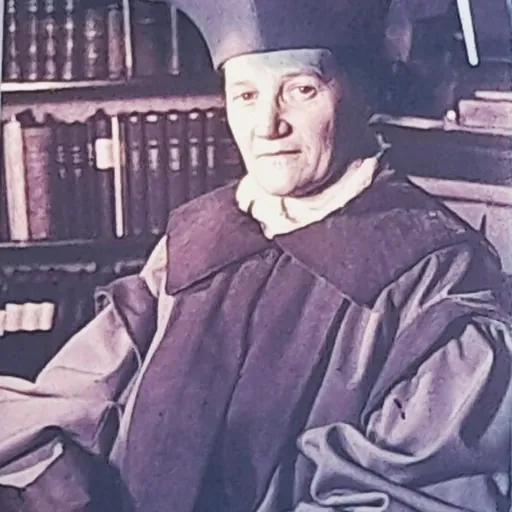
Gertrud Schubart-Fikentscher
German law professor
About Gertrud Schubart-Fikentscher
Lived 1896 – 1985 (aged 88). Gertrud Schubart-Fikentscher was a German legal historian, university teacher, jurist and historian, known for Germany and Jurisprudence.
Gertrud Schubart-Fikentscher (23 December 1896 – 24 March 1985) became Germany's first female professor of Law in September 1948, and remained the country's only female university law professor - after 1957 an emeritus (retired) law professor - for seventeen years. She taught at the University of Halle. By the time she received and accepted her professorship she was a few months short of her fifty-second birthday, reflecting a somewhat indirect career trajectory, her having grown up in a country where the educational system was not set up to enable women either to study or teach at any university.
Life Provenance and early years Gertrud Klara Rosalie Fikentscher was born into a Protestant family in Zwickau, where her father successfully ran a small family business in the manufacturing sector. Between 1903 and 1913 she attended the "Höhere Bürgerschule" girls' school in Zwickau, after which she received further tuition privately for the next few years. Meanwhile World War I broke out in 1914. In 1916 she left her parents' home and relocated to Berlin where she lived with relatives.
In October 1928 she passed her Part I national law exams ("Staatsexamen") which under some circumstances might have preceded a traineeship with a law firm. It is not clear whether she ever contemplated that step. On 17 December 1928 she married her uncle, the leading scholar and internationally respected papyrologist, Wilhelm Schubart (1873-1960), whose first wife had died the previous April. Gertrud Fikenscher had known her uncle and his wife since moving to Berlin twelve years earlier, and it is likely that it was only on account of Schubart's encouragement that she had pursued her legal studies with such persistence. The newly married couple spent six months between April and November 1929 in Egypt together in connection with Wilhelm Schubart's papyrological researches. It was Wilhelm's sixth visit to Egypt and Gertrud's first (and only) stay in the country. Her dissertation was based on a study of the Brünner Schöffenbuch from which she had distilled a study of marriage law in the medieval period. She analysed the Roman Law basis for the medieval legal context and drew conclusions on the legal status of women as this had evolved in the Holy Roman Empire by and during the medieval period. Had she been pursuing a conventional academic career, her doctorate would have been followed a few years later by her Habilitation (higher academic degree). However, in January 1933 the Hitler government had taken power; they lost no time in transforming the country into a one- party dictatorship. There is no indication that Schubart-Fikentscher had been politically engaged up to this point, but sources nevertheless state that "on account of her political convictions" she was refused the opportunity to progress to a Habilitation degree. Although she was closely involved with Berlin University, both on account of her work and through her husband, she appears to have been employed on a free-lance basis during this period. Between 1938 and 1940 she undertook research into "the development of German city privileges in East Europe". Despite Schubart-Fikentscher's subsequent academic distinctions in the German Democratic Republic (1949-1989), it would remain banned there, however. Between 1943 and 1946 she taught Civil Law and Legal History at the Leipzig University Law Faculty.
Her gender and evident lack of enthusiasm for the National Socialists was held against her, but Schubart-Fikentscher's record of academic research, following the publication of her doctoral dissertation in 1942, was nevertheless - at least in part - a matter of public record, and she enjoyed strong backing from Alfred Schultze (1864-1946 Hans Thieme, whose professorial chair she (informally) occupied, had ended the war as an army officer, and had in 1946 accepted a professorship at the University of Göttingen (in the British occupation zone), but still the Leipzig university authorities hesitated over how to manage his professorship and appoint in his place the woman who had been doing the job since 1943. The Halle appointment meant turning down the offer of a professorship from the University of Heidelberg which she received at around the same time. Between 1948 and 1950 the university authorities at Leipzig now made strenuous efforts to persuade her to return and accept an equivalent position there, but Schubart-Fikentscher preferred to stick with her Halle professorship.
During the years till her retirement in 1957 Gertrud Schubart-Fikentscher had a successful teaching career at University of Halle, also taking her turn with administrative duties. She served as dean of faculty during 1950/51 and as Director of the Institute for Civil Law and Legal History from 1951. Those of her students who later achieved academic eminence on their own account included Rolf Lieberwirth, whose doctorate she supervised, and who in 1969 took over her former professorship at Halle.
Retirement and Thomasius
After her retirement Schubart-Fikentscher continued her research on legal history. Topics to which she turned included the legal status of fools and bastards. She was also able to devote more time to her long-standing interest in the enlightenment pioneer-philosopher Christian Thomasius, a study which she pursued well into her old age. Fortunately for her continuing researches, the university library, to which she remained a frequent visitor, had survived the destruction of war. In addition, after her promotion to a full professorship, she had found herself in the unusual position of being part of marriage that was in receipt of two professorial salaries/pensions. Although the slaughter of war forced East Germany to become a European pace setter in terms of the number of married women in full-time employment, it was highly unusual for both partners in a marriage to be as well paid as the Schubarts, and during the 1950s she wrote to second-hand bookshops across the country in search of books on topics that interested her. Second-hand books on legal history and philosophy were evidently cheap and plentiful, and she acquired a significant private research library. (The books subsequently found their way to the Halle university library as part of her literary estate.)
She also purchased a fine portrait of Thomasius from the Goltz family of Greifswald. It was not entirely clear how it had come into the hands of the Goltz family. The result of her purchasing activities during the 1950s meant that following her retirement, despite living modestly, she was well provided for, not just on account of her university pension. After her death the portrait of Thomasius was bequeathed to the university on the express condition that it would be kept on display in the department of Legal History.
By 1985 she was revered among legal academics colleagues as something of a "grand old lady". That year she suffered a serious accident as a result of which she was confined to bed. She died shortly afterwards.
Memberships and recognition In 1948/49 Schubart-Fikentscher was elected a corresponding member of the Monumenta Germaniae Historica. A year later she was elected to membership of the Saxon Academy of Sciences and Humanities.
More unconventionally, in 1951 she resigned her membership of the Socialist Unity Party which, since its inception in April 1946, had emerged as the ruling party in a new kind of German one-party dictatorship in June 1951. It was, in the judgment of one commentator, a risky move, which she explained as follows: "As a grown woman in my mid-50s I formed my own convictions, which most likely did not always conform to the party's expectations" At least one source also makes mention of her having stood up for students and other members of the university who were persecuted on political grounds. Her status as Germany's only female law professor, combined with the assessment that she was not a dissident activist by temperament, seem to have protected her even after her party resignation, and she continued to teach until she reached retirement age in 1956. Her husband died in 1960 and in 1962 she received the GDR Patriotic Order of Merit in Bronze.
Selected works
Don’t just read it —
keep it.
Full-length biographies made to live with: read them, listen on the way to work, watch them tonight.
- E-book
- Audio
- Video
Instant download · yours to keep · every purchase keeps this site free
Important facts
Family & relationships
People in Gertrud Schubart-Fikentscher's life
Named in this biography and alive at the same time

Related people
Same field, nearest in time

Contemporaries
People whose lives overlapped Gertrud Schubart-Fikentscher's

Frequently asked questions
Who was Gertrud Schubart-Fikentscher?
German law professor (1896-1985)
When was Gertrud Schubart-Fikentscher born?
Gertrud Schubart-Fikentscher was born on 23 December 1896 in Zwickau.
When did Gertrud Schubart-Fikentscher die?
Gertrud Schubart-Fikentscher died on 24 March 1985 in Halle (Saale).
What was Gertrud Schubart-Fikentscher's occupation?
Gertrud Schubart-Fikentscher was a legal historian, university teacher, jurist and historian.
What was Gertrud Schubart-Fikentscher known for?
Gertrud Schubart-Fikentscher was known for Germany and Jurisprudence.
What nationality was Gertrud Schubart-Fikentscher?
Gertrud Schubart-Fikentscher was German.
Sources & further reading
· Wikipedia: Gertrud Schubart-Fikentscher
· DBpedia: Gertrud Schubart-Fikentscher
Cite this page
APA: Biography.guide. (2026). Gertrud Schubart-Fikentscher. https://biography.guide/gertrud-schubart-fikentscher/
MLA: "Gertrud Schubart-Fikentscher." Biography.guide, https://biography.guide/gertrud-schubart-fikentscher/.
Chicago: "Gertrud Schubart-Fikentscher." Biography.guide. https://biography.guide/gertrud-schubart-fikentscher/.
Data last updated: 2026-09-30 · Spot an error? Report a correction.
Portrait: Wikimedia Commons · author & licence
Page generated 2026-10-04 14:26 UTC