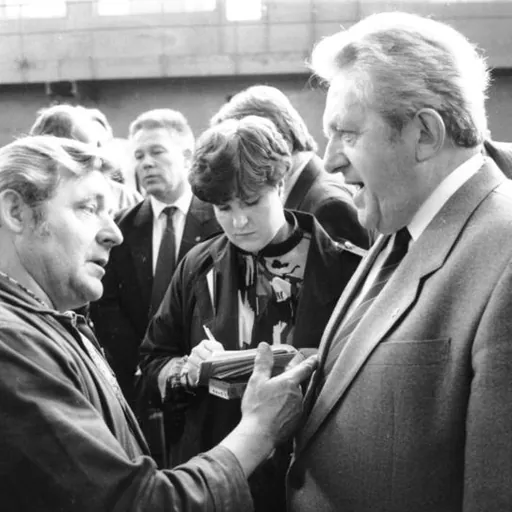
About Gerhard Müller
Lived 1928 – 2020 (aged 92). Gerhard Müller was a German politician.
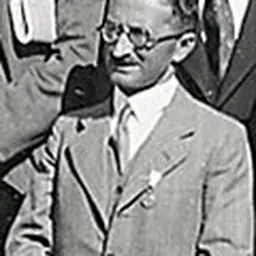
Gerhard Müller (4 February 1928 – 19 June 2020) was a German teacher, politician and party functionary of the Socialist Unity Party (SED).
In the German Democratic Republic, he served as the longtime First Secretary of the SED in Bezirk Erfurt and was a candidate member of the Politburo of the Central Committee of the SED.
Life and career Early career Gerhard Müller was born on 4 February 1928, in Chemnitz, growing up in a working-class family. His early education spanned from 1934 to 1942 at the primary school in Bad Brambach, followed by a brief period at the commercial school in Auerbach. In 1942, he switched to the Teacher Training Institute in Auerbach, where he studied until January 1945.
Afterward, he was enlisted in the Reich Labor Service and experienced the end of World War II within its ranks. Until January 1946, Müller worked as a construction worker in Landwüst and later in Plauen. In the winter of 1946, he obtained a place at the Teacher Training Institute in Bad Elster, resuming his studies until August 1946. During this time, Müller initially joined the SPD but later became a member of the SED due to the forced merger of the SPD and KPD. He also joined the FDGB (Free German Trade Union Federation) and the FDJ (Free German Youth). This made him the second most powerful figure in the Bezirk after the First Secretary Johannes Chemnitzer, and effectively chief of staff of the local SED leadership.
Bezirk Erfurt SED career
In April 1980, following intense internal criticism reported anonymously to Erich Mückenberger, the then-chairman of the Central Party Control Commission, Alois Bräutigam, the long-standing First Secretary of the SED in Bezirk Erfurt, resigned from his position, officially citing health reasons. Simultaneously, on 11 April 1980, during a session of the Bezirk Erfurt SED, Müller was co-opted into the Bezirk leadership and appointed as the new First Secretary.
Unlike all other Bezirk First Secretaries at that time, Müller was not a member of the SED Central Committee (ZK) at that point. It wasn't until the X. Party Congress of the SED in 1981 that he was elected as a member of the ZK. He was also viewed as a hardliner: During the summer of 1989, he delivered several speeches praising the violent suppression of the student unrest in China as exemplary.
Müller was awarded the Patriotic Order of Merit in 1978, the Karl Marx Order in 1984, and the Hero of Labour title in 1988.
Peaceful Revolution On 9 November 1989, the long-anticipated 10th session of the Central Committee of the SED took place. Prior to this session, the incumbent Politburo had resigned collectively. Despite Müller's extensive tenure as the First Secretary of an Bezirk SED leadership, he stood for re-election to the Politburo. However, among the members of the Central Committee, he failed to garner enough votes and was not elected to the new Politburo. This loss of trust led him to submit his resignation as the First Secretary before the Bezirk Erfurt SED Delegates' Conference scheduled for 11 November 1989 in Erfurt. His resignation request was granted by the remaining leadership. Herbert Kroker was elected as his successor. At the final session of the SED Central Committee on 3 December 1989, Müller was expelled from both the Central Committee and the SED.
Reunified Germany Regarding legal matters, on 1 June 1990, Müller was charged, and in 1992, he was convicted of incitement to breach of trust and fraud, resulting in an eight-month prison sentence, which was served with ten months of pretrial detention. In 1992, another trial concerning breach of trust in Erfurt commenced but was later suspended.
Subsequently, on 3 November 1994, the Erfurt Regional Court sentenced him to eight months in prison, suspended on probation, for incitement to electoral fraud during the municipal elections in the German Democratic Republic (East Germany) in 1989.
Müller resided in Neubrandenburg and was a member of the DKP. He died on 19 June 2020, at the age of 92.
Don’t just read it —
keep it.
Full-length biographies made to live with: read them, listen on the way to work, watch them tonight.
- E-book
- Audio
- Video
Instant download · yours to keep · every purchase keeps this site free
Important facts
People in Gerhard Müller's life
Named in this biography and alive at the same time




Related people
Same field, nearest in time



Contemporaries
People whose lives overlapped Gerhard Müller's



Frequently asked questions
Who was Gerhard Müller?
German politician (born in 1928)
When was Gerhard Müller born?
Gerhard Müller was born on 4 February 1928 in Chemnitz.
When did Gerhard Müller die?
Gerhard Müller died on 19 June 2020.
What was Gerhard Müller's occupation?
Gerhard Müller was a politician.
What nationality was Gerhard Müller?
Gerhard Müller was German.
Sources & further reading
· DBpedia: Gerhard Müller (politician)
Cite this page
APA: Biography.guide. (2026). Gerhard Müller. https://biography.guide/gerhard-muller-politician/
MLA: "Gerhard Müller." Biography.guide, https://biography.guide/gerhard-muller-politician/.
Chicago: "Gerhard Müller." Biography.guide. https://biography.guide/gerhard-muller-politician/.
Data last updated: 2026-09-23 · Spot an error? Report a correction.
Portrait: Wikimedia Commons · author & licence
Page generated 2026-09-27 05:05 UTC