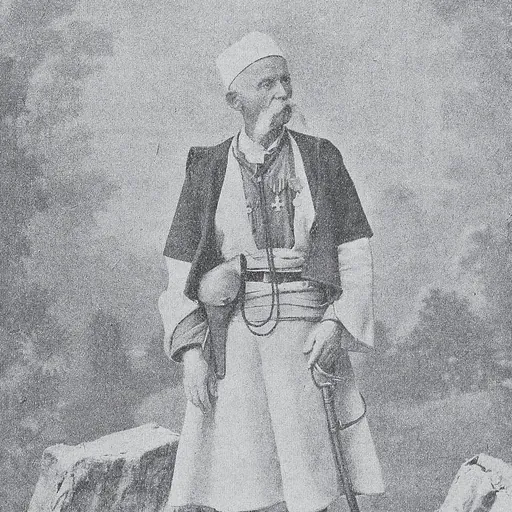
About Georgi Pulevski
Lived 1817 – 1893 (aged 75–76). Georgi Pulevski was a Turkish writer, bricklayer, lexicographer and revolutionary.
Georgi Pulevski, sometimes also Gjorgji, Gjorgjija Pulevski or Đorđe Puljevski ( or Ѓорѓија Пулевски, , ; 1817 – 13 February 1893), was a Mijak
Pulevski was born in Galičnik, he trained as a stonemason and later became a self-taught writer. He is known as one of the first authors to express the idea of a distinct Macedonian nation and Macedonian language.
Life
Pulevski was born in the village of Galičnik in the Mijak tribal region in 1817. As a seven-year-old, he went to Danubian Principalities with his father as a migrant worker (pečalbar). He was trained as a stonemason. Pulevski did not have a formal education. According to popular legends, Pulevski was engaged as a hajduk in the area of Golo Brdo.
At the age of 45, Pulevski fought as a member of the First Bulgarian Legion in 1862 against the Ottoman siege at Belgrade. He also participated in the Serbian–Ottoman War in 1876, and then in the Russo-Turkish War of 1877–78 as part of the Bulgarian Volunteer Corps, which led to the Liberation of Bulgaria; during the latter, he was a voivode of a unit of Bulgarian volunteers, taking part in the Battle of Shipka Pass. He also participated as a volunteer in the Kresna-Razlog Uprising (1878–79), also referred to as Macedonian uprising by the insurgents. By decree of Prince Alexander I of Bulgaria at the end of 1879, he was granted financial assistance from the state budget for the development of his literary activity.
In an application for a veteran pension to the Bulgarian Parliament in 1882, he expressed his regret about the failure of the unification of Ottoman Macedonia with Bulgaria. In 1883, aged 66, Pulevski received a government pension in recognition of his service as a Bulgarian volunteer. Pulevski settled in the village of Progorelec, near Lom, Bulgaria, where he received gratuitously agricultural land from the state. Later he moved to Kyustendil. In 1888 in Sofia he founded the Slavo-Macedonian Literary Society, which aimed at promoting the Macedonian language and literature, but it was dispersed by the authorities and some of its members were imprisoned.
Works
Pulevski authored Dictionary of Four Languages in 1873, where he identified the vernacular Slavic language of Macedonia as "Serbo-Albanian". In 1875, Pulevski published Dictionary of Three Languages (Rečnik od tri jezika, Речник од три језика) in Belgrade, which probably contained the first use of the term "Slavic Macedonian" or "Slav Macedonian" for the vernacular of the Macedonian Slavs. The basis of his language was his native Galičnik dialect but with certain and unsystematic concessions to the central Macedonian dialects. It was an attempt to use a supra-dialectal language. Pulevski stated that the Macedonians were a separate nation and advocated for the Macedonian language. However, there is no exclusive connection of nation, language, territory and statehood in the work, which is different from the ideas in the later work On Macedonian Matters by Krste Misirkov. Pulevski incorporated Kuzman Shapkarev's 1868 primer Elementary Knowledge for Little Children into the work.
His next published works were a revolutionary poem, Samovila Makedonska (Macedonian Fairy), published in 1878, and a Macedonian Song Book in two volumes, published in 1879, which contained both folk songs collected by Pulevski and some original poems by himself. In Bulgarian sources his so-called last grammar work is mentioned Jazitshnica, soderzsayushtaja starobolgarski ezik, uredena em izpravlena da se uchat bolgarski i makedonski sinove i kerki; (Grammar, containing Old Bulgarian language, arranged and corrected to be taught to Bulgarian and Macedonian sons and daughters), in which he considered the Macedonian dialects to be old Bulgarian and the differences between the two purely geographical. However, the details around it are unclear as to where it is kept or when it is dated. He was narrating the Slavic peoples' medieval history under titles regarding the history of Bulgaria, Wallachia, and Serbia, but he was stressing his own conclusions concerning ethnicity. According to Ristovska-Josifovska, he had a clear conception of how Macedonians differed from other Slavs. The work was firmly and directly influenced by Mauro Orbini's work, where the pan-Slavic idea and the autochthonism of the Slavs in the Balkans and beyond are asserted. Pulevski also wrote about the places where the Mijaks were concentrated, their migrations and the Mijak region.
Pulevski claimed that the Macedonians were descendants of the ancient Macedonians. This opinion was based on the claim that Philip II and Alexander III were of Slavic origin and thus this confirmed the ancient ancestry of the modern Macedonians. These views were criticised by the historian Konstantin Jireček as "foolish". Pulevski himself, besides as Macedonian, described himself as a "Serbian patriot" in 1874, and also after 1877 he espoused a mixed Macedono-Bulgarian identity as well. In the Jazitshnica, he viewed Macedonian identity as being a regional phenomenon, similar to Herzegovinians and Thracians. In his grammatical works, he included neologisms that were not included in modern Macedonian and opted for a phonological orthography, inspired by the work of Vuk Karadžić.
Linguist Victor Friedman regards Pulevski as a "complex and modern personality that very well understood the complexities of ethnical-national and civilian-national affiliations in the multilingual and multicultural environment of Macedonia." in Bulgaria he is regarded as a Bulgarian. According to Tchavdar Marinov, of the Bulgarian Academy of Sciences, there are reasons to interpret the case of Pulevski as a lack of clear national identity by him, while his numerous self-identifications reveal the absence of a clear national identity among the Slavic portion of the population in the region of Macedonia.
List of works Dictionary of three languages - wikisource translation. "A dictionary of three languages" on Commons. "A dictionary of four languages" on Commons. Язичница содержающа старобългарски (македонски) язик, суредена ем исправена за да учат бугарски и македонски синове и кьерки.
Don’t just read it —
keep it.
Full-length biographies made to live with: read them, listen on the way to work, watch them tonight.
- E-book
- Audio
- Video
Instant download · yours to keep · every purchase keeps this site free
Important facts
People in Georgi Pulevski's life
Named in this biography and alive at the same time
Related people
Same field, nearest in time

Contemporaries
People whose lives overlapped Georgi Pulevski's




Frequently asked questions
Who was Georgi Pulevski?
Mijak writer
When was Georgi Pulevski born?
Georgi Pulevski was born in 1817 in Galičnik.
When did Georgi Pulevski die?
Georgi Pulevski died on 13 February 1893 in Sofia.
What was Georgi Pulevski's occupation?
Georgi Pulevski was a writer, bricklayer, lexicographer and revolutionary.
What nationality was Georgi Pulevski?
Georgi Pulevski was Turkish.
Sources & further reading
Cite this page
APA: Biography.guide. (2026). Georgi Pulevski. https://biography.guide/georgi-pulevski/
MLA: "Georgi Pulevski." Biography.guide, https://biography.guide/georgi-pulevski/.
Chicago: "Georgi Pulevski." Biography.guide. https://biography.guide/georgi-pulevski/.
Data last updated: 2026-09-21 · Spot an error? Report a correction.
Portrait: Wikimedia Commons · author & licence
Page generated 2026-09-27 04:58 UTC