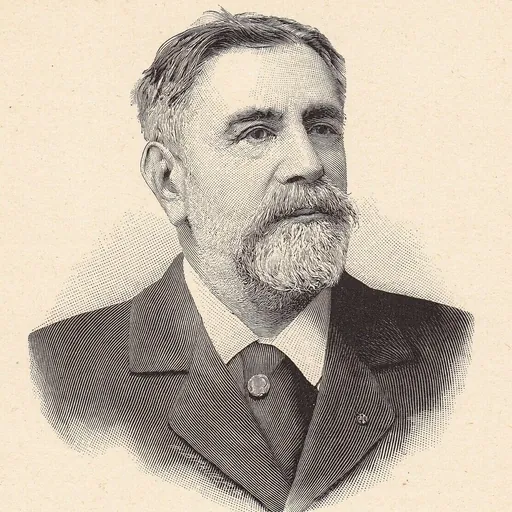
Georges Perrot
French archaeologist and classical scholar
About Georges Perrot
Lived 1832 – 1914 (aged 81). Georges Perrot was a French historian of classical antiquity, epigrapher, classical archaeologist, university teacher, hellenist and art historian.
Georges Perrot ( , ; 12 November 1832 – 30 June 1914) was a French archaeologist.
He taught at the Sorbonne from 1875 and was director of the École Normale Supérieure from 1888 to 1902. In 1874 he was elected to the Academie des Inscriptions et Belles-Lettres, where he served as the permanent secretary from 1904 until his death.
After discovering a first fragment of the Gortyn code in 1857, his most famous archaeological discovery was made while on an expedition to Asia Minor in 1861, where he found a Greek translation of the document known as 'The Political Testament of the Emperor Augustus'. Perrot edited and contributed to the journal Revue archéologique. His works include the two accounts of his expedition to Asia Minor (published 1862 and 1864), and the ten-volume Histoire de l'art dans l'antiquité, which he wrote with Charles Chipiez (1882–1914).
Works (reprinted 1872, vols. 1–2)
(reprinted 1869)
Vol. 1 (1882): L'Égypte Vol. 2 (1884): Chaldée et Assyrie Vol. 3 (1885): Phénicie, Cypre Vol. 4 (1887): Judée. Sardaigne, Syrie, Cappadoce Vol. 5 (1890): Perse. Phrygie, Lydie et Carie, Lycie Vol. 6 (1894): La Grèce primitive. L'art mycénien Vol. 7 (1898): La Grèce de l'épopée. La Grèce archaïque (le temple) Vol. 8 (1903): La Grèce archaïque. La sculpture Vol. 9 (1911): La Grèce archai͏̈que. La glyptique, la numismatique, la peinture, la céramique Vol. 10 (1914): La Grèce archai͏̈que. La céramique d'Athènes
Don’t just read it —
keep it.
Full-length biographies made to live with: read them, listen on the way to work, watch them tonight.
- E-book
- Audio
- Video
Instant download · yours to keep · every purchase keeps this site free
Important facts
People in Georges Perrot's life
Named in this biography and alive at the same time

Related people
Same field, nearest in time



Contemporaries
People whose lives overlapped Georges Perrot's



Frequently asked questions
Who was Georges Perrot?
French archaeologist and classical scholar (1832–1914)
When was Georges Perrot born?
Georges Perrot was born on 12 November 1832 in Villeneuve-Saint-Georges.
When did Georges Perrot die?
Georges Perrot died on 30 June 1914 in Paris.
What was Georges Perrot's occupation?
Georges Perrot was a historian of classical antiquity, epigrapher, classical archaeologist, university teacher, hellenist and art historian.
What nationality was Georges Perrot?
Georges Perrot was French.
Sources & further reading
Cite this page
APA: Biography.guide. (2026). Georges Perrot. https://biography.guide/georges-perrot/
MLA: "Georges Perrot." Biography.guide, https://biography.guide/georges-perrot/.
Chicago: "Georges Perrot." Biography.guide. https://biography.guide/georges-perrot/.
Data last updated: 2026-09-24 · Spot an error? Report a correction.
Portrait: Wikimedia Commons · author & licence
Page generated 2026-09-27 05:09 UTC