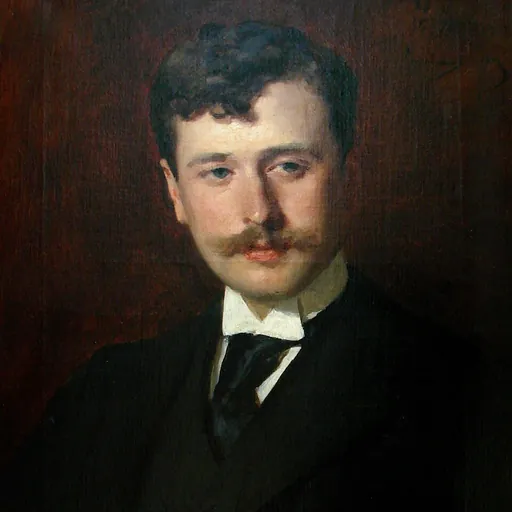
About Georges Feydeau
Lived 1862 – 1921 (aged 58). Georges Feydeau was a French playwright and writer.
Georges-Léon-Jules-Marie Feydeau (; 8 December 1862 – 5 June 1921) was a French playwright of the Belle Époque era, remembered for his farces, written between 1886 and 1914.
Feydeau was born in Paris to middle-class parents and raised in an artistic and literary environment. From an early age he was fascinated by the theatre, and as a child he wrote plays and organised his schoolfellows into a drama group. In his teens he wrote comic monologues and moved on to writing longer plays. His first full-length comedy, , was well received, but was followed by a string of comparative failures. He gave up writing for a time in the early 1890s and studied the methods of earlier masters of French comedy, particularly Eugène Labiche, Alfred Hennequin and Henri Meilhac. With his technique honed, and sometimes in collaboration with a co-author, he wrote seventeen full-length plays between 1892 and 1914, many of which have become staples of the theatrical repertoire in France and abroad. They include (, 1894), La Dame de chez Maxim (, 1899), La Puce à l'oreille (, 1907) and Occupe-toi d'Amélie! (, 1908).
The plays of Feydeau are marked by closely observed characters, with whom his audiences could identify, plunged into fast-moving comic plots of mistaken identity, attempted adultery, split-second timing and a precariously happy ending. After the great success they enjoyed in his lifetime they were neglected after his death, until the 1940s and 1950s, when productions by Jean-Louis Barrault and the Comédie-Française led a revival of interest in his works, at first in Paris and subsequently worldwide.
Feydeau's personal life was marred by depression, unsuccessful gambling and divorce. In 1919 his mental condition deteriorated sharply and he spent his final two years in a sanatorium at Rueil (now Rueil-Malmaison), near Paris. He died there in 1921 at the age of fifty-eight.
Life and career Early years Feydeau was born at his parents' house in the Rue de Clichy, Paris, on 8 December 1862.
Feydeau's mother was Lodzia Bogaslawa, née Zelewska, known as "Léocadie". When she married Ernest Feydeau in 1861, he was a forty-year-old childless widower and she was twenty-two. She was a famous beauty, and rumours spread that she was the mistress of the Duc de Morny or even the Emperor Napoleon III and that one of them was the father of Georges, her first child. In later life Léocadie commented, "How can anyone be stupid enough to believe that a boy as intelligent as Georges is the son of that idiotic emperor!" but Feydeau's greatest successes were in farce. He said that he made so much money from La Dame de chez Maxim that he could afford to take two years' break from writing and devote himself instead to his hobby, painting. That play remains a favourite with French audiences; in English-speaking countries A Flea in Her Ear became the most popular.
Farcical style The critic S. Beynon John contrasts Feydeau's farce with that of the English theatre of the same period – the latter "cosy and genial", and Feydeau's "sharply subversive". John also contrasts Feydeau with the earlier French farceur, Eugène Labiche: "Labiche's world, though fantasticated, is rooted in ordinary life; Feydeau's is cruel, claustrophobic, and smacks of mania". Discussing his technique, Feydeau said, "When I sit down to write a play I identify those characters who have every reason to avoid each other; and I make it my business to bring them together as soon, and as often, as I can." he carefully avoided it in his plays, holding that witty theatrical dialogue interrupted the action.
The critic W. D. Howarth sums up Feydeau's typical dramatic template as "a nightmare sequence of events in otherwise unremarkable lives". |group=n
When Feydeau took a break from writing to study the works of his most successful predecessors, he focused in particular on three playwrights: Labiche, Hennequin and Meilhac.
Contemporary opinions of Feydeau covered a wide range. Catulle Mendès wrote, "I continue to deplore the fact that M. Georges Feydeau uses his truly remarkable talent on plays that will be performed four or five hundred times but that will never be read". for others, they were his finest achievements, comparable with Strindberg in their naturalism; Feydeau was seen here as a moralist as well as an entertainer. For the authors of Les Annales du théâtre et de la musique, and critics in Le Figaro his farces were what made Feydeau incomparable.
Full-length works + TitleFeydeau's descriptionYearTheatrePerfsTitle in EnglishNotes Eglantine d'Amboise pièce historique en deux actes et 3 tableaux 1873 – – The wild rose of Amboise Juvenilia: not staged in Feydeau's lifetime comédie en 3 actes 1886 Renaissance 79 Ladies' tailor La Lycéenne vaudeville-opérette en 3 actes 1887 Nouveautés 20 The schoolgirl music by Gaston Serpette vaudeville en 3 actes 1888 Déjazet 36 A pig in a poke Les Fiancés de Loches vaudeville en 3 actes 1888 Cluny 64 The fiancés from Loches with Maurice Desvallières L'Affaire Edouard vaudeville en 3 actes 1889 Variétés 17 The Edward affair Le Mariage de Barillon vaudeville en 3 actes 1890 Renaissance 26 Barillon's wedding with Desvallières Monsieur chasse! comédie en 3 actes 1892 Palais-Royal 114 Monsieur is hunting! Champignol malgré lui vaudeville en 3 actes 1892 Nouveautés 434 Champignol despite himself with Desvallières Le Système Ribadier vaudeville en 3 actes 1892 Palais-Royal 78 The Ribadier systemwith Maurice Hennequin vaudeville en 3 actes 1894 Odéon 45 The ribbonwith Desvallières vaudeville en 3 actes 1894 Nouveautés 371 Free Exchange Hotel with Desvallières Un fil à la patte vaudeville en 3 actes 1894 Palais-Royal 129 Tied by the leg Le Dindon comédie en 3 actes 1896 Palais-Royal 238 The dupe La Dame de chez Maxim vaudeville en 3 actes 1899 Nouveautés 579 The lady from Maxim'sLe Billet de Joséphine opéra1902Gaîté16 The duchess of the Folies-Bergère comédie en quatre actes 1904 Nouveautés 211 The hand goes round L'Âge d'or comédie musicale en 3 actes et neuf tableaux 1905 Variétés 33 The golden age with Desvallières; music by Louis Varney Le Bourgeon comédie de moeurs en 3 actes 1906 Vaudeville 92 The bud La Puce à l'oreille vaudeville en 3 actes 1907 Variétés 86 A flea in her ear Occupe-toi d'Amélie! comédie en 3 actes 1908 Nouveautés 288 The road race with Francis Croisset Je ne trompe pas mon mari! vaudeville en 3 actes 1914 Athénée 200 I don't cheat on my husband with René Peter Cent millions qui tombent pièce en 3 actes – – 100 million falling unfinished À qui ma femme? vaudeville en 3 actes – – Whose is my wife? not staged in Feydeau's lifetime.
One-act pieces
L'Amour doit se taire (drame, "Love must be silent", 1878) Par la fenêtre (comédie, "Through the window", 1882) (comédie, "Love and piano", 1883) (comédie-bouffe, "Gallows-bird", 1883) L'Homme de paille (comédie-bouffe, "The straw man", 1884) Fiancés en herbe (comédie enfantine, "Unripe fiancés", 1886) Deux coqs pour une poule (comédie, "Two cocks for one hen", 1887) Un bain de ménage (vaudeville, "A household bath", 1888) C'est une femme du monde (comédie, "She's a society lady"; with Desvallières, 1890) Notre futur (comédie, "Our future", 1894)
(comédie, "Save me from my friends", 1896) (vaudeville, "Sleep, I insist!", 1897) (comédie, "Night session", 1897) Monsieur Nounou (pochade, "Monsieur Nounou"; with Desvallières, 1900) (vaudeville, "Madame's late mother", 1908) (comédie, "Purging baby", 1910) (comédie, "Léonie is ahead of time", 1911) (comédie, "Don't walk about stark naked", 1911) On va faire la cocotte (comédie, "We're going to play cocotte", unfinished, 1911) (comédie, "Hortense says 'I don't give a damn'", 1916)
Monologues For female performer La Petite révoltée ("The rebellious girl", 1880) Un coup de tête ("A whim", 1882) Aux antipodes ("Poles apart", 1883)
For male performer
Le Mouchoir ("The handkerchief", 1881) J'ai mal aux dents ("I've got toothache", 1882) Le Potache ("The schoolboy", 1882) Trop vieux ("Too old", 1882) Un monsieur qui n'aime pas les monologues ("A gentleman who dislikes monologues", 1882) Patte en l'air ("Paw in the air", 1883) Le Petit Ménage ("The small household", 1883) Le Billet de mille ("The 1,000 note", 1884) Les Célèbres ("The famous", 1884) Le Volontaire ("The volunteer", 1884)
Le Colis ("The parcel", 1885) Les Réformes ("The reformers", 1885) L'Homme économe ("The Thrifty man", 1886) L'Homme intègre ("The man of integrity", 1886) Les Enfants ("The children", 1887) Tout à Brown-Séquard ! ("Everything to Brown-Séquard", 1890) Le Juré ("The juror", 1898) Un monsieur qui est condamné à mort ("A gentleman who is condemned to death", 1899) Complainte du pauv' propriétaire ("The poor owner's complaint", 1916) Madame Sganarelle ("Madame Sganarelle")
Legacy
After his death Feydeau's plays were neglected for many years. It was not until the 1940s that major revivals were staged in Paris, after which Feydeau gradually became a staple of the repertory in France and abroad. The Comédie-Française admitted a Feydeau work to its repertoire for the first time in 1941, with a production of the one-act Feu la mère de Madame, directed by Fernand Ledoux, starring Madeleine Renaud and Pierre Bertin. At the Théâtre Marigny in 1948 Renaud starred in the first production of Occupe-toi d'Amélie! since Feydeau's 1908 original, with the company she co-founded with Jean-Louis Barrault. They took the production to Broadway in 1952, and the West End in 1956, playing in the original French and gaining enthusiastic reviews from the New York and London critics. In the meanwhile the Comédie-Française staged its first full-length Feydeau production, Le Dindon (1951). English adaptations had been familiar in Feydeau's day, and in the 1950s new versions began to appear, including Peter Glenville's Hotel Paradiso (1956, from ) and Noël Coward's Look After Lulu! (1959, from Occupe-toi d'Amélie!);
The 1960s saw two celebrated productions by Jacques Charon. This led to an invitation from Laurence Olivier to Charon to direct John Mortimer's adaptation of La Puce à l'oreille as A Flea in Her Ear for the National Theatre (1966). Charon followed this with Mortimer's version of Un Fil à la patte (Cat Among the Pigeons) in the West End (1969). In the 1970s the Comédie-Française added two more Feydeau plays to its repertoire: Mais n'te promène donc pas toute nue! (1971) and La Puce à l'oreille (1978), both directed by Jean-Laurent Cochet. In New York there were productions of Le Dindon (1972 as There's One in Every Marriage), La Main passe (1973 as Chemin de fer), and Monsieur chasse! (1978, as 13 rue de l'amour). In London the National Theatre presented a second Mortimer adaptation, The Lady from Maxim's (1977).
During the last two decades of the twentieth century interest in Feydeau continued. The Comédie-Française presented four more of his plays: La Dame de chez Maxim (1981) directed by Jean-Paul Roussillon, Léonie est en avance (1985) directed by Stuart Seide, Occupe-toi d'Amélie! (1995) directed by Roger Planchon, and Chat en poche (1998) directed by Muriel Mayette. There were numerous Feydeau revivals in theatres in Paris, cities across France, and Brussels, including seven productions of Le Système Ribadier three of Monsieur chasse!, five of La Dame de chez Maxim, and four of La Puce à l'oreille. In London the National Theatre presented Mortimer's adaptation of L'Hôtel du libre-échange (1984, as A Little Hotel on the Side), which was later played on Broadway. Other English adaptations included Peter Hall and Nicki Frei's versions of Le Dindon (1994, as An Absolute Turkey) and Occupe-toi d'Amélie! (1996, as Mind Millie for Me).
During the first two decades of the 21st century, the Comédie-Française presented seven Feydeau productions: Le Dindon (2002, directed by Lukas Hemleb), Un Fil à la patte (2010 Jérôme Deschamps), Quatre pièces – a quadruple bill of one-act plays and a monologue (Amour et Piano, Un monsieur qui n'aime pas les monologues, Fiancés en herbe and Feu la mère de madame, 2009, Gian Manuel Rau), Le Cercle des castagnettes (monologues, 2012, Alain Françon), Le Système Ribadier (2013, Zabou Breitman), L'Hôtel du libre-échange (2017, Isabelle Nanty) and La Puce à l'oreille (2019, Lilo Baur). The Internet Broadway Database records no Feydeau productions in the 21st century. Among British productions were Frei's 2003 version of Le Système Rebadier (as Where There's a Will) directed by Hall and Mortimer's A Flea in Her Ear, revived at the Old Vic in 2010, directed by Richard Eyre.
Adaptations
Several of Feydeau's plays have been adapted for the cinema and television. Although he was active well into the early years of film he never wrote for the medium, but within two years of his death in 1921 other writers and directors began to take his plays as the basis for films, of which more than twenty have been made, in several countries and languages. At least fourteen of his plays have been adapted for television.
Notes, references and sources
Don’t just read it —
keep it.
Full-length biographies made to live with: read them, listen on the way to work, watch them tonight.
- E-book
- Audio
- Video
Instant download · yours to keep · every purchase keeps this site free
Important facts
People in Georges Feydeau's life
Named in this biography and alive at the same time





Related people
Same field, nearest in time


Contemporaries
People whose lives overlapped Georges Feydeau's



Frequently asked questions
Who was Georges Feydeau?
French writer (1862–1921)
When was Georges Feydeau born?
Georges Feydeau was born on 8 December 1862 in rue de Clichy.
When did Georges Feydeau die?
Georges Feydeau died on 5 June 1921 in Rueil-Malmaison.
What was Georges Feydeau's occupation?
Georges Feydeau was a playwright and writer.
What nationality was Georges Feydeau?
Georges Feydeau was French.
Sources & further reading
Cite this page
APA: Biography.guide. (2026). Georges Feydeau. https://biography.guide/georges-feydeau/
MLA: "Georges Feydeau." Biography.guide, https://biography.guide/georges-feydeau/.
Chicago: "Georges Feydeau." Biography.guide. https://biography.guide/georges-feydeau/.
Data last updated: 2026-09-21 · Spot an error? Report a correction.
Portrait: Wikimedia Commons · author & licence
Page generated 2026-09-27 04:58 UTC