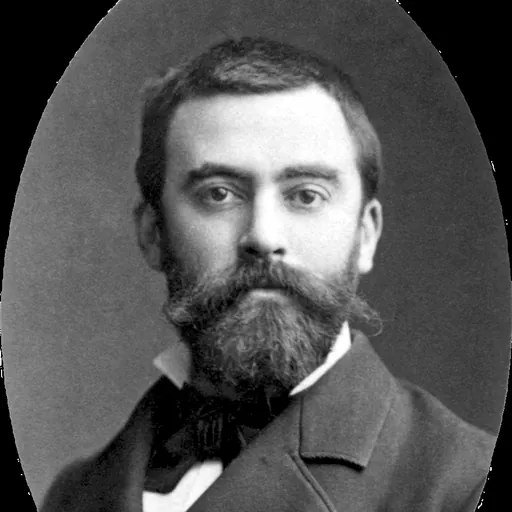
About Gaston Serpette
Lived 1846 – 1904 (aged 57). Gaston Serpette was a French conductor, composer and music critic.
Henri Charles Antoine Gaston Serpette (4 November 1846 – 3 November 1904) was a French composer, best known for his operettas. After winning the prestigious Prix de Rome as a student at the Paris Conservatoire, he was expected to pursue a career in serious music. Instead, he turned to operetta, writing more than twenty full-length pieces between 1874 and 1900. He accepted some conducting work and also served as a critic and journalist for a number of French newspapers and magazines.
Early life and work Serpette, the son of a rich industrialist, was born in Nantes, in western France. He qualified as a lawyer before deciding to devote himself to music. In 1868 he entered the composition class of Ambroise Thomas at the Paris Conservatoire, and in 1871 won France's top musical prize, the Prix de Rome, previously won by Berlioz, Thomas, Gounod, Bizet and Massenet, among others. Serpette's winning entry was Jeanne d'Arc, a cantata to a libretto by M. J. Barbier, which was performed at the Paris Opéra in November of the same year. However, to the distress of the conservative element at the Conservatoire, Serpette also submitted an operetta. When it was played on the piano to Gounod, Thomas and the members of the Académie des Beaux-Arts, the academy's secretary, Viscount Delaborde, declared that Serpette "had gone to the bad". The piece was well received at the Théâtre des Bouffes-Parisiens, in January 1874, He added that the music "though not remarkable for originality, is above mediocrity, and ... far surpasses the usual run of opéra-bouffe music." A Serpette piece, Le carnet du diable, was reviewed in The Era in 1895 under the headline, "Indecency in Paris".
Serpette's works were continually in demand in Paris. Between 1874 and 1900, with librettists including such writers as Henri Meilhac and Georges Feydeau, he wrote more than twenty full-length operettas, and at least nine shorter ones.
This was not Serpette's only incursion into print. He was music critic for a number of Paris newspapers and journals. and wrote the musical column of the Paris newspaper, in which his disagreement with Solomon was published.
Towards the end of his career, Serpette had more of his works performed in England. Augustus Harris and F. C. Burnand adapted La demoiselle du téléphone as The Telephone Girl in 1896; it toured the country for three years. Serpette, in line with his earlier comments on adaptations, agreed to the addition of new musical items by J. M. Glover. His last show, written in 1903, originally entitled Cuvée reservée 1810, was specially composed for England, and, under the title Amorelle, toured the provinces in 1903–04 before opening at the Comedy Theatre in London in February 1904.
Serpette was made a Chevalier of the Legion of Honour in 1898. For some time he left Paris to live in Algeria, where he had purchased vineyards. During one of his sea trips between Algiers and Marseille, he was knocked down by a freak wave, breaking his leg; he walked with a limp for the rest of his life.
Works Opéras-bouffes and operettas La Branche cassée, opéra-bouffe in 3 acts, libretto by Adolphe Jaime and Jules Noriac, Bouffes-Parisiens, 1874 Le Manoir de Pic-Tordu, operetta in 3 acts, libretto by Saint-Albin and Arnold Mortier, Variétés, 1875 Le Moulin du Vert-Galant, operetta in 3 acts, libretto by Eugène Grangé and V. Bernard, Bouffes-Parisiens, 1876 La Petite Muette, operetta in 3 acts, libretto by Paul Ferrier, Bouffes-Parisiens, 1877 Rothomago, operetta in 4 acts, 1880, Alhambra Theatre (London) La Nuit de Saint-Germain, operetta in 3 acts, libretto by G. Hirsch, Fantaisies-Parisiennes (Brussels) 1880, Madame le Diable ou Madame Satan, operetta in 4 acts, libretto by Henri Meilhac, Arnold Mortier and Albert Millaud, Théâtre de la Renaissance, 1882 La Princesse, operetta in 1 act, libretto by Raoul Toché, Variétés, 1882 Steeplechase, operetta in 1 act, libretto by Paul Decourcelle, Londres, 1883 Tige de Lotus, operetta in 1 act, libretto by Raoul Toché, Casino de Contrexéville, 1883 Franfreluche, operetta in 1 act, libretto by G. Hirsch, Saint-Artoman, Paul Burani, Renaissance, 1883 Madame Réséda, operetta in 1 act, libretto by Jules Prével, Renaissance, 1884 Le Château de Tire-Larigot, operetta in 3 acts, libretto by 'Ernest Blum and Raoul Toché, Théâtre des Nouveautés, 1884 Le Petit Chaperon rouge, operetta in 3 acts, libretto by Ernest Blum and Raoul Toché, Nouveautés, 1885 Le Singe d'une nuit d'été, operetta in 1 act, libretto by Édouard Noël, Bouffes-Parisiens, 1886 Adam et Eve, operetta in 3 acts, libretto by Ernest Blum and Raoul Toché, Nouveautés, 1886 La Gamine de Paris, operetta in 3 acts, libretto by Eugène Letterier and Albert Vanloo, Bouffes-Parisiens, 1887 La Lycéenne, operetta in 3 acts, libretto by Georges Feydeau, 1887 Cendrillonnette, operetta in 4 acts in collaboration with Victor Roger, libretto by Paul Ferrier, Bouffes-Parisiens, 1890 La Demoiselle du téléphone, operetta in 3 acts, libretto by Maurice Desvallières and Antony Mars, Nouveautés, 1891 Mé-ne-ka, operetta in 1 act, libretto by Paul Ferrier, Nouveautés, 1892 La Bonne de chez Duval, operetta in 3 acts, libretto by H. Raymond and Antony Mars, 1892 Cousin-Cousine, operetta in 3 acts, libretto by Maurice Ordonneau and H. Kéroul, Folies-Dramatiques, 1893 La Tourte, operetta in 1 act, libretto by Paul Bilhaud, Asnières, 1895 La Dot de Brigitte, operetta in 1 act in collaboration with Victor Roger, libretto by Paul Ferrier, Bouffes-Parisiens, 1895 Le Carnet du diable, operetta in 3 acts, libretto by Paul Ferrier and Ernest Blum, Variétés, 1895 Le Capitole, operetta in 3 acts, libretto by Paul Ferrierand Charles Clairville, Nouveautés, 1895 Le Royaume des femmes, operetta in 3 acts, libretto by Paul Ferrier and Ernest Blum, 1896 Le Carillon, operetta in 4 acts, libretto by Paul Ferrier and Ernest Blum, Variétés, 1896 Shakespeare, operetta in 3 acts, libretto by Paul Gavault and Robert de Flers, Bouffes-Parisiens, 1899 Frileuse ou l'Enfant du cocktail (non-représenté) Cuvée réservée 1810 (Amorelle 1810), libretto by Barton White and Ernest Boyd-Jones, Kennington (Londres), 1903
Vocal music (melodies, etc.) La Bouquetière, lyrics by Gaston Serpette, 1877 La Mort des amants, text by Charles Baudelaire, 1879
Don’t just read it —
keep it.
Full-length biographies made to live with: read them, listen on the way to work, watch them tonight.
- E-book
- Audio
- Video
Instant download · yours to keep · every purchase keeps this site free
Important facts
People in Gaston Serpette's life
Named in this biography and alive at the same time



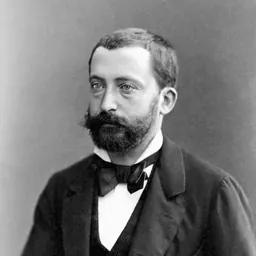
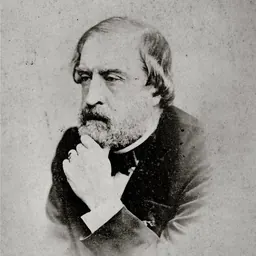
Related people
Same field, nearest in time
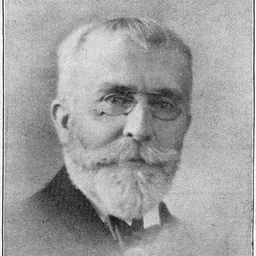



Contemporaries
People whose lives overlapped Gaston Serpette's
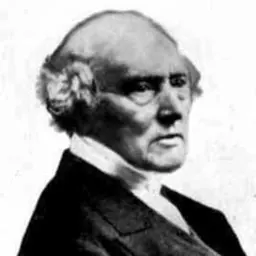


Frequently asked questions
Who was Gaston Serpette?
French composer (1846-1904)
When was Gaston Serpette born?
Gaston Serpette was born on 4 November 1846 in Nantes.
When did Gaston Serpette die?
Gaston Serpette died on 3 November 1904 in 9th arrondissement of Paris.
What was Gaston Serpette's occupation?
Gaston Serpette was a conductor, composer and music critic.
What nationality was Gaston Serpette?
Gaston Serpette was French.
Sources & further reading
Cite this page
APA: Biography.guide. (2026). Gaston Serpette. https://biography.guide/gaston-serpette/
MLA: "Gaston Serpette." Biography.guide, https://biography.guide/gaston-serpette/.
Chicago: "Gaston Serpette." Biography.guide. https://biography.guide/gaston-serpette/.
Data last updated: 2026-09-23 · Spot an error? Report a correction.
Portrait: Wikimedia Commons · author & licence
Page generated 2026-09-27 05:07 UTC